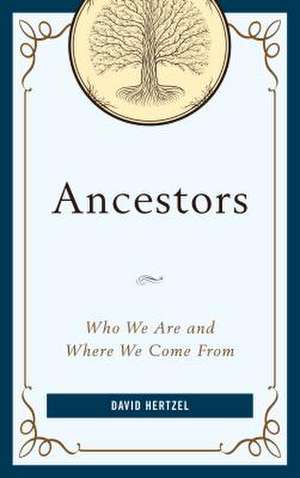
Ancestors: Who We Are and Where We Come From: Rowman & Littlefield Publishers
Autor David Hertzelen Limba Engleză Hardback – 3 aug 2017
In Ancestors, David Hertzel offers an introductory foray into the nature of relationships people today have with their ancestors, and explores the significance of ancestry and ancestral belief in our modern world. Guided by two questions-"who are your ancestors?" and "what is your relationship to your ancestors?"-Hertzel interviewed thirty-five elders and people of prominence within particular social or intellectual communities. Interviewees were accomplished in an area related to ancestry, its nature or its meaning, and included genealogists, geneticists, tribal chiefs and elders, researchers in some aspect of family or ancestry, family elders, and experienced practitioners or supervisors of particular ancestral rituals. Interviewees were selected from a variety of cultural backgrounds for purposes of contrast, comparison, and breadth-but they are not spokespeople and were not asked to 'represent' particular belief systems, doctrines, or Peoples. Rather, the interviewees describe their own personal experiences and beliefs involving ancestors.
From these interviews, Hertzel identifies common themes to ancestral practices and beliefs, such as the way we sanctify our ancestors, how we create a living narrative of our ancestry, and how experiences like suffering and love are shared across generations and appear to transcend death. Excerpts from interviews serve as examples throughout his narrative exploration of the concept of ancestry; a selection of full interviews are embedded throughout the text and offer glimpses into the diversity of ways that people think about who they are and where they come from.
Din seria Rowman & Littlefield Publishers
-
 Preț: 113.89 lei
 - 13%
 Preț: 155.38 lei
 -
 Preț: 109.93 lei
 - 20%
 Preț: 370.93 lei
 - 19%
 Preț: 323.76 lei
 - 25%
 Preț: 228.52 lei
 - 19%
 Preț: 328.78 lei
 - 28%
 Preț: 148.13 lei
 - 20%
 Preț: 191.09 lei
 - 24%
 Preț: 255.02 lei
 - 16%
 Preț: 109.26 lei
 - 31%
 Preț: 351.69 lei
 - 15%
 Preț: 127.13 lei
 - 22%
 Preț: 330.19 lei
 - 19%
 Preț: 324.21 lei
 - 30%
 Preț: 355.24 lei
 - 23%
 Preț: 258.39 lei
 -
 Preț: 402.96 lei
 - 23%
 Preț: 282.77 lei
 - 24%
 Preț: 275.28 lei
 - 31%
 Preț: 351.50 lei
 - 22%
 Preț: 331.09 lei
 - 32%
 Preț: 373.39 lei
 - 34%
 Preț: 842.33 lei
 - 19%
 Preț: 314.30 lei
 - 23%
 Preț: 363.28 lei
 - 21%
 Preț: 128.84 lei
 - 30%
 Preț: 774.75 lei
 - 23%
 Preț: 278.65 lei
 - 22%
 Preț: 266.38 lei
 - 19%
 Preț: 344.02 lei
 - 32%
 Preț: 594.45 lei
 - 31%
 Preț: 566.85 lei
 - 22%
 Preț: 367.22 lei
 - 19%
 Preț: 322.03 lei
 - 16%
 Preț: 148.06 lei
 - 21%
 Preț: 369.53 lei
 - 19%
 Preț: 323.37 lei
 - 20%
 Preț: 314.77 lei
 - 30%
 Preț: 424.70 lei
 - 25%
 Preț: 344.18 lei
 - 30%
 Preț: 703.64 lei
 - 14%
 Preț: 152.49 lei
 - 30%
 Preț: 847.72 lei
 - 19%
 Preț: 316.66 lei
 - 23%
 Preț: 283.57 lei
 - 29%
 Preț: 727.24 lei
 - 23%
 Preț: 262.16 lei
 - 19%
 Preț: 343.92 lei
Preț: 309.53 lei
Preț vechi: 382.86 lei
-19%
Puncte Express: 464
Carte tipărită la comandă
Livrare economică 04-18 decembrie
Livrare prin curier în România Termenul estimat este afișat lângă disponibilitate.
Transport gratuit de la 400.00 lei Plată online sau ramburs, în funcție de opțiunile comenzii.
Retur gratuit în 14 zile Comandă securizată și suport în română.
Specificații
ISBN-13: 9781538104361
ISBN-10: 1538104369
Pagini: 248
Ilustrații: 21 b/w photos; 14 textboxes
Dimensiuni: 157 x 237 x 23 mm
Greutate: 0.45 kg
Editura: Bloomsbury Publishing
Colecția Rowman & Littlefield
Seria Rowman & Littlefield Publishers
Locul publicării:New York, United States
ISBN-10: 1538104369
Pagini: 248
Ilustrații: 21 b/w photos; 14 textboxes
Dimensiuni: 157 x 237 x 23 mm
Greutate: 0.45 kg
Editura: Bloomsbury Publishing
Colecția Rowman & Littlefield
Seria Rowman & Littlefield Publishers
Locul publicării:New York, United States
V-ar putea interesa
-
 The Unlikely JourneyDerek StewartPreț: 131.71 lei
 -
 -35%Preț: 541.08 lei835.73 lei
 -
 -25%Preț: 305.22 lei406.32 lei
 -
 ResponsibilityBarbara Darling-Smith-29%Preț: 343.67 lei482.99 lei
 -
 Taking Parenting Public: The Case for a New Social MovementSylvia Ann Hewlett-19%Preț: 315.93 lei389.85 lei
 -
 -43%Preț: 152.95 lei266.51 lei
 -
 Dysfunctional Families in the Wessex Novels of Thomas HardyLois Bethe Schoenfeld-36%Preț: 372.04 lei578.18 lei
 -
 -24%Preț: 274.08 lei359.53 lei
 -
 KinshipJackie Smith ArnoldPreț: 118.38 lei
 -
 Bringing Home the LaundryBrody JanisPreț: 88.06 lei
 -
 Raising Strong DaughtersJeanette GadebergPreț: 81.16 lei
 -
 -5%Preț: 132.13 lei139.09 lei
 -
 Freddy & Frieda's Travelling TalesClaudia Eicker-HarrisPreț: 59.98 lei
 -
 Breaking Anger's Embrace and Other Insights on the Human ConditionThomas E. SchneiderPreț: 92.04 lei
 -
 The Road Map to Senior CareStephen AndrikoPreț: 97.40 lei
 -
 Revenge of the SardinesTr KerthPreț: 199.62 lei
 -
 World History WorkbookDavid HertzelPreț: 336.80 lei
 -
 Lessons Learned: How to Negotiate the Life You Want to LiveHarris R. CohenPreț: 98.25 lei
 -
 -25%Preț: 177.29 lei237.74 lei
 -
 Howard Thurman's Philosophical MysticismAnthony Sean Neal-31%Preț: 531.09 lei768.75 lei
 -
 The Hurting ChurchConnie KerkstraPreț: 65.46 lei
 -
 Preț: 160.44 lei
 -
 Go, Be LovingJonquil HindsPreț: 109.68 lei
 -
 A Cowherd in Paradise: From China to CanadaMay Q. Wong-11%Preț: 173.37 lei195.05 lei
 -
 Preț: 115.13 lei
Cuprins
Chapter 1: Ancestors: Who We Are and Where We Come From
Chapter 2: Sacred Is as Sacred Does
Chapter 3: "Who Are Your Ancestors?"
Chapter 4: Every Person is an Ancestor, a Descendant, and an Individual
Chapter 5: The Ancestral Narrative
Chapter 6: Ancestors in Space and Time
Chapter 7: Good Ancestors, Bad Ancestors
Chapter 8: Reciprocal Arrangements
Conclusion
Directory of Interviewees
Bibliography
Chapter 2: Sacred Is as Sacred Does
Chapter 3: "Who Are Your Ancestors?"
Chapter 4: Every Person is an Ancestor, a Descendant, and an Individual
Chapter 5: The Ancestral Narrative
Chapter 6: Ancestors in Space and Time
Chapter 7: Good Ancestors, Bad Ancestors
Chapter 8: Reciprocal Arrangements
Conclusion
Directory of Interviewees
Bibliography
Recenzii
Hertzel's book serves as a corrective to youth-obsessed culture by insisting that we owe a debt to those who've gone before us. He interviewed more than 30 'people of prominence within a particular social or intellectual community' and calls such folks 'elders.' The interviews focus on two questions: Who are your ancestors, and what is your relationship to them? The elders he interviewed represent Native American spirituality and Hindu, Mormon, Protestant, Catholic, Buddhist, and Jewish faiths, in addition to other cultures. Whether interviewees felt they were in some kind of contact with their ancestors or not, many comments reach similar conclusions: it is important to remember, to honor, and to be guided by those who have gone before. In addition, Hertzel weaves in his own insights based on the interviews and considers what constitutes family and what is our obligation to them. This book could be enjoyed by general readership; for a book club; or used to augment philosophy, religion, sociology, or history class discussions.
Dr. Hertzel, as a historian, weaves an impressive multidisciplinary approach to the voices in his book. At its heart the book is tolerant, expansive and relentlessly curious about the beliefs - religious, spiritual, and psychological - found in the interviewees' relationships to their ancestors. The subjects of the book are quite open, sometimes painfully so, about their views and their relations to those who have passed, both immediate and distant. If the book deals with loss, it also deals with hope. If it deals with intangible religious mysteries, it is also grounded by an honest humor. If it deals with diversity, it also touches on a number of commonalities. Ancestors: Who We Are and Where We Come From is history in its most important guise: it is a history about ourselves and our place in the world.
David Hertzel takes us on an introductory foray into the nature of relationships people today have with their ancestors and explores the significance of ancestry and ancestral belief in our modern world. . . . Hertzel firmly believes that we stand on the shoulders of those who came before and we are indebted to them. . . . The subjects of the book are quite open, sometimes painfully so, about their views and how they relate to their ancestors and even though this book deals with loss, it also deals with hope. We read of intangible religious mysteries, diversity, and commonalities. Here is history as seen through families, and we understand that progression has no substance unless we trace the influence of one generation upon the other, which is exactly what this important book achieves. Here is the truth in both the cultural and spiritual effects of those who came before us.
Human history viewed through families as a linear progression has no substance unless we trace the influence of one generation upon the other, which is exactly what this important book achieves. Hertzel's groundbreaking work uncovers the truth in both the cultural and spiritual effects of ancestors. The modern world needs this book and Hertzel's insights more than ever.
We live with a deep personal and spiritual loneliness brought on by the atomization of society, time spent with technology instead of family, and busyness in place of relationships. David Hertzel gives us the healing medicine for these conditions by reminding us that we value deeply our family ancestors who live in our memories and souls. If you want true peace, read these interviews to be reminded how near your own ancestors really are.
There are so many worlds hidden in places so close to us, so intimate to our life and its meaning. Hertzel opens windows to the hearts of our neighbors and the worlds of meaning around their ancestors. This insightful book is an experience of life and death that will enlighten and intrigue.
Dr. Hertzel, as a historian, weaves an impressive multidisciplinary approach to the voices in his book. At its heart the book is tolerant, expansive and relentlessly curious about the beliefs - religious, spiritual, and psychological - found in the interviewees' relationships to their ancestors. The subjects of the book are quite open, sometimes painfully so, about their views and their relations to those who have passed, both immediate and distant. If the book deals with loss, it also deals with hope. If it deals with intangible religious mysteries, it is also grounded by an honest humor. If it deals with diversity, it also touches on a number of commonalities. Ancestors: Who We Are and Where We Come From is history in its most important guise: it is a history about ourselves and our place in the world.
David Hertzel takes us on an introductory foray into the nature of relationships people today have with their ancestors and explores the significance of ancestry and ancestral belief in our modern world. . . . Hertzel firmly believes that we stand on the shoulders of those who came before and we are indebted to them. . . . The subjects of the book are quite open, sometimes painfully so, about their views and how they relate to their ancestors and even though this book deals with loss, it also deals with hope. We read of intangible religious mysteries, diversity, and commonalities. Here is history as seen through families, and we understand that progression has no substance unless we trace the influence of one generation upon the other, which is exactly what this important book achieves. Here is the truth in both the cultural and spiritual effects of those who came before us.
Human history viewed through families as a linear progression has no substance unless we trace the influence of one generation upon the other, which is exactly what this important book achieves. Hertzel's groundbreaking work uncovers the truth in both the cultural and spiritual effects of ancestors. The modern world needs this book and Hertzel's insights more than ever.
We live with a deep personal and spiritual loneliness brought on by the atomization of society, time spent with technology instead of family, and busyness in place of relationships. David Hertzel gives us the healing medicine for these conditions by reminding us that we value deeply our family ancestors who live in our memories and souls. If you want true peace, read these interviews to be reminded how near your own ancestors really are.
There are so many worlds hidden in places so close to us, so intimate to our life and its meaning. Hertzel opens windows to the hearts of our neighbors and the worlds of meaning around their ancestors. This insightful book is an experience of life and death that will enlighten and intrigue.