
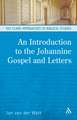
An Introduction to the Johannine Gospel and Letters: T&T Clark Approaches to Biblical Studies
Autor Jan Van Der Watten Limba Engleză Hardback – 23 ian 2008
This
accessible
guide
to
the
Gospel
and
Letters
of
John
introduces
readers
to
key
issues
arising
from
historical,
literary,
and
theological
approaches
to
the
Johannine
literature,
also
discussing
the
methodological
rationale
underlying
each
of
these
approaches.
After
introducing
the
reader
to
the
development
of
the
narrative
structure
of
the
book,
the
message
(theology)
is
discussed
in
detail,
with
the
aim
of
introducing
the
reader
to
the
interrelatedness
of
the
multiple
theological
ideas
in
this
Gospel.
Similarities,
but
also
differences
between
the
Gospel
and
Letters
are
constantly
considered.
Familiar
with
the
content
of
the
Gospel,
readers
are
then
confronted
with
questions
about
the
origin,
development
and
socio-cultural
nature
of
the
Gospel
and
letters.
In
each
case
the
scholarly
field
is
briefly
reviewed
and
major
solutions
are
discussed.
Thorough
discussions
on
different
issues
are
presented
in
different
chapters,
each
time
referring
to
the
relevant
methodological
approaches.
How
do
the
Gospel
and
Letters
relate
to
the
synoptics,
or
the
Old
Testament?
Do
we
have
a
Gospel
composed
of
multiple
sources
or
is
it
a
seamless
document.
How
was
this
influential
document
written
and
where
do
the
ideas
found
in
the
Gospel
come
from?
Since the aim of this book is to form a solid and comprehensive basis for future study of the Johannine literature, readers are placed firmly within the scholarly currents and streams of the Johannine literature. In terms of a metaphor: after reading the book, explorers will know what is out there and why. Now they can start to dig deeper for themselves without feeling lost in an uncharted land.
Since the aim of this book is to form a solid and comprehensive basis for future study of the Johannine literature, readers are placed firmly within the scholarly currents and streams of the Johannine literature. In terms of a metaphor: after reading the book, explorers will know what is out there and why. Now they can start to dig deeper for themselves without feeling lost in an uncharted land.
Preț: 384.54 lei
Preț vechi: 432.07 lei
-11% Nou
Puncte Express: 577
Preț estimativ în valută:
68.03€ • 79.99$ • 59.59£
68.03€ • 79.99$ • 59.59£
Carte indisponibilă temporar
Doresc să fiu notificat când acest titlu va fi disponibil:
Se trimite...
Preluare comenzi: 021 569.72.76
Specificații
ISBN-13: 9780567045843
ISBN-10: 0567045846
Pagini: 162
Dimensiuni: 138 x 216 mm
Greutate: 0.31 kg
Editura: Bloomsbury Publishing
Colecția T&T Clark
Seria T&T Clark Approaches to Biblical Studies
Locul publicării:London, United Kingdom
ISBN-10: 0567045846
Pagini: 162
Dimensiuni: 138 x 216 mm
Greutate: 0.31 kg
Editura: Bloomsbury Publishing
Colecția T&T Clark
Seria T&T Clark Approaches to Biblical Studies
Locul publicării:London, United Kingdom
V-ar putea interesa
-
 Language, Theology, and the Bible: Essays in Honour of James BarrSamuel E. Balentine-34%Preț: 708.42 lei1078.30 lei
 -
 -14%Preț: 931.60 lei1083.26 lei
 -
 Paul's Visual Piety: The Metamorphosis of the BeholderJ. M. F. Heath-14%Preț: 905.29 lei1052.67 lei
 -
 -51%Preț: 1052.80 lei2127.96 lei
 -
 -14%Preț: 711.05 lei826.81 lei
 -
 The Death of Scripture and the Rise of Biblical StudiesMichael C. LegaspiPreț: 313.64 lei
 -
 Finding God in the Psalms – Sing, Pray, LiveTom WrightPreț: 75.69 lei
 -
 God Believes in Love: Straight Talk about Gay MarriageGene RobinsonPreț: 96.80 lei
 -
 Theological Wordbook of the Old TestamentR. Laird HarrisPreț: 380.66 lei
 -
 Dictionary of Jesus and the GospelsJoel B. Green-8%Preț: 429.91 lei467.30 lei
 -
 Preț: 204.12 lei
 -
 Thou Art That: Transforming Religious MetaphorJoseph CampbellPreț: 86.15 lei
 -
 A Short History of the New TestamentHalvor Moxnes-18%Preț: 102.72 lei125.51 lei
 -
 Esau's BlessingOra Horn ProuserPreț: 122.39 lei
Caracteristici
Part
of
the
The
T&T
Clark
Approaches
to
Biblical
Studies
series,
developed
for
those
taking
courses
in
biblical
studies
or
theological
or
ministerial
education.
Cuprins
Introduction
Chapter 1: Meeting the Gospel and letters of John
1. Introduction
2. Briefly... the prologues of the Gospel and First John
3. A Story with a Message: the Gospel according to John
3.1 The Structure of the Gospel
3.1.1 The stated purpose of the Gospel
3.1.2 Broad structure of the Gospel
3.1.3 The development and flow of the contents of the Gospel
4. What are the Letters of John about? An overview of their content
5. An intriguing question: what is the relation between the Gospel and Letters of John?
Chapter 2: Theological analysis of the Johannine literature
1. Theological analysis of the Johannine message - about method
1.1 Approaching the Gospel theologically Excursus: Examples of some theological approaches to the Johannine literature
1.2 Theology and John's Gospel: Relational theology Excursus: The pictorial nature of Johannine theology
2. John's view of reality: contrasting worlds
2.1 Contrasting realities
2.2 Creational contrasts
2.2.1 Contrast in space - heaven and earth
2.2.2 Contrasting time: pre-existence, eternity and earthly time
2.3 Contrasts with ethical implications: Good and evil
3. God's loving mission to this world: from the 'above' to the 'below'
3.1 Who is the God we meet in the Johannine writings?
3.2 The unique relationship between the Father and the Son
3.3 The Letters enrich the view of God
4. God reaches out - He sends his Son
4.1 A world in need of God - the origin of evil
4.2 The mission of Jesus Excursus: I am- sayings (Gr. = ego eimi)
5. Get to know Jesus better (Christology)
5.1 Jesus has many names... names with a message
5.2 Jesus' identity as the Son of God, the Father
5.3 Jesus' humanity and divinity
5.3.1 Jesus is God Excursus: Jesus as God
5.3.2 Jesus was truly human
5.4 Jesus, the Revealer
5.5 Jesus, the King
5.6 The added symphony of the Letters
5.7 Conclusion
6. Salvation: becoming part of the family of God
6.1 The way to salvation: believe in Jesus
6.1.1 The problem - it is a matter of existence
6.1.2 Faith as a means of attaining salvation
6.1.3 Salvation: being born into the family of God Excursus: The role of the cross in salvation
6.2 Being saved: having eternal life or being a child in the family of God
6.2.1 Life (salvation) means an intimate relationship with the Father and the Son
6.2.2 The expected behaviour in the family (ethics)
6.2.3 Care in the family Excursus: Sacraments?
7. The church and the road ahead... the Spirit, the mission and the future
7.1 Jesus goes back to his Father
7.2 His followers remain behind and are under pressure
7.3 Followers with a mission
7.4 The presence of the 'absent' Jesus
7.5 Believers receive a Helper, the Paraclete
7.5.1 The Spirit as Paraclete
7.5.2 The Paraclete as special Helper
7.6 The Holy Spirit
7.7 The eschatological future
7.7.1 Not a realized or futuristic eschatology, but a progressively realizing eschatology
7.7.2 The last day...
8. Conclusion
Chapter 3: The Gospel and Letters of John in relation to other similar documents
Excursus: How did the Gospel and Letters became part of the canon?
1. The relationship between John and the Synoptics
1.1 The problem
1.2 The implications of answers to the problem - a methodological remark
1.3 The similarities between the synoptics and John
1.4 What are the differences between the synoptics and John?
1.5 How should the literary problem of the Gospel according to John be solved?
2. The Old Testament
3. What about the Letters?
4. Conclusion
Chapter 4: The composition of the Gospel: multiple sources or a seamless document?
1. A Highway or a Rocky Road?
1.1 The material in this Gospel divided into blocks (a on the chart)
1.2 A problem: tensions and breaks in the text of the Gospel
1.3 Suggested solutions for tensions and breaks in the text
1.3.1 A process of development... sources, redactions, editorial work
1.3.2 Editorial work resulting in tensions in the text
1.4 The text is a 'seamless robe' or close knit unit
1.4.1 Reading the text as it is
1.4.2 Some exegetical approaches resulting from focus on the text as it is
Chapter 5: Where does John's Gospel comes from?
1. Who wrote the Gospel?
1.1 John, the son of Zebedee
1.2 Different John's?
1.3 Not a single author but a process of development
1.3.1 The Gospel as a 'two level drama' - where the Jesus-events and the community situation are integrated
Excursus: Martyn's suggestions
1.3.2 The Gospel developed in stages under community influence
Excursus: Exegetical advantages that arise from a multilayered approach
1.3.3 The authorship of the Letters
2. When were the Gospel and Letters composed and where?
2.1 A date? Which date?
2.2 Place or places? The place of origin of the Gospel and Letters
3. Possible historical scenarios that prompted the composition of the Gospel and Letters
Chapter 6: Where did the author(s) of the Johannine literature get their ideas from?
1. The unique character of the Johannine literature
2. Socio-religious influences: Brief methodological considerations
3. The possible socio-religious ecology of John's Gospel and Letters
3.1 Hellenism as the religious setting for John's Gospel and Letters Excursus: Hellenism
3.2 Docetistic and Gnostic influences Excursus: What is Gnosticism?
3.3 Judaism in various forms
4. Conclusion
Conclusion: Johannine literature today
Further Reading and Bibliography
Index of Biblical References
General Index
Chapter 1: Meeting the Gospel and letters of John
1. Introduction
2. Briefly... the prologues of the Gospel and First John
3. A Story with a Message: the Gospel according to John
3.1 The Structure of the Gospel
3.1.1 The stated purpose of the Gospel
3.1.2 Broad structure of the Gospel
3.1.3 The development and flow of the contents of the Gospel
4. What are the Letters of John about? An overview of their content
5. An intriguing question: what is the relation between the Gospel and Letters of John?
Chapter 2: Theological analysis of the Johannine literature
1. Theological analysis of the Johannine message - about method
1.1 Approaching the Gospel theologically Excursus: Examples of some theological approaches to the Johannine literature
1.2 Theology and John's Gospel: Relational theology Excursus: The pictorial nature of Johannine theology
2. John's view of reality: contrasting worlds
2.1 Contrasting realities
2.2 Creational contrasts
2.2.1 Contrast in space - heaven and earth
2.2.2 Contrasting time: pre-existence, eternity and earthly time
2.3 Contrasts with ethical implications: Good and evil
3. God's loving mission to this world: from the 'above' to the 'below'
3.1 Who is the God we meet in the Johannine writings?
3.2 The unique relationship between the Father and the Son
3.3 The Letters enrich the view of God
4. God reaches out - He sends his Son
4.1 A world in need of God - the origin of evil
4.2 The mission of Jesus Excursus: I am- sayings (Gr. = ego eimi)
5. Get to know Jesus better (Christology)
5.1 Jesus has many names... names with a message
5.2 Jesus' identity as the Son of God, the Father
5.3 Jesus' humanity and divinity
5.3.1 Jesus is God Excursus: Jesus as God
5.3.2 Jesus was truly human
5.4 Jesus, the Revealer
5.5 Jesus, the King
5.6 The added symphony of the Letters
5.7 Conclusion
6. Salvation: becoming part of the family of God
6.1 The way to salvation: believe in Jesus
6.1.1 The problem - it is a matter of existence
6.1.2 Faith as a means of attaining salvation
6.1.3 Salvation: being born into the family of God Excursus: The role of the cross in salvation
6.2 Being saved: having eternal life or being a child in the family of God
6.2.1 Life (salvation) means an intimate relationship with the Father and the Son
6.2.2 The expected behaviour in the family (ethics)
6.2.3 Care in the family Excursus: Sacraments?
7. The church and the road ahead... the Spirit, the mission and the future
7.1 Jesus goes back to his Father
7.2 His followers remain behind and are under pressure
7.3 Followers with a mission
7.4 The presence of the 'absent' Jesus
7.5 Believers receive a Helper, the Paraclete
7.5.1 The Spirit as Paraclete
7.5.2 The Paraclete as special Helper
7.6 The Holy Spirit
7.7 The eschatological future
7.7.1 Not a realized or futuristic eschatology, but a progressively realizing eschatology
7.7.2 The last day...
8. Conclusion
Chapter 3: The Gospel and Letters of John in relation to other similar documents
Excursus: How did the Gospel and Letters became part of the canon?
1. The relationship between John and the Synoptics
1.1 The problem
1.2 The implications of answers to the problem - a methodological remark
1.3 The similarities between the synoptics and John
1.4 What are the differences between the synoptics and John?
1.5 How should the literary problem of the Gospel according to John be solved?
2. The Old Testament
3. What about the Letters?
4. Conclusion
Chapter 4: The composition of the Gospel: multiple sources or a seamless document?
1. A Highway or a Rocky Road?
1.1 The material in this Gospel divided into blocks (a on the chart)
1.2 A problem: tensions and breaks in the text of the Gospel
1.3 Suggested solutions for tensions and breaks in the text
1.3.1 A process of development... sources, redactions, editorial work
1.3.2 Editorial work resulting in tensions in the text
1.4 The text is a 'seamless robe' or close knit unit
1.4.1 Reading the text as it is
1.4.2 Some exegetical approaches resulting from focus on the text as it is
Chapter 5: Where does John's Gospel comes from?
1. Who wrote the Gospel?
1.1 John, the son of Zebedee
1.2 Different John's?
1.3 Not a single author but a process of development
1.3.1 The Gospel as a 'two level drama' - where the Jesus-events and the community situation are integrated
Excursus: Martyn's suggestions
1.3.2 The Gospel developed in stages under community influence
Excursus: Exegetical advantages that arise from a multilayered approach
1.3.3 The authorship of the Letters
2. When were the Gospel and Letters composed and where?
2.1 A date? Which date?
2.2 Place or places? The place of origin of the Gospel and Letters
3. Possible historical scenarios that prompted the composition of the Gospel and Letters
Chapter 6: Where did the author(s) of the Johannine literature get their ideas from?
1. The unique character of the Johannine literature
2. Socio-religious influences: Brief methodological considerations
3. The possible socio-religious ecology of John's Gospel and Letters
3.1 Hellenism as the religious setting for John's Gospel and Letters Excursus: Hellenism
3.2 Docetistic and Gnostic influences Excursus: What is Gnosticism?
3.3 Judaism in various forms
4. Conclusion
Conclusion: Johannine literature today
Further Reading and Bibliography
Index of Biblical References
General Index
Recenzii
"Jan
van
der
Watt
has
laboured
long
in
the
Johannine
vineyard
and
his
most
recent
book,
'An
Introduction
to
the
Johannine
Gospel
and
Letters'
shows
the
ripe
fruit
of
that
labour. Not
only
are
the
issues
of Introduction
addressed
here
but
also
various
of
the
major
theological,
ethical
and
social
issues
are
illuminated
in
this
reader
friendly
study.
Highly
recommended."
-
Ben
Witherington
III,
Asbury
Theological
Seminary,
USA
"Jan van der Watt has provided us with a splendid textbook to the Gospel and the three letters of John. His book masterfully combines the quest of the historical origin of these New Testament writings, an exposition of their literary relationship and structure, and the theological analysis of the Johannine writings. The book has succeeded in conjoining two virtues which are often considered as being incompatible: It is written at the highest scholarly stage and it is easy to read. This makes the book important and useful not only for academic people - experts and novices as well -, but also for everybody who is interested in the history and theology of the most fascinating New Testament writings." - Michael Wolter, University of Bonn, Germany
"This fine introduction to the Gospel and the Letters of John results quite obviously from long years of hard labour that its author has invested in researching the Johannine writings. All the basic issues are covered: structure, content, source theories, composition history, social world, relationship to the Synoptics and the Old Testament, the link to Gnosticism, and so on. The often conflicting views of other prominent scholars are always presented in a very fair way. The author usually opts for more complex and balanced solutions, which I mostly share. A number of charts help the reader to get a firm grasp of the argument. Special features of the Gospel like irony and imagery are discussed, and a solid overview of its theology is given. This study is highly recommended as a textbook for classes on John. I am sure that the students will just love it." - Hans-Josef Klauck, Naomi Shenstone Donnelley Professor of New Testament and Early Christian Literature, The University of Chicago, Divinity School
Mention - New Testament Abstracts, Vol. 52 No. 3, 2008
"Van der Watt succeeds in summarizing a great deal of material without bogging down in detail. He also shows a talent for explaining basic terms of biblical scholarship without disrupting the overall flow of the topic at hand. In short, the book is helpful in summarizing issues of Johannine scholarship while remaining accessible to those with no background in terminology or methodologies of biblical studies...Van der Watt demonstrates a gift for covering a lot of ground while illuminating that ground clearly, concisely, and engagingly. He also succeeds in showing how issues typically associated with scholarly study have an impact on practical issues of interpretation. Overall, this is an excellent introduction to Johannine studies for students or for congregational ministers seeking an acquaintance with the trends and overall sweep of Johannine scholarship." -Milton Stanley, Stone-Campbell Journal 11, Fall 2008
'This would make a fine textbook or reference book for an introductory class on John at a seminary or within other academic environments. It would also make an excellent leader's reference for a pastor or other experienced lay reader teaching an adult class on John.'
"This is a crisp, succinct, and well-informed introduction to the Johannine literature..." -Donald Senior, C.P., The Bible Today, September 2008
"The author admirably fulfils his purpose of introducing students to the diverse ways of approaching these texts and of relating them to one another, thus bringing out their multifaceted nature. He employs a vivid style and incorporates helpful excurses and diagrams into his text to explain and illustrate particular points under discussion... In sum, we have here as useful and comprehensive an introduction to the subject, for teachers and students alike, as any encountered by me over many years of teaching in the field." Journal for the Study of the New Testament Booklist 2009
"...this book abounds in insight and many helpful ways of putting things. It is sufficiently comprehensive that it surveys many positions from which van der Watt himself demurs, but sufficiently a reflection of van der Watt' own views that the book avoids the temptation to be ridiculously bland."
"Jan van der Watt has provided us with a splendid textbook to the Gospel and the three letters of John. His book masterfully combines the quest of the historical origin of these New Testament writings, an exposition of their literary relationship and structure, and the theological analysis of the Johannine writings. The book has succeeded in conjoining two virtues which are often considered as being incompatible: It is written at the highest scholarly stage and it is easy to read. This makes the book important and useful not only for academic people - experts and novices as well -, but also for everybody who is interested in the history and theology of the most fascinating New Testament writings." - Michael Wolter, University of Bonn, Germany
"This fine introduction to the Gospel and the Letters of John results quite obviously from long years of hard labour that its author has invested in researching the Johannine writings. All the basic issues are covered: structure, content, source theories, composition history, social world, relationship to the Synoptics and the Old Testament, the link to Gnosticism, and so on. The often conflicting views of other prominent scholars are always presented in a very fair way. The author usually opts for more complex and balanced solutions, which I mostly share. A number of charts help the reader to get a firm grasp of the argument. Special features of the Gospel like irony and imagery are discussed, and a solid overview of its theology is given. This study is highly recommended as a textbook for classes on John. I am sure that the students will just love it." - Hans-Josef Klauck, Naomi Shenstone Donnelley Professor of New Testament and Early Christian Literature, The University of Chicago, Divinity School
Mention - New Testament Abstracts, Vol. 52 No. 3, 2008
"Van der Watt succeeds in summarizing a great deal of material without bogging down in detail. He also shows a talent for explaining basic terms of biblical scholarship without disrupting the overall flow of the topic at hand. In short, the book is helpful in summarizing issues of Johannine scholarship while remaining accessible to those with no background in terminology or methodologies of biblical studies...Van der Watt demonstrates a gift for covering a lot of ground while illuminating that ground clearly, concisely, and engagingly. He also succeeds in showing how issues typically associated with scholarly study have an impact on practical issues of interpretation. Overall, this is an excellent introduction to Johannine studies for students or for congregational ministers seeking an acquaintance with the trends and overall sweep of Johannine scholarship." -Milton Stanley, Stone-Campbell Journal 11, Fall 2008
'This would make a fine textbook or reference book for an introductory class on John at a seminary or within other academic environments. It would also make an excellent leader's reference for a pastor or other experienced lay reader teaching an adult class on John.'
"This is a crisp, succinct, and well-informed introduction to the Johannine literature..." -Donald Senior, C.P., The Bible Today, September 2008
"The author admirably fulfils his purpose of introducing students to the diverse ways of approaching these texts and of relating them to one another, thus bringing out their multifaceted nature. He employs a vivid style and incorporates helpful excurses and diagrams into his text to explain and illustrate particular points under discussion... In sum, we have here as useful and comprehensive an introduction to the subject, for teachers and students alike, as any encountered by me over many years of teaching in the field." Journal for the Study of the New Testament Booklist 2009
"...this book abounds in insight and many helpful ways of putting things. It is sufficiently comprehensive that it surveys many positions from which van der Watt himself demurs, but sufficiently a reflection of van der Watt' own views that the book avoids the temptation to be ridiculously bland."