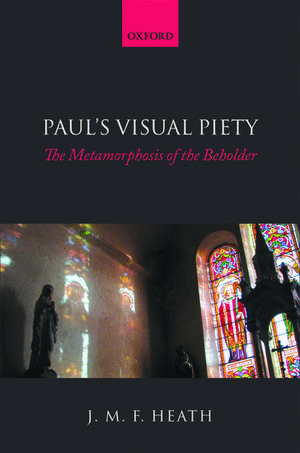
Paul's Visual Piety: The Metamorphosis of the Beholder
Autor J. M. F. Heathen Limba Engleză Hardback – 2 mai 2013
Preț: 998.09 lei
Preț vechi: 1454.49 lei
-31%
Puncte Express: 1497
Carte tipărită la comandă
Livrare economică 04-09 decembrie
Livrare prin curier în România Termenul estimat este afișat lângă disponibilitate.
Transport gratuit pentru acest produs Plată online sau ramburs, în funcție de opțiunile comenzii.
Retur gratuit în 14 zile Comandă securizată și suport în română.
Specificații
ISBN-13: 9780199664146
ISBN-10: 0199664145
Pagini: 328
Ilustrații: 8 in-text black and white figures
Dimensiuni: 162 x 241 x 26 mm
Greutate: 0.7 kg
Editura: OUP OXFORD
Colecția OUP Oxford
Locul publicării:Oxford, United Kingdom
ISBN-10: 0199664145
Pagini: 328
Ilustrații: 8 in-text black and white figures
Dimensiuni: 162 x 241 x 26 mm
Greutate: 0.7 kg
Editura: OUP OXFORD
Colecția OUP Oxford
Locul publicării:Oxford, United Kingdom
V-ar putea interesa
-
 Sixth Ezra: The Text and OriginTheodore A. Bergren-31%Preț: 605.25 lei874.72 lei
 -
 Preț: 234.49 lei
 -
 Preț: 254.81 lei
 -
 Preț: 286.35 lei
 -
 indexed: The Scofield® Study Bible III, NKJVOxford University PressPreț: 399.61 lei
 -
 The Scofield® Study Bible III, NKJVOxford University PressPreț: 399.37 lei
 -
 Preț: 285.86 lei
 -
 Lazarus Awakening Study GuideJoanna WeaverPreț: 84.90 lei
 -
 Sacred SenseWilliam P. BrownPreț: 136.06 lei
 -
 Discovering MatthewIan BoxallPreț: 138.16 lei
 -
 God of Justice – The IJM Institute Global Church CurriculumAbraham GeorgePreț: 128.21 lei
 -
 7 Chapters, 7 DaysTiffany L WadePreț: 60.36 lei
 -
 -18%Preț: 2507.69 lei3058.16 lei
 -
 Pillars of Cloud and FireHerbert Robinson MarburyPreț: 264.67 lei
 -
 The Faith of a MockingbirdMatt RawlePreț: 97.57 lei
 -
 Worship and WisdomG. Wright DoylePreț: 119.30 lei
 -
 Preț: 177.31 lei
 -
 The Abundant LifeGreg E. Viehman M. D.Preț: 107.20 lei
 -
 Creating a Glory AtmosphereJ Darrell TurnerPreț: 56.79 lei
 -
 The Gothic Version of the Gospels and Pauline EpistlesCarla Falluomini-23%Preț: 860.29 lei1117.27 lei
 -
 The Divine-Human CommunionAndrzej A. Napiórkowski-23%Preț: 672.15 lei872.92 lei
Recenzii
The book offers many rewards for the careful reading and re-reading it demands. From wide-ranging early chapters, where Heath makes a compelling case for ancient visual piety and its virtual eclipse in post-Reformation exegesis of Paul, to close readings of certain passages in Romans 1-4 and 2 Corinthians 2-7, we are asked to look through both a telescope (the wide theoretical and historical view) and a microscope (the focus on a few key texts)
Cuprins
- I
- Introduction: Formative Visuality
- 1: A Disciplinary Blind-Spot and its Origins
- 2: Various Visuals: Visual Culture, Visual Practice, Visual Piety
- II
- Introduction: Hellenistic, Jewish or Both?: Hellenistic, Jewish or Both?
- 3: Greco-Roman Visual Practices:Greco-Roman Visual Practices
- 4: Jewish Visual Practices: Jewish Visual Practices
- III
- Introduction: Luther s Faith and Paul s Sight: Romans 1:17 and 2 Corinthians 3:18
- 5: The Epistle to the Romans
- 6: Sense Perception and Transformative Judgement: 2 Corinthians 2:14-7:4
- 7: Beholding in a Mirror we are being Metamorphosed : 2 Corinthians 3:18
- 8: Metamorphosis of the Servant s Beholder
- 9: From Jew to Gentile in Paul s Visual Piety
- Finis: Synagoga et Ecclesia