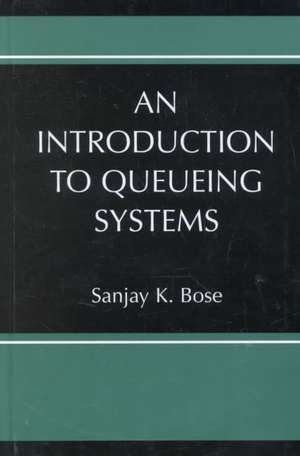
An Introduction to Queueing Systems
Autor Sanjay K. Boseen Limba Engleză Hardback – 31 dec 2001
Preț: 1024.77 lei
Preț vechi: 1280.96 lei
-20%
Puncte Express: 1537
Carte tipărită la comandă
Livrare economică 05-19 decembrie
Livrare prin curier în România Termenul estimat este afișat lângă disponibilitate.
Transport gratuit pentru acest produs Plată online sau ramburs, în funcție de opțiunile comenzii.
Retur gratuit în 14 zile Comandă securizată și suport în română.
Specificații
ISBN-13: 9780306467349
ISBN-10: 0306467348
Pagini: 312
Ilustrații: XX, 288 p.
Dimensiuni: 160 x 241 x 22 mm
Greutate: 0.58 kg
Ediția:2002
Editura: Springer Us
Locul publicării:New York, NY, United States
ISBN-10: 0306467348
Pagini: 312
Ilustrații: XX, 288 p.
Dimensiuni: 160 x 241 x 22 mm
Greutate: 0.58 kg
Ediția:2002
Editura: Springer Us
Locul publicării:New York, NY, United States
V-ar putea interesa
-
 Computer Networks: A Systems ApproachLarry L. Peterson-41%Preț: 558.53 lei941.05 lei
 -
 Frontiers in Queueing: Models and Applications in Science and EngineeringJewgeni H. Dshalalow-9%Preț: 1154.97 lei1269.20 lei
 -
 -20%Preț: 377.89 lei472.36 lei
 -
 Data and Computer CommunicationsWilliam Stallings-11%Preț: 638.48 lei717.39 lei
 -
![Computer Networking [Global Edition]](https://i1.books-express.ro/bt/9781292405469/computer-networking-global-edition.jpg) Computer Networking [Global Edition]James Kurose-20%Preț: 655.16 lei818.95 lei
Computer Networking [Global Edition]James Kurose-20%Preț: 655.16 lei818.95 lei -
 Networking All-In-One for DummiesDoug Lowe-20%Preț: 258.11 lei322.63 lei
 -
 Foundations of Analog and Digital Electronic CircuitsAnant Agarwal-28%Preț: 546.19 lei754.30 lei
 -
 Distributions in Stochastic Network ModelsG Sh Tsitsiashvili-27%Preț: 833.47 lei1134.59 lei
 -
 Queueing Models in Industry & BusinessAliakbar Montazer Haghighi-26%Preț: 1227.23 lei1665.92 lei
 -
 Preț: 441.94 lei
 -
 Networking and ComputationThomas G. RobertazziPreț: 462.45 lei
 -
 Networked SystemsSalem Lahlou-20%Preț: 996.76 lei1245.95 lei
 -
 -20%Preț: 327.36 lei409.20 lei
 -
 -20%Preț: 324.19 lei405.23 lei
 -
 -20%Preț: 642.40 lei803.00 lei
 -
 Packet Tracer for Young Beginning AdminsDamian Strojek-20%Preț: 260.34 lei325.42 lei
 -
 Computer Networks in Packet Tracer for BeginnersDamian Strojek-20%Preț: 264.34 lei330.42 lei
 -
 Computer Networks in Packet Tracer for Intermediate UsersDamian Strojek-20%Preț: 265.31 lei331.65 lei
Public țintă
ResearchDescriere
Queueing is an aspect of modern life that we encounter at every step in our daily activities. Whether it happens at the checkout counter in the supermarket or in accessing the Internet, the basic phenomenon of queueing arises whenever a shared facility needs to be accessed for service by a ]arge number of jobs or customers. The study of queueing is important as it gravides both a theoretical background to the kind of service that we may expect from such a facility and the way in which the facility itself may be designed to provide some specified grade of service to its customers. Our study of queueing was basically motivated by its use in the study of communication systems and computer networks. The various computers, routers and switches in such a network may be modelled as individual queues. The whole system may itself be modelled as a queueing network providing the required service to the messages, packets or cells that need to be carried. Application of queueing theory provides the theoretical framework for the design and study of such networks. The purpose of this book is to support a course on queueing systems at the senior undergraduate or graduate Ievels. Such a course would then provide the theoretical background on which a subsequent course on the performance modeHing and analysis of computer networks may be based.