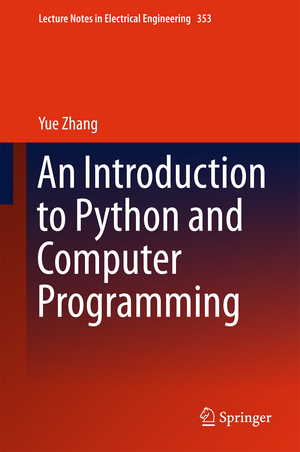
An Introduction to Python and Computer Programming: Lecture Notes in Electrical Engineering, cartea 353
Autor Yue Zhangen Limba Engleză Hardback – 27 iul 2015
Din seria Lecture Notes in Electrical Engineering
-
 Preț: 334.57 lei
- 18%
 Preț: 1786.47 lei
- 18%
 Preț: 929.11 lei
- 18%
 Preț: 1732.22 lei
- 20%
 Preț: 1527.09 lei
- 18%
 Preț: 5633.90 lei
- 20%
 Preț: 1982.28 lei
- 20%
 Preț: 1989.99 lei
- 18%
 Preț: 1632.11 lei
- 18%
 Preț: 2208.79 lei
- 18%
 Preț: 1639.71 lei
- 18%
 Preț: 1919.69 lei
- 18%
 Preț: 2191.21 lei
- 18%
 Preț: 852.65 lei
- 18%
 Preț: 1631.64 lei
- 18%
 Preț: 1174.56 lei
- 18%
 Preț: 2198.57 lei
- 18%
 Preț: 1436.03 lei
- 20%
 Preț: 1525.35 lei
- 20%
 Preț: 1217.26 lei
- 20%
 Preț: 1534.29 lei
- 18%
 Preț: 2636.52 lei
- 20%
 Preț: 1533.05 lei
- 18%
 Preț: 1907.83 lei
- 20%
 Preț: 1226.21 lei
- 18%
 Preț: 1611.64 lei
- 18%
 Preț: 1159.08 lei
- 18%
 Preț: 1910.00 lei
- 18%
 Preț: 1768.37 lei
- 18%
 Preț: 1343.53 lei
- 20%
 Preț: 1497.78 lei
- 18%
 Preț: 1457.43 lei
- 20%
 Preț: 1214.51 lei
- 18%
 Preț: 841.38 lei
- 20%
 Preț: 1216.73 lei
- 20%
 Preț: 1712.93 lei
- 20%
 Preț: 2279.96 lei
- 18%
 Preț: 1436.98 lei
- 18%
 Preț: 1362.60 lei
- 20%
 Preț: 1521.89 lei
- 18%
 Preț: 1457.43 lei
- 18%
 Preț: 1897.63 lei
- 18%
 Preț: 1619.27 lei
- 18%
 Preț: 1170.53 lei
- 18%
 Preț: 1743.62 lei
- 18%
 Preț: 1457.43 lei
- 18%
 Preț: 753.02 lei
- 18%
 Preț: 1342.72 lei
- 18%
 Preț: 1452.91 lei
- 18%
 Preț: 751.37 lei
Preț: 1041.97 lei
Preț vechi: 1270.69 lei
-18%
Puncte Express: 1563
Carte tipărită la comandă
Livrare economică 14-28 decembrie
Livrare prin curier în România Termenul estimat este afișat lângă disponibilitate.
Transport gratuit pentru acest produs Plată online sau ramburs, în funcție de opțiunile comenzii.
Retur gratuit în 14 zile Comandă securizată și suport în română.
Specificații
ISBN-13: 9789812876089
ISBN-10: 9812876081
Pagini: 308
Ilustrații: X, 295 p. 58 illus., 5 illus. in color.
Dimensiuni: 160 x 241 x 23 mm
Greutate: 0.58 kg
Ediția:1st edition 2015
Editura: Springer
Colecția Lecture Notes in Electrical Engineering
Seria Lecture Notes in Electrical Engineering
Locul publicării:Singapore, Singapore
V-ar putea interesa
-
 Sound Propagation in Stratified FluidsCalvin H. Wilcox-15%Preț: 611.57 lei719.49 lei
-
 Computational Heat Transfer, Volume 1A A Samarskii-9%Preț: 3503.54 lei3850.05 lei
-
 Lie Groups, Physics, and GeometryRobert Gilmore-14%Preț: 724.87 lei842.88 lei
-
 Natural Language ProcessingYue Zhang-20%Preț: 479.12 lei598.90 lei
-
 Lore and VerseYue ZhangPreț: 269.85 lei
-
 Zno NanostructuresYue Zhang-14%Preț: 1353.00 lei1573.26 lei
-
 Chinese Computational LinguisticsMaosong Sun-20%Preț: 345.68 lei432.09 lei
-
 Computational IntelligenceAmit Konar-18%Preț: 782.22 lei953.92 lei
-
 Soft Computing Applications in IndustryBhanu Prasad-18%Preț: 984.87 lei1201.06 lei
-
 Multimedia Semantics - The Role of MetadataMichael Granitzer-15%Preț: 665.10 lei782.47 lei
-
 Computer Recognition Systems 3Marek Kurzynski-18%Preț: 1184.45 lei1444.45 lei
-
 -18%Preț: 914.06 lei1114.71 lei
-
 -18%Preț: 917.40 lei1118.78 lei
-
 Biomedical Data and ApplicationsAmandeep S. Sidhu-18%Preț: 916.33 lei1117.47 lei
-
 Information Hiding and ApplicationsHsiang-Cheh Huang-18%Preț: 911.05 lei1111.04 lei
-
 Mathematik 1Albert FetzerPreț: 462.13 lei
-
 Mathematik 2Albert FetzerPreț: 441.16 lei
-
 Computational Intelligence in Flow Shop and Job Shop SchedulingUday K. Chakraborty-18%Preț: 951.85 lei1160.79 lei
-
 Swarm Intelligence for Multi-objective Problems in Data MiningCarlos Coello Coello-18%Preț: 948.98 lei1157.30 lei
-
 Intelligent Systems for Knowledge ManagementEdward Szczerbicki-18%Preț: 951.01 lei1159.77 lei
-
 Constructive Neural NetworksLeonardo Franco-18%Preț: 912.25 lei1112.51 lei
-
 -18%Preț: 950.22 lei1158.80 lei
-
 Emotional IntelligenceAruna Chakraborty-18%Preț: 914.21 lei1114.88 lei
-
 Stochastic Integral Equations and Rainfall-Runoff ModelsTheodore V. Hromadka II-15%Preț: 620.68 lei730.21 lei
-
 Computational and Experimental Mechanics of Advanced MaterialsVadim V. Silberschmidt-15%Preț: 635.04 lei747.11 lei
-
 -15%Preț: 611.12 lei718.97 lei
-
 Preț: 373.36 lei
-
 -15%Preț: 623.60 lei733.64 lei
Public țintă
Professional/practitionerCuprins
An introduction to Python and computer programming.- Using Python as a Calculator.- The First Python Program.- Branching and Looping.- Problem solving using branches and loops.- Functions.- Lists and mutability.- Sequences, Mappings and Sets.- Problem solving using lists and functions.- Classes.- Summary.
Recenzii
“There are 11 chapters, each of which has aselection of exercises at the end. The problems are well written and generallyincrease in complexity. … Tailored to the instructor, it provides a goodfoundation.” (David Bellin, Computing Reviews, October, 2015)
Notă biografică
Xiaoyun Li, Chair Professor and Honorary Dean of College of International Development and Global Agriculture, China Agricultural University.Lixia Tang, Professor of the College of Humanities and Development Studies, China Agricultural University.
Jixia ¿Lu, Professor of the College of Humanities and Development Studies, China Agricultural University.
Xiuli Xu, Dean of the College of International Development and Global Agriculture (CIDGA) at China Agricultural University.
Yue Zhang, Assistant Professor at College of Humanities and Development Studies and College of International Development and Global Agriculture (CIDGA), China Agricultural University.
Gubo Qi, Professor at the College of Humanities and Development Studies and the College of International Development and Global Agriculture, China Agricultural University.
Chuanhong Zhang, Associate professor of College of Humanities and Development Studies/ and Director of Center for International Development Aid Studies at College of International Development and Global Agriculture (CIDGA), China Agricultural University.
Textul de pe ultima copertă
This book introduces Python programming language and fundamental concepts in algorithms and computing. Its target audience includes students and engineers with little or no background in programming, who need to master a practical programming language and learn the basic thinking in computer science/programming. The main contents come from lecture notes for engineering students from all disciplines, and has received high ratings. Its materials and ordering have been adjusted repeatedly according to classroom reception. Compared to alternative textbooks in the market, this book introduces the underlying Python implementation of number, string, list, tuple, dict, function, class, instance and module objects in a consistent and easy-to-understand way, making assignment, function definition, function call, mutability and binding environments understandable inside-out. By giving the abstraction of implementation mechanisms, this book builds a solid understanding of the Python programming language.
Caracteristici
Gives a gentle introduction to Python and programming, avoiding details that can hinder the understanding of important concepts Incorporates the very fundamentals of algorithms and computation which applies to all programming languages Abstracts the kernel of Python, in particular the object system, into a unique and novel diagram system Includes supplementary material: sn.pub/extras