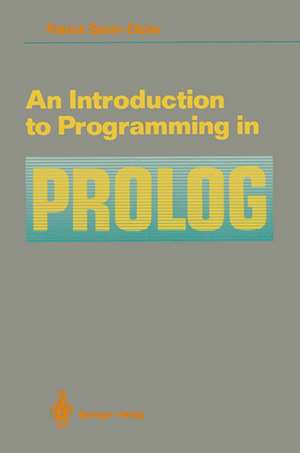
An Introduction to Programming in Prolog
Autor Patrick Saint-Dizier Traducere de Sharon J. Hamiltonen Limba Engleză Paperback – 18 dec 1989
Preț: 317.29 lei
Preț vechi: 396.61 lei
-20%
Puncte Express: 476
Carte tipărită la comandă
Livrare economică 08-22 decembrie
Livrare prin curier în România Termenul estimat este afișat lângă disponibilitate.
Transport gratuit de la 400.00 lei Plată online sau ramburs, în funcție de opțiunile comenzii.
Retur gratuit în 14 zile Comandă securizată și suport în română.
Specificații
ISBN-13: 9780387971445
ISBN-10: 0387971440
Pagini: 200
Ilustrații: XI, 184 p.
Dimensiuni: 155 x 235 x 12 mm
Greutate: 0.31 kg
Ediția:Softcover reprint of the original 1st ed. 1990
Editura: Springer
Locul publicării:New York, NY, United States
ISBN-10: 0387971440
Pagini: 200
Ilustrații: XI, 184 p.
Dimensiuni: 155 x 235 x 12 mm
Greutate: 0.31 kg
Ediția:Softcover reprint of the original 1st ed. 1990
Editura: Springer
Locul publicării:New York, NY, United States
V-ar putea interesa
-
 The C++ Programming LanguageBjarne Stroustrup-20%Preț: 507.21 lei634.02 lei
 -
 Open Geometry: OpenGL® + Advanced GeometryGeorg Glaeser-20%Preț: 659.05 lei823.82 lei
 -
 Computational Lexical SemanticsPatrick Saint-DizierPreț: 461.50 lei
 -
 Python Programming for BiologyTim J. Stevens-20%Preț: 460.01 lei575.01 lei
 -
 Verilog - 2001Stuart Sutherland-15%Preț: 661.73 lei778.50 lei
 -
 Languages for Digital Embedded SystemsStephen A. Edwards-18%Preț: 981.53 lei1196.99 lei
 -
 Formal Semantics and Proof Techniques for Optimizing VHDL ModelsKothanda Umamageswaran-15%Preț: 660.08 lei776.57 lei
 -
 Beginning Programming with C++ For DummiesStephen R. Davis-20%Preț: 173.62 lei217.02 lei
 -
 Syntax and Semantics of PrepositionsPatrick Saint-Dizier-18%Preț: 982.58 lei1198.27 lei
 -
 Pro ASP.NET Web API SecurityBadrinarayanan Lakshmiraghavan-20%Preț: 525.86 lei657.33 lei
 -
 -20%Preț: 230.97 lei288.71 lei
 -
 -20%Preț: 156.43 lei195.54 lei
 -
 Functional Programming in ScalaRunar Bjarnason-20%Preț: 340.60 lei425.75 lei
 -
 Python Programming for BeginnersJoseph Joyner-20%Preț: 53.61 lei67.02 lei
 -
 Murachs C# 2012Joel Murach-28%Preț: 359.74 lei496.79 lei
 -
 Types for Proofs and ProgramsStefano Berardi-20%Preț: 341.62 lei427.03 lei
 -
 Programming Languages and SystemsWei-Ngan Chin-20%Preț: 330.96 lei413.70 lei
 -
 Modular Programming LanguagesLászló Böszörményi-20%Preț: 334.59 lei418.24 lei
Public țintă
ResearchCuprins
1 Representing Facts in Prolog.- 1. Trees.- 2. Facts.- 3. Properties and Relations.- 4. Introducing Facts in Prolog.- Exercises.- 2 Querying the Fact Base.- 1. Elementary Questions.- 2. Questions with Variables.- 3. Conjunction of Elementary Questions.- 4. An Example of a Prolog Execution.- Exercises.- 3 Expressing Rules.- 1. Advantages of Rules.- 2. Constructing a Rule.- 3. Rules without Conditions.- 4. Rules and Logic.- 5. Facts and Rules with Complex Arguments.- 6 Summary.- Exercises.- 4 Syntax of Prolog. The Unification Mechanism.- 1. Numbers and Atoms.- 2. Variables.- 3. Terms.- 4. Clauses.- 5. Formal Definitions of Terms and Clauses.- 6. Substitutions.- 7. Unification of Terms.- Exercises.- 5 Arithmetic Operations.- 1. Arithmetic Operators.- 2. Logical Operators.- 3. Application to Databases.- 6 Procedures.- 1. The Problem.- 2. Procedures.- 3. Execution Order of Clauses in a Procedure.- 4. Procedures and Classical Programming.- Exercises.- 7 Recursion.- 1. Recursion and Recurrence.- 2. Paths in a Graph.- 3. Calculating the Length of a Path.- Exercises.- 8 Structure and Management of Control.- 1. Control Structure.- 2. The Execution Process.- 3. Predicates for Controlling Resolution.- 4. Negation as Failure.- Exercises.- 9 Lists.- 1. Representing Lists.- 2. Searching for an Element in a List.- 3. Set Operations.- 4. Concatenation of Two Lists.- 5. Palindromes.- Exercises.- 10 Predefined Predicates.- 1. Identifying Kinds of Terms.- 2. Decomposition and Construction of Terms.- 3. Input-Output Operations.- 4. Defining New Operators.- Exercises.- 11 Some Programming Advice.- 1. General Principles.- 2. Top-Down Approach.- 3. Testing Prolog Programs.- 4. Thinking in Prolog.- 5. Toward Applications.- 12 Formal Aspects of Programming in Logic.- 1. First-Order Logic.- 2. Clausal Forms and Horn Clauses.- 3. Declarative and Procedural Semantics of Prolog.- 4. SLD Resolution.- 5. SLD Resolution in Prolog.- 6. Meaning of a Program.- 13 Playing with Words.- 1. Crisscross Puzzles.- 2. The Game of Domino.- 3. The Longest Word.- 14 Deductive Databases.- 1. Basic Structures.- 2. A Film Database.- 3. Basic Operations.- 4. Advanced Tools.- 5. Expressing Integrity Constraints.- 6. Problems of Quantification.- 7. A World with Three Truth Values.- 15 An Expert System about Animals.- 1. Structure of an Expert System.- 2. Modeling a Problem.- 3. Guessing Names of Animals.- 4. Toward Actual Expert Systems.- 16 Count It Out.- 1. The Basic Game.- 2. A More Complex Calculation.- 3. Searching for an Approximate Solution.- 17 The Automatic Analysis of Natural Language.- 1. Natural Language and Logic.- 2. Introduction to Logic Grammar.- 3. Semantic Constraints.- 4. Generation of Natural Language.- 5. Automatic Construction of an Analyzer.- 6. A More Complex Logical Formula.- 7. Toward an Evaluator.- Appendix A Exercise Answers.- Appendix B Main Predefined Predicates.