
An Introduction to Machine Learning
Autor Miroslav Kubaten Limba Engleză Paperback – 15 oct 2016
Implementarea sistemelor de inteligență artificială necesită adesea o înțelegere care să depășească simpla utilizare a unor biblioteci software predefinite. An Introduction to Machine Learning abordează direct această provocare, oferind fundamentul teoretic și practic necesar pentru a construi algoritmi capabili să învețe din date. În această a treia ediție, Miroslav Kubat extinde aria de acoperire către subiecte de actualitate precum rețelele neuronale profunde și învățarea temporală, fără a sacrifica claritatea explicațiilor pentru conceptele clasice. Subliniem modul în care volumul este structurat pentru a asigura o progresie logică a cunoștințelor. Primele capitole pun bazele prin clasificatori Bayesieni și k-nearest neighbor, evoluând natural spre structuri complexe precum arborii de decizie și rețelele Kohonen. Merită menționat că, spre deosebire de alte manuale tehnice, Miroslav Kubat alocă spațiu generos capitolului de evaluare a performanței și semnificației statistice, aspecte critice pentru validarea oricărui model de învățare automată. Putem afirma că rigoarea este menținută prin includerea unor teme avansate precum algoritmii genetici și modelele Markov ascunse, oferind o viziune de ansamblu asupra întregului domeniu. Cititorul care a aplicat deja conceptele de bază din Machine Learning Foundations de Taeho Jo va găsi în această lucrare o aprofundare necesară a problemelor practice de teren, cum ar fi selecția caracteristicilor sau gestionarea domeniilor multi-label. În timp ce alte resurse se concentrează pe fundamente, An Introduction to Machine Learning face tranziția către aplicații reale, discutând deschis despre bias și contextul datelor în producție. Este un instrument de lucru esențial pentru cei care doresc să înțeleagă mecanismele interne ale Machine Learning și să optimizeze performanța modelelor în scenarii complexe.
Preț: 322.83 lei
Preț vechi: 403.54 lei
-20%
Carte tipărită la comandă
Livrare economică 10-24 august
Specificații
ISBN-10: 3319348868
Pagini: 308
Ilustrații: XIII, 291 p. 71 illus., 2 illus. in color.
Dimensiuni: 155 x 235 x 17 mm
Greutate: 0.47 kg
Ediția:Softcover reprint of the original 1st edition 2015
Editura: Springer
Locul publicării:Cham, Switzerland
V-ar putea interesa
-
 Using Artificial Intelligence Absolute Beginner's GuideMichael Miller-20%Preț: 189.01 lei236.26 lei
 -
 Machine LearningKevin P. Murphy-22%Preț: 705.06 lei904.07 lei
 -
 Introduction to Machine LearningEthem Alpaydin-26%Preț: 546.60 lei742.39 lei
 -
 Probabilistic Machine LearningKevin P. Murphy-23%Preț: 823.54 lei1063.72 lei
 -
 Understanding Deep LearningSimon J. D. Prince-30%Preț: 596.55 lei853.73 lei
 -
 Gaussian Processes for Machine LearningCarl Edward Rasmussen-28%Preț: 338.48 lei469.96 lei
 -
 -20%Preț: 656.32 lei820.40 lei
 -
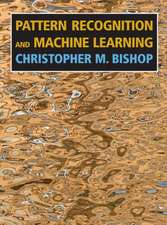 Pattern Recognition and Machine LearningChristopher M. Bishop-20%Preț: 574.36 lei717.95 lei
 -
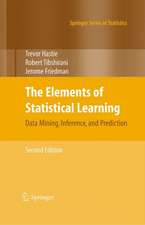 The Elements of Statistical LearningTrevor Hastie-20%Preț: 533.31 lei666.64 lei
 -
 -40%Preț: 380.74 lei636.55 lei
 -
 -32%Preț: 599.32 lei887.17 lei
 -
 Pattern RecognitionM Narasimha Murty-20%Preț: 247.41 lei309.26 lei
 -
 Machine Learning For DummiesJohn Paul Mueller-20%Preț: 147.53 lei184.42 lei
 -
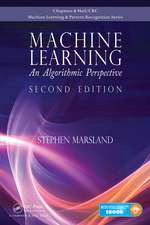 Machine Learning: An Algorithmic Perspective, Second EditionStephen Marsland-20%Preț: 615.27 lei769.10 lei
 -
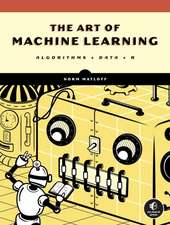 -37%Preț: 242.00 lei384.88 lei
 -
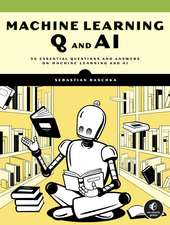 -20%Preț: 241.03 lei301.29 lei
 -
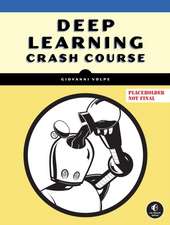 Deep Learning Crash CourseGiovanni Volpe-36%Preț: 280.53 lei438.97 lei
 -
 Practical Deep Learning, 2nd Edition: A Python-Based IntroductionRonald T. Kneusel-37%Preț: 321.88 lei507.68 lei
 -
 Materials Data ScienceStefan Sandfeld-15%Preț: 573.37 lei674.56 lei
 -
 Multivariate Analysis and Machine Learning TechniquesSrikrishnan Sundararajan-20%Preț: 534.82 lei668.53 lei
De ce să citești această carte
Această carte se adresează studenților și inginerilor software care au nevoie de o bază solidă în inteligența artificială. Cititorul câștigă o înțelegere clară a modului în care funcționează algoritmii, de la cei mai simpli la deep learning, primind în același timp sfaturi practice despre cum să evalueze corect performanța unui model. Este o resursă valoroasă pentru oricine dorește să evite abordarea de tip „black box” în dezvoltarea de software inteligent.
Despre autor
Miroslav Kubat este un cercetător recunoscut în domeniul inteligenței artificiale, cu o experiență vastă în predarea și dezvoltarea algoritmilor de învățare automată. Expertiza sa este reflectată în capacitatea de a sintetiza concepte matematice complexe în explicații accesibile, susținute de numeroase exemple și diagrame. Prin colaborarea cu editura Springer, Kubat a reușit să transforme acest manual într-o referință standard pentru cursurile de profil, fiind apreciat pentru echilibrul dintre rigoarea academică și aplicabilitatea practică a metodelor prezentate.
Descriere scurtă
Cuprins
Recenzii
“It is superbly organized: each section includes a ‘what have you learned’ summary, and every chapter has a short summary, accompanying (brief) historical remarks, and a slew of exercises. … In most of the chapters, there are very clear examples, well chosen and illustrated, that really help the reader understand each concept. … I did learn quite a bit about very basic machine learning by reading this book.” (Jacques Carette, Computing Reviews, January, 2016)
Notă biografică
Caracteristici
Textul de pe ultima copertă
The main topics include Bayesian classifiers, nearest-neighbor classifiers, linear and polynomial classifiers, decision trees, rule-induction programs, artificial neural networks, support vector machines, boosting algorithms, unsupervised learning (including Kohonen networks and auto-encoding), deep learning, reinforcement learning, temporal learning (including long short-term memory), hidden Markov models, and the genetic algorithm. Special attention is devoted to performance evaluation, statistical assessment, and to many practical issues ranging from feature selection and feature construction to bias, context, multi-label domains, and the problem of imbalanced classes.