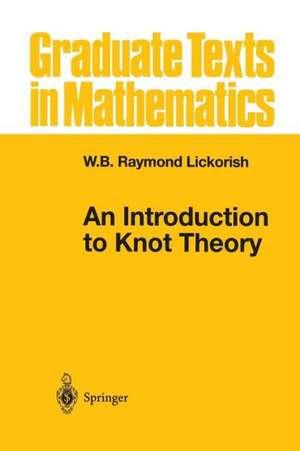
An Introduction to Knot Theory: Graduate Texts in Mathematics, cartea 175
Autor W.B.Raymond Lickorishen Limba Engleză Paperback – 12 oct 2012
Descoperim în An Introduction to Knot Theory o lucrare de referință ce evidențiază interdisciplinaritatea profundă a matematicii moderne, unde studiul curbelor închise în spațiul tridimensional se intersectează cu biologia moleculară, mecanica statistică și teoria cuantică a câmpurilor. Autorul, W.B.Raymond Lickorish, distilează experiența cursurilor susținute la University of Cambridge într-un volum ce prioritizează rigoarea topologiei geometrice în detrimentul abordărilor pur decorative sau intuitive.
Notăm cu interes structura progresivă a manualului, care ghidează cititorul de la conceptele de bază, precum suprafețele Seifert și factorizarea nodurilor, către subiecte avansate de cercetare. Reținem ponderea semnificativă acordată polinoamelor — Jones, Alexander, Conway sau Kauffman — care servesc drept invarianți esențiali în distingerea nodurilor. Spre deosebire de alte introduceri, An Introduction to Knot Theory avansează rapid spre interacțiunea nodurilor cu topologia 3-varietăților, incluzând demonstrații despre chirurgia pe S3 și calculul invarianților cuantici. Acoperă aceeași arie tematică precum Knot Theory and Its Applications de Kunio Murasugi, dar cu o abordare mult mai tehnică și orientată spre fundamentarea teoretică necesară la nivel de studii masterale sau doctorat, punând accent pe demonstrații matematice precise în locul aplicațiilor computaționale.
Fiecare capitol este calibrat pentru a construi o înțelegere solidă, terminându-se cu seturi de exerciții care transformă lectura într-un proces activ de învățare. Deși este o ediție din 1997, rigoarea cu care sunt tratate spațiile de acoperire și matricele Goeritz menține relevanța cărții în curriculumul actual de matematică avansată.
Din seria Graduate Texts in Mathematics
- 13%
 Preț: 389.43 lei
 -
 Preț: 382.46 lei
 -
 Preț: 489.62 lei
 - 15%
 Preț: 395.55 lei
 - 15%
 Preț: 402.87 lei
 - 15%
 Preț: 384.73 lei
 - 15%
 Preț: 394.84 lei
 -
 Preț: 388.76 lei
 -
 Preț: 364.67 lei
 -
 Preț: 366.24 lei
 - 15%
 Preț: 429.68 lei
 - 15%
 Preț: 428.65 lei
 -
 Preț: 372.27 lei
 - 15%
 Preț: 468.11 lei
 -
 Preț: 392.36 lei
 - 15%
 Preț: 506.99 lei
 -
 Preț: 425.51 lei
 -
 Preț: 261.07 lei
 - 15%
 Preț: 562.38 lei
 -
 Preț: 381.34 lei
 - 15%
 Preț: 424.86 lei
 - 15%
 Preț: 518.68 lei
 - 15%
 Preț: 489.24 lei
 - 15%
 Preț: 540.38 lei
 -
 Preț: 481.43 lei
 -
 Preț: 422.40 lei
 -
 Preț: 375.31 lei
 - 15%
 Preț: 576.47 lei
 - 15%
 Preț: 477.57 lei
 -
 Preț: 442.38 lei
 - 15%
 Preț: 460.83 lei
 -
 Preț: 480.91 lei
 - 15%
 Preț: 681.72 lei
 -
 Preț: 443.71 lei
 - 15%
 Preț: 580.34 lei
 -
 Preț: 371.33 lei
 - 15%
 Preț: 566.70 lei
 - 15%
 Preț: 516.13 lei
Preț: 449.14 lei
Preț vechi: 528.40 lei
-15%
Carte tipărită la comandă
Livrare economică 09-23 iunie
Specificații
ISBN-10: 1461268699
Pagini: 220
Ilustrații: X, 204 p.
Dimensiuni: 155 x 235 x 12 mm
Greutate: 0.31 kg
Ediția:Softcover reprint of the original 1st ed. 1997
Editura: Springer
Colecția Springer
Seria Graduate Texts in Mathematics
Locul publicării:New York, NY, United States
V-ar putea interesa
-
 KS2 English SATs Practice WorkbookCollins Ks2Preț: 45.84 lei
 -
 Fourier Analysis and Its ApplicationsAnders VretbladPreț: 478.48 lei
 -
 Preț: 414.20 lei
 -
 Homology TheoryJames W. Vick-15%Preț: 568.75 lei669.12 lei
 -
 Prime Numbers and the Riemann HypothesisBarry MazurPreț: 198.69 lei
 -
 Professor Stewart's Casebook of Mathematical MysteriesProfessor Ian Stewart-20%Preț: 60.38 lei75.50 lei
 -
 Bridging the Gap to University MathematicsEdward HurstPreț: 129.99 lei
 -
 Numerical Methods for Inverse ProblemsMichel Kern-9%Preț: 946.35 lei1039.95 lei
 -
 The Tower of Hanoi – Myths and MathsAndreas M. HinzPreț: 329.09 lei
 -
 -18%Preț: 1376.99 lei1679.25 lei
 -
 An Invitation to MathematicsDierk SchleicherPreț: 342.44 lei
Public țintă
GraduateDe ce să citești această carte
Recomandăm această lucrare studenților de la masterat și cercetătorilor care doresc o bază teoretică solidă în topologia geometrică. An Introduction to Knot Theory nu este doar o prezentare a nodurilor, ci un instrument de lucru care clarifică legătura dintre polinoamele moderne și structura spațiului. Câștigați o perspectivă riguroasă asupra invarianților cuantici și a chirurgiei pe varietăți, elemente esențiale pentru orice topolog în formare.
Descriere scurtă
Cuprins
Recenzii
An Introduction to Knot Theory
"This essential introduction to vital areas of mathematics with connections to physics, while intended for graduate students, should fall within the ken of motivated upper-division undergraduates."—CHOICE