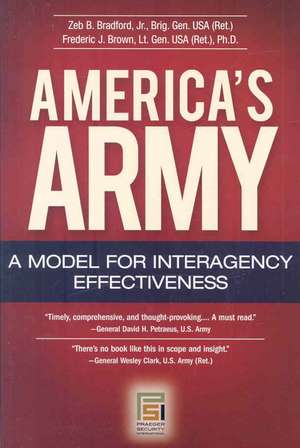
America's Army: A Model for Interagency Effectiveness: Praeger Security International
Autor Zeb B. Bradford Jr., Frederic J. Brownen Limba Engleză Hardback – 30 mar 2008
Bradford and Brown point to the current war in Iraq, a lack of interagency competence across the national government, and the botched disaster relief efforts of Katrina as glaring examples of the failure of America's Army to adapt to present-day challenges. Given the rapid and dramatic changes throughout the world, the authors stress how selective adaptation of specific programs and procedures can contribute to improving policy execution within and across all facets of government, including the armed forces. Yet this adaptation to change must be institutionalized, requiring the Army to become a constantly evolving learning organization. Only within this context can the army manage to act on the myriad demands of the day including taking the leadership in international cooperation, fighting the amorphous enemy of The Long War against terrorism, responding effectively to disaster scenarios, and engaging in stabilization and reconstruction efforts around the world.
Din seria Praeger Security International
- 31%
 Preț: 388.21 lei
 - 35%
 Preț: 365.05 lei
 - 22%
 Preț: 344.06 lei
 - 22%
 Preț: 345.89 lei
 - 30%
 Preț: 394.17 lei
 - 31%
 Preț: 388.13 lei
 - 28%
 Preț: 432.56 lei
 - 22%
 Preț: 328.84 lei
 - 43%
 Preț: 588.28 lei
 - 31%
 Preț: 332.74 lei
 - 22%
 Preț: 345.89 lei
 - 22%
 Preț: 331.27 lei
 - 22%
 Preț: 331.27 lei
 - 30%
 Preț: 395.83 lei
 - 22%
 Preț: 330.07 lei
 - 22%
 Preț: 330.07 lei
 - 22%
 Preț: 330.67 lei
 - 18%
 Preț: 345.89 lei
 - 22%
 Preț: 366.32 lei
 - 18%
 Preț: 344.66 lei
 - 41%
 Preț: 417.57 lei
 - 22%
 Preț: 332.36 lei
 - 31%
 Preț: 387.57 lei
 - 22%
 Preț: 330.07 lei
 - 22%
 Preț: 348.32 lei
 - 38%
 Preț: 281.30 lei
 - 22%
 Preț: 344.66 lei
 - 22%
 Preț: 332.50 lei
 - 22%
 Preț: 261.64 lei
 - 43%
 Preț: 588.28 lei
 - 19%
 Preț: 343.43 lei
 - 22%
 Preț: 310.51 lei
 - 22%
 Preț: 363.21 lei
 - 30%
 Preț: 399.22 lei
 - 22%
 Preț: 311.52 lei
 - 19%
 Preț: 344.06 lei
 - 21%
 Preț: 335.43 lei
 - 28%
 Preț: 348.68 lei
 - 38%
 Preț: 426.57 lei
 - 22%
 Preț: 365.05 lei
 - 33%
 Preț: 261.94 lei
 - 22%
 Preț: 364.42 lei
 - 22%
 Preț: 344.26 lei
 - 18%
 Preț: 311.52 lei
 - 31%
 Preț: 392.03 lei
 - 22%
 Preț: 331.27 lei
 - 22%
 Preț: 325.51 lei
 - 22%
 Preț: 362.32 lei
 - 22%
 Preț: 330.67 lei
 - 22%
 Preț: 365.05 lei
Preț: 346.49 lei
Preț vechi: 423.72 lei
-18%
Puncte Express: 520
Carte tipărită la comandă
Livrare economică 09-23 iunie
Specificații
ISBN-13: 9780313350245
ISBN-10: 0313350248
Pagini: 268
Dimensiuni: 156 x 235 x 25 mm
Greutate: 0.57 kg
Editura: Bloomsbury Publishing
Colecția Praeger
Seria Praeger Security International
Locul publicării:New York, United States
ISBN-10: 0313350248
Pagini: 268
Dimensiuni: 156 x 235 x 25 mm
Greutate: 0.57 kg
Editura: Bloomsbury Publishing
Colecția Praeger
Seria Praeger Security International
Locul publicării:New York, United States
V-ar putea interesa
-
 -25%Preț: 223.44 lei298.06 lei
 -
 -18%Preț: 1251.75 lei1526.52 lei
 -
 Samurai!Saburo SakaiPreț: 131.17 lei
 -
 Military BlundersSaul David-27%Preț: 69.76 lei96.11 lei
 -
 Plane Spotter’s GuideTony Holmes-23%Preț: 44.17 lei57.50 lei
 -
 US Army Paratrooper in the Pacific Theater 1943–45Gordon L. Rottman-33%Preț: 73.26 lei109.45 lei
 -
 Vercors 1944Peter Lieb-33%Preț: 83.85 lei124.54 lei
 -
 Spartan Warrior 735–331 BCDuncan B. Campbell-33%Preț: 73.26 lei109.39 lei
 -
 The BazookaGordon L. Rottman-33%Preț: 78.64 lei117.06 lei
 -
 Watches Without TimeMatt ZellerPreț: 116.12 lei
Cuprins
Foreword: Competence and Capability in National Security
Chapter I: National Security in a World Transformed
Chapter II: The Long War War
Chapter III: Americas Army Today
Chapter IV: Sustaining Excellence - The Volunteer Force
Chapter V: Improved Responsiveness as a Learning Organization
Chapter VI: Imperatives for Tomorrow Organizational Adaptation to Continuing Change
Chapter VII: Teams of Leaders An Implementation Force Multiplier
Chapter VIII: Homeland Defense First Responding
Chapter IX: Hedges Planning for the Contingent
Chapter X: Conclusions
Chapter I: National Security in a World Transformed
Chapter II: The Long War War
Chapter III: Americas Army Today
Chapter IV: Sustaining Excellence - The Volunteer Force
Chapter V: Improved Responsiveness as a Learning Organization
Chapter VI: Imperatives for Tomorrow Organizational Adaptation to Continuing Change
Chapter VII: Teams of Leaders An Implementation Force Multiplier
Chapter VIII: Homeland Defense First Responding
Chapter IX: Hedges Planning for the Contingent
Chapter X: Conclusions
Recenzii
Twenty-five years after their 1973 collabortion, The U.S. Army in Transition, authors Zeb B. Bradford Jr. and Frederic J. Brown have teamed up again to present America's Army, an in-depth argument for the Army's cascade of excellence to be exploited and emulated within the cultures and practices of other. . . agencies of federal, state and local governance.
[A] timely and relevant book. . . . Those involved in defense, management, and leadership will gain immensely from the book's holistic perspective and insightful examples.
The book is well written and provides a ready reference to the evolution of the American Army in this new world. The detailed presentation of ongoing Army initiatives to achieve its strategic imperatives will inform military professionals and civilian readers alike. Both groups will no doubt benefit from reflection on the policy-strategy-execution recommendations provided by two well-thought leaders.
America's Army is relevant to the Air Force community insofar as it details, in great depth, the perspective of land-power advocates in the national-security arena. It is important that airpower advocates understand such a perspective in the competition for resources and ideas.
[A] timely and relevant book. . . . Those involved in defense, management, and leadership will gain immensely from the book's holistic perspective and insightful examples.
The book is well written and provides a ready reference to the evolution of the American Army in this new world. The detailed presentation of ongoing Army initiatives to achieve its strategic imperatives will inform military professionals and civilian readers alike. Both groups will no doubt benefit from reflection on the policy-strategy-execution recommendations provided by two well-thought leaders.
America's Army is relevant to the Air Force community insofar as it details, in great depth, the perspective of land-power advocates in the national-security arena. It is important that airpower advocates understand such a perspective in the competition for resources and ideas.