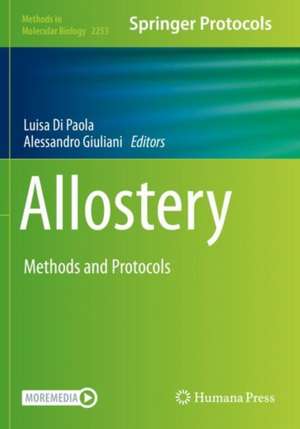
Allostery: Methods in Molecular Biology, cartea 2253
Editat de Luisa Di Paola, Alessandro Giulianien Limba Engleză Paperback – 16 dec 2021
Thorough and practical, Allostery: Methods and Protocols is a valuable resource for any scientists and researcher interested in learning more about this developing field.
Din seria Methods in Molecular Biology
- 5%
 Preț: 752.32 lei
 - 5%
 Preț: 753.38 lei
 - 5%
 Preț: 762.24 lei
 - 5%
 Preț: 767.04 lei
 - 15%
 Preț: 682.63 lei
 - 18%
 Preț: 1056.83 lei
 - 5%
 Preț: 756.75 lei
 - 18%
 Preț: 942.11 lei
 - 15%
 Preț: 683.53 lei
 - 15%
 Preț: 673.77 lei
 - 18%
 Preț: 1459.88 lei
 - 5%
 Preț: 762.94 lei
 - 18%
 Preț: 1001.24 lei
 - 15%
 Preț: 679.26 lei
 - 5%
 Preț: 759.52 lei
 - 18%
 Preț: 1014.54 lei
 - 5%
 Preț: 755.09 lei
 - 5%
 Preț: 760.91 lei
 - 18%
 Preț: 992.42 lei
 - 15%
 Preț: 672.54 lei
 - 5%
 Preț: 1087.05 lei
 - 18%
 Preț: 972.05 lei
 - 18%
 Preț: 2199.73 lei
 - 5%
 Preț: 1345.68 lei
 - 18%
 Preț: 1435.06 lei
 - 18%
 Preț: 1446.89 lei
 - 18%
 Preț: 1171.86 lei
 - 18%
 Preț: 1461.94 lei
 - 18%
 Preț: 1166.54 lei
 - 18%
 Preț: 1001.54 lei
 - 5%
 Preț: 1347.38 lei
 - 5%
 Preț: 1150.76 lei
 - 5%
 Preț: 755.42 lei
 - 18%
 Preț: 1160.38 lei
 - 18%
 Preț: 991.80 lei
 - 18%
 Preț: 1453.36 lei
 - 5%
 Preț: 1331.69 lei
 - 18%
 Preț: 1285.76 lei
 - 18%
 Preț: 1275.27 lei
 - 5%
 Preț: 1704.75 lei
 - 5%
 Preț: 1159.98 lei
 - 5%
 Preț: 1470.11 lei
 - 18%
 Preț: 771.93 lei
 - 5%
 Preț: 1674.66 lei
 - 18%
 Preț: 749.09 lei
 - 5%
 Preț: 1142.35 lei
 - 5%
 Preț: 1355.98 lei
 - 5%
 Preț: 1679.79 lei
 - 18%
 Preț: 786.39 lei
Preț: 698.09 lei
Preț vechi: 821.28 lei
-15%
Puncte Express: 1047
Carte tipărită la comandă
Livrare economică 27 noiembrie-11 decembrie
Livrare prin curier în România Termenul estimat este afișat lângă disponibilitate.
Transport gratuit pentru acest produs Plată online sau ramburs, în funcție de opțiunile comenzii.
Retur gratuit în 14 zile Comandă securizată și suport în română.
Specificații
ISBN-13: 9781071611562
ISBN-10: 1071611569
Pagini: 288
Ilustrații: XII, 274 p. 99 illus., 91 illus. in color.
Dimensiuni: 178 x 254 x 16 mm
Greutate: 0.55 kg
Ediția:1st ed. 2021
Editura: Springer
Colecția Methods in Molecular Biology
Seria Methods in Molecular Biology
Locul publicării:New York, NY, United States
ISBN-10: 1071611569
Pagini: 288
Ilustrații: XII, 274 p. 99 illus., 91 illus. in color.
Dimensiuni: 178 x 254 x 16 mm
Greutate: 0.55 kg
Ediția:1st ed. 2021
Editura: Springer
Colecția Methods in Molecular Biology
Seria Methods in Molecular Biology
Locul publicării:New York, NY, United States
Cuprins
Allostery: The Rebound of Proteins.- Disclosing Allostery Through Protein Contact Networks.- Identification of Allosteric Effects in Proteins by Elastic Network Models.- Locating and Navigating Energy Transport Networks in Proteins.- Probing Allosteric Mechanism with Long-Range Rigidity Transmission across Protein Networks.- Protein Assembly: Defining the Strength of Protein-Protein Interactions Coupling the Theory with Experiments.- Network Re-Wiring during Allostery and Protein-Protein Interactions: A Graph Spectral Approach.- Topology Results on Adjacent Amino Acid Networks of Oligomeric Proteins.- Community Network Analysis of Allosteric Proteins.- The PyInteraph Workflow for the Study of Interaction Networks Form Protein Structural Ensembles.- The Allosteric Effect in Antibody-Antigen Recognition.- Distal Regions Regulate Dihydrofolate Reductase-Ligand Interactions.- Investigating Conformational Dynamics and Allostery in the p53 DNA-Binding Domain Using Molecular Simulations.- Molecular Dynamics Simulation Techniques as a Tool in Drug Discovery and Pharmacology: A Focus on Allosteric Drugs.- Cooperativity and Allostery in RNA Systems.
Textul de pe ultima copertă
This volume explores the basic issues of “allostery” and “network” that are fundamental to studying this field. Chapters in this book look at how the basic “machine-like” proteins, that are similar to “human machines,” need to be organized, architecturally, to relate to different organizational layers. Chapters cover topics such as methodological/computational factors focused on links between allostery and network formalism; the presence of oscillating modes transversing the structure and underlying network wiring of the allosteric process; the “action at distance” by transduction of signals across an organized network structure; and the P53 protein located at the cross-road of cell cycle regulation, genome integrity, and cancer development. Written in the highly successful Methods in Molecular Biology series format, chapters include introductions to their respective topics, lists of the necessary materials and reagents, step-by-step, readily reproducible laboratory protocols, and tips on troubleshooting and avoiding known pitfalls.
Thorough and practical, Allostery: Methods and Protocols is a valuable resource for any scientists and researcher interested in learning more about this developing field.
Caracteristici
Includes cutting-edge methods and protocols Provides step-by-step detail essential for reproducible results Contains key notes and implementation advice from the experts