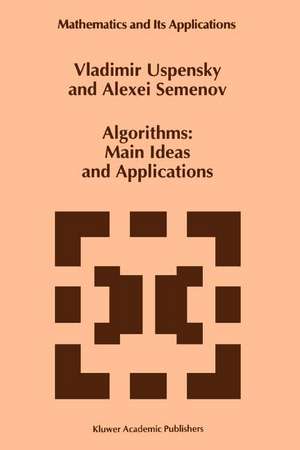
Algorithms: Main Ideas and Applications
Autor Vladimir Uspensky, A. L. Semenoven Limba Engleză Paperback – 7 dec 2010
Preț: 899.46 lei
Preț vechi: 1096.89 lei
-18%
Puncte Express: 1349
Carte tipărită la comandă
Livrare economică 18 noiembrie-02 decembrie
Livrare prin curier în România Termenul estimat este afișat lângă disponibilitate.
Transport gratuit pentru acest produs Plată online sau ramburs, în funcție de opțiunile comenzii.
Retur gratuit în 14 zile Comandă securizată și suport în română.
Specificații
ISBN-13: 9789048142569
ISBN-10: 9048142563
Pagini: 284
Ilustrații: XII, 270 p.
Dimensiuni: 155 x 235 x 16 mm
Greutate: 0.44 kg
Ediția:Softcover reprint of hardcover 1st ed. 1993
Editura: Springer
Locul publicării:Dordrecht, Netherlands
ISBN-10: 9048142563
Pagini: 284
Ilustrații: XII, 270 p.
Dimensiuni: 155 x 235 x 16 mm
Greutate: 0.44 kg
Ediția:Softcover reprint of hardcover 1st ed. 1993
Editura: Springer
Locul publicării:Dordrecht, Netherlands
V-ar putea interesa
-
 Simplicity TheoryByunghan Kim-31%Preț: 740.46 lei1080.15 lei
 -
 In Defence of Objective BayesianismJon Williamson-31%Preț: 692.16 lei1006.15 lei
 -
 The Nature of ComputationCristopher Moore-22%Preț: 640.29 lei819.12 lei
 -
 Category TheorySteve Awodey-21%Preț: 465.97 lei592.28 lei
 -
 Computability and RandomnessAndré Nies-21%Preț: 418.44 lei529.70 lei
 -
 A Course in Model TheoryBruno Poizat-15%Preț: 612.43 lei720.50 lei
 -
 Inductive LogicDov M. Gabbay-26%Preț: 1245.09 lei1677.70 lei
 -
 Lectures in Logic and Set TheoryGeorge TourlakisPreț: 438.01 lei
 -
 A Course in Model TheoryKatrin Tent-11%Preț: 520.25 lei584.55 lei
 -
 Lambda Calculus with TypesHenk Barendregt-11%Preț: 698.84 lei785.21 lei
 -
 Nonstandard Methods of AnalysisA. G. Kusraev-15%Preț: 632.28 lei743.86 lei
 -
 The Theory of Partial Algebraic OperationsE. S. Ljapin-15%Preț: 646.54 lei760.64 lei
 -
 Simple TheoriesFrank O. WagnerPreț: 405.57 lei
 -
 Intuition and the Axiomatic MethodEmily Carson-18%Preț: 943.24 lei1150.29 lei
 -
 Mathematical Logic for Computer ScienceMordechai Ben-Ari-20%Preț: 395.53 lei494.41 lei
 -
 The Joy of SetsKeith Devlin-15%Preț: 443.91 lei522.24 lei
 -
 Preț: 497.59 lei
 -
 Introducing InfinityBrian CleggPreț: 63.40 lei
 -
 Sets, Logic and CategoriesPeter J. CameronPreț: 280.57 lei
 -
 Lattice Theory: Special Topics and ApplicationsGeorge Grätzer-15%Preț: 656.38 lei772.20 lei
 -
 -15%Preț: 735.59 lei865.39 lei
 -
 The Theory of AlgorithmsA. A. Markov-18%Preț: 917.45 lei1118.84 lei
 -
 Foundational Theories of Classical and Constructive MathematicsGiovanni Sommaruga-15%Preț: 617.08 lei725.97 lei
 -
 Preț: 400.39 lei
 -
 -15%Preț: 620.68 lei730.21 lei
 -
 Likeness to TruthG. OddiePreț: 372.96 lei
Public țintă
ResearchCuprins
Notation and Terminology.- 1.0 Preliminary notions of the theory of algorithms: constructive objects and aggregates; local properties and local actions.- 1.1 The general notion of an algorithm as an independent (separate) concept.- 1.2 Representative computational models.- 1.3 The general notion of a calculus as an independent (separate) concept.- 1.4 Representative generating models.- 1.5 Interrelations between algorithms and calculuses.- 1.6 Time and Space as complexities of computation and generation.- 1.7 Computable functions and generable sets; decidable sets; enumerable sets.- 1.8 The concept of a ?-recursive function.- 1.9 Possibility of an arithmetical and even Diophantine representation of any enumerable set of natural numbers.- 1.10 Construction of an undecidable generable set.- 1.11 Post’s reducibility problem.- 1.12 The concept of a relative algorithm, or an oracle algorithm.- 1.13 The concept of a computable operation.- 1.14 The concept of a program; programs as objects of computation and generation.- 1.15 The concept of a numbering and the theory of numberings.- 1.16 First steps in the invariant, or machine-independent, theory of complexity of computations.- 1.17 The theory of complexity and entropy of constructive objects.- 1.18 Convenient computational models.- 2.1 Investigations of mass problems.- 2.2 Applications to the foundations of mathematics: constructive semantics.- 2.3 Applications to mathematical logic: formalized languages of logic and arithmetic.- 2.4 Computable analysis.- 2.5 Numbered structures.- 2.6 Applications to probability theory: definitions of a random sequence.- 2.7 Applications to information theory: the algorithmic approach to the concept of quantity of information.- 2.8 Complexity bounds for particular problems.- 2.9 Influenceof the theory of algorithms on algorithmic practice.- Appendix. Probabilistic Algorithms (How the Use of Randomness Makes Computations Shorter).- A.1 Preliminary remarks.- A.2 Main results.- A.3 Formal definitions.- References.- Author Index.