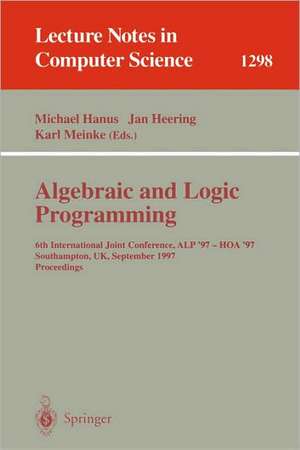
Algebraic and Logic Programming
Editat de Michael Hanus, Jan Heering, Karl Meinkeen Limba Engleză Paperback – 20 aug 1997
The 18 revised full papers presented in the book were selected from 31 submissions. The volume is divided in sections on functional and logic programming, higher-order methods, term rewriting, types, lambda-calculus, and theorem proving methods.
Preț: 331.75 lei
Preț vechi: 414.68 lei
-20%
Puncte Express: 498
Carte tipărită la comandă
Livrare economică 27 noiembrie-11 decembrie
Livrare prin curier în România Termenul estimat este afișat lângă disponibilitate.
Transport gratuit de la 400.00 lei Plată online sau ramburs, în funcție de opțiunile comenzii.
Retur gratuit în 14 zile Comandă securizată și suport în română.
Specificații
ISBN-13: 9783540634591
ISBN-10: 3540634592
Pagini: 308
Ilustrații: XI, 297 p.
Dimensiuni: 155 x 235 x 17 mm
Greutate: 0.47 kg
Ediția:1997
Editura: Springer
Locul publicării:Berlin, Heidelberg, Germany
ISBN-10: 3540634592
Pagini: 308
Ilustrații: XI, 297 p.
Dimensiuni: 155 x 235 x 17 mm
Greutate: 0.47 kg
Ediția:1997
Editura: Springer
Locul publicării:Berlin, Heidelberg, Germany
V-ar putea interesa
-
 The C++ Programming LanguageBjarne Stroustrup-20%Preț: 507.21 lei634.02 lei
 -
 -20%Preț: 320.55 lei400.68 lei
 -
 Programming with Motif™Keith D. Gregory-20%Preț: 644.13 lei805.17 lei
 -
 Hardware Description Languages and Their ApplicationsCarlos Delgado Kloos-20%Preț: 977.44 lei1221.81 lei
 -
 Python Programming for BiologyTim J. Stevens-20%Preț: 460.01 lei575.01 lei
 -
 Beginning Programming with C++ For DummiesStephen R. Davis-20%Preț: 173.62 lei217.02 lei
 -
 Pro ASP.NET Web API SecurityBadrinarayanan Lakshmiraghavan-20%Preț: 525.86 lei657.33 lei
 -
 -20%Preț: 230.97 lei288.71 lei
 -
 -20%Preț: 153.00 lei191.25 lei
 -
 Functional Programming in ScalaRunar Bjarnason-20%Preț: 340.60 lei425.75 lei
 -
 Python Programming for BeginnersJoseph Joyner-20%Preț: 53.61 lei67.02 lei
 -
 Murachs C# 2012Joel Murach-28%Preț: 359.74 lei496.79 lei
 -
 Declarative Programming and Knowledge ManagementMichael Hanus-20%Preț: 333.13 lei416.42 lei
 -
 -20%Preț: 336.31 lei420.38 lei
 -
 Higher-Order Algebra, Logic, and Term RewritingGilles Dowek-20%Preț: 335.24 lei419.05 lei
 -
 -20%Preț: 322.43 lei403.04 lei
 -
 -20%Preț: 333.13 lei416.42 lei
 -
 -20%Preț: 324.99 lei406.23 lei
 -
 -20%Preț: 321.81 lei402.26 lei
 -
 Implementation and Application of Functional LanguagesJurriaan Hage-20%Preț: 416.81 lei521.01 lei
 -
 -20%Preț: 402.28 lei502.84 lei
 -
 -20%Preț: 324.99 lei406.23 lei
Public țintă
ResearchCuprins
Safe folding/unfolding with conditional narrowing.- Optimal non-deterministic functional logic computations.- A semantic basis for termination analysis of logic programs and its realization using symbolic norm constraints.- Parallelizing functional programs by generalization.- Higher-order equational unification via explicit substitutions.- Parameterised higher-order algebraic specifications.- Higher-order lazy narrowing calculus: A computation model for a higher-order functional logic language.- On composable properties of term rewriting systems.- Needed reductions with context-sensitive rewriting.- Conditional term graph rewriting.- Lazy narrowing with parametric order sorted types.- Termination of algebraic type systems: The syntactic approach.- Proof net semantics of proof search computation.- Explicit substitutions for the ??-calculus.- A left-linear variant of ??.- Perpetuality and uniform normalization.- Model generation with existentially quantified variables and constraints.- Optimal left-to-right pattern-matching automata.