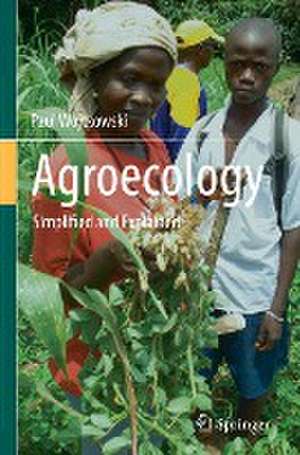
Agroecology: Simplified and Explained
Autor Paul Wojtkowskien Limba Engleză Hardback – 3 apr 2019
The book begins by comparing agroecology against conventional, monoculturally-based agriculture. In doing so, it defines the unique features of agroecology and their significance in achieving sustainable and environmentally-friendly agriculture. The book goes on to discuss the underlying technologies, the various manifestations of biodiversity, and the risk countermeasures associated with agroecology. This includes the farm landscape as a positive base for ecology, and how, if used well, it can produce major economic growth. The book concludes by summarizing the key findings, and assessing the macro-challenges facing agroecology.
Preț: 924.22 lei
Preț vechi: 1127.09 lei
-18%
Puncte Express: 1386
Carte disponibilă
Livrare economică 17-31 octombrie
Livrare prin curier în România Termenul estimat este afișat lângă disponibilitate.
Transport gratuit pentru acest produs Plată online sau ramburs, în funcție de opțiunile comenzii.
Retur gratuit în 14 zile Comandă securizată și suport în română.
Specificații
ISBN-13: 9783319932088
ISBN-10: 331993208X
Pagini: 327
Ilustrații: XVIII, 437 p. 117 illus., 90 illus. in color.
Dimensiuni: 155 x 235 mm
Greutate: 0.91 kg
Ediția:1st ed. 2019
Editura: Springer International Publishing
Colecția Springer
Locul publicării:Cham, Switzerland
ISBN-10: 331993208X
Pagini: 327
Ilustrații: XVIII, 437 p. 117 illus., 90 illus. in color.
Dimensiuni: 155 x 235 mm
Greutate: 0.91 kg
Ediția:1st ed. 2019
Editura: Springer International Publishing
Colecția Springer
Locul publicării:Cham, Switzerland
V-ar putea interesa
-
 Reflections On A Summer SeaTrevor NortonPreț: 113.94 lei
 -
 Ecological Paradigms Lost: Routes of Theory ChangeBeatrix Beisner-25%Preț: 481.91 lei638.43 lei
 -
 The Ecology of Wildlife DiseasesPeter Hudson-29%Preț: 523.41 lei732.94 lei
 -
 The Structure and Dynamics of Geographic RangesKevin J. Gaston-29%Preț: 450.69 lei630.58 lei
 -
 Metapopulation EcologyIlkka Hanski-28%Preț: 524.71 lei733.70 lei
 -
 -32%Preț: 525.60 lei778.30 lei
 -
 EcosystemsGordon DickinsonPreț: 460.32 lei
 -
 Integrat Ecol Evol Spatial ContJonathan Silvertown-11%Preț: 604.32 lei679.01 lei
 -
 EcologyJ. L. Chapman-19%Preț: 605.62 lei747.67 lei
 -
 Ecology of Desert RiversRichard Kingsford-14%Preț: 949.36 lei1103.91 lei
 -
 Stream EcologyJ David Allan-15%Preț: 665.96 lei783.48 lei
 -
 Artificial Reefs in Fisheries ManagementStephen A. Bortone-18%Preț: 1127.03 lei1374.42 lei
 -
 Handbook of Inland Aquatic Ecosystem ManagementSven Jorgensen-18%Preț: 1260.08 lei1536.68 lei
 -
 Handbook of Ecosystem Theories and ManagementFelix Muller-18%Preț: 2096.58 lei2556.81 lei
 -
 BIOS Instant Notes in EcologyAulay MacKenziePreț: 269.27 lei
 -
 Modelling Fluctuating PopulationsR. M. NisbetPreț: 384.75 lei
Cuprins
Chapter1: Introduction.- Chapter2: Agroecosystem Design.- Chapter3: The Agroecological Matrix.- Chapter4: Agrotechnologies.- Chapter 5: Productive Intercropping.- Chapter6: Feed Systems and Facilitative Intercrops.- Chapter7: Complex Agroecosystems.- Chapter8: Risk.- Chapter9: Landscape Agroecology.- Chapter10: Advanced Economics.- Chapter11: Macro-Challenges.- Chapter12: Summary
Notă biografică
Dr. Paul Wojtkowski is a writer, independent consultant, and an internationally recognized expert in land-use sciences (agriculture, forestry, and agroforestry). He has a Ph.D. in Forest Economics (University of Georgia, 1989). As an independent author, he has published eight books and several key articles on agroecology and agroforestry. Dr. Wojtkowski has extensive international experience. In presenting the problems, practicalities, best management practices found worldwide, he is able to provide singular insight into agroecology.
Textul de pe ultima copertă
This book presents the core elements that underwrite agroecology. Expressed across twelve chapters, the universality of the core is the essence of agroecology. This alone would be of interest to researchers, students, and academics. Furthermore, the book contains a long, detailed, and inclusive glossary that, with over 160 entries, elaborates on the topics presented. Included are recent developments as well as time-tested, traditional farm practices. The book also advances the theoretical base, fills gaps in the published research, and suggests future opportunities and future directions. The book is internationally oriented, presenting both temperate and tropical agriculture.
The book begins by comparing agroecology against conventional, monoculturally-based agriculture. In doing so, it defines the unique features of agroecology and their significance in achieving sustainable and environmentally-friendly agriculture. The book goes on to discuss the underlying technologies, the various manifestations of biodiversity, and the risk countermeasures associated with agroecology. This includes the farm landscape as a positive base for ecology, and how, if used well, it can produce major economic growth. The book concludes by summarizing the key findings, and assessing the macro-challenges facing agroecology.
The book begins by comparing agroecology against conventional, monoculturally-based agriculture. In doing so, it defines the unique features of agroecology and their significance in achieving sustainable and environmentally-friendly agriculture. The book goes on to discuss the underlying technologies, the various manifestations of biodiversity, and the risk countermeasures associated with agroecology. This includes the farm landscape as a positive base for ecology, and how, if used well, it can produce major economic growth. The book concludes by summarizing the key findings, and assessing the macro-challenges facing agroecology.
Caracteristici
Offers a complete reference source of the basics and core aspects of agroecology
Presents temperate and tropical agriculture, covering the totality of agroecology for an international audience
Written as a comprehensive resource for researchers, students and academics
Presents temperate and tropical agriculture, covering the totality of agroecology for an international audience
Written as a comprehensive resource for researchers, students and academics
Descriere
Descriere de la o altă ediție sau format:
Agroecology theory is not endless. A point is reached where the central elements become visible, equations distill, and a conceptual apex is reached. This is agroecology condensed into core concepts and theorems describing how crops relate to each other, the land, and their surroundings. This book covers advanced agroecology, including agroecological theory as well as applications of biodiversity that underwrite agroecology. Since much of agroecology theory is new, the resulting algorithms are equally novel, though presented so as to be useful and appreciated by less mathematically inclined professionals.
Agroecology theory is not endless. A point is reached where the central elements become visible, equations distill, and a conceptual apex is reached. This is agroecology condensed into core concepts and theorems describing how crops relate to each other, the land, and their surroundings. This book covers advanced agroecology, including agroecological theory as well as applications of biodiversity that underwrite agroecology. Since much of agroecology theory is new, the resulting algorithms are equally novel, though presented so as to be useful and appreciated by less mathematically inclined professionals.