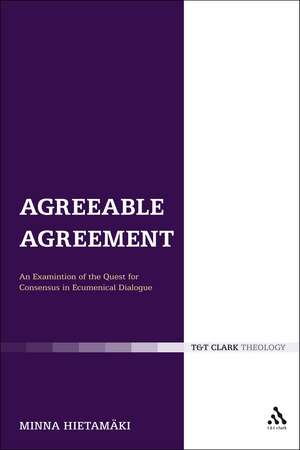
Agreeable Agreement: An Examination of the Quest for Consensus in Ecumenical Dialogue: Ecclesiological Investigations
Autor Dr Minna Hietamäkien Limba Engleză Hardback – 18 feb 2010
In recent bilateral ecumenical dialogue the aim of the dialogue has been to reach some form of doctrinal consensus. The three major chapters of the book discuss the variety of forms of doctrinal consensus found in ecumenical dialogues among Anglicans, Lutherans and Roman Catholics. In general, the dialogue documents argue for agreement/consensus based on commonality or compatibility.
Each of the three dialogue processes has specific characteristics and formulates its argument in a unique way. The Lutheran-Roman Catholic dialogue has a particular interest in hermeneutical questions and proposes various forms of "differentiated" or perspectival forms of consensus. The Anglican-Roman Catholic dialogue emphasises the correctness of interpretations. The documents consciously look towards a "common future", not the separated past.
Each of the three dialogue processes has specific characteristics and formulates its argument in a unique way. The Lutheran-Roman Catholic dialogue has a particular interest in hermeneutical questions and proposes various forms of "differentiated" or perspectival forms of consensus. The Anglican-Roman Catholic dialogue emphasises the correctness of interpretations. The documents consciously look towards a "common future", not the separated past.
Din seria Ecclesiological Investigations
- 25%
 Preț: 1025.27 lei
 - 25%
 Preț: 960.08 lei
 - 25%
 Preț: 1024.84 lei
 -
 Preț: 277.08 lei
 - 27%
 Preț: 977.33 lei
 - 25%
 Preț: 275.79 lei
 - 24%
 Preț: 213.41 lei
 - 15%
 Preț: 279.55 lei
 - 25%
 Preț: 283.01 lei
 -
 Preț: 186.51 lei
 - 25%
 Preț: 277.79 lei
 - 17%
 Preț: 215.41 lei
 - 16%
 Preț: 282.53 lei
 - 25%
 Preț: 278.18 lei
 - 25%
 Preț: 276.19 lei
 -
 Preț: 285.85 lei
 - 15%
 Preț: 279.48 lei
 - 25%
 Preț: 257.24 lei
 - 24%
 Preț: 266.06 lei
 - 25%
 Preț: 266.99 lei
 - 15%
 Preț: 281.31 lei
 - 24%
 Preț: 284.75 lei
 - 27%
 Preț: 278.37 lei
 -
 Preț: 283.24 lei
Preț: 1042.67 lei
Preț vechi: 1212.41 lei
-14%
Puncte Express: 1564
Carte tipărită la comandă
Livrare economică 07-21 decembrie
Livrare prin curier în România Termenul estimat este afișat lângă disponibilitate.
Transport gratuit pentru acest produs Plată online sau ramburs, în funcție de opțiunile comenzii.
Retur gratuit în 14 zile Comandă securizată și suport în română.
Specificații
ISBN-13: 9780567607188
ISBN-10: 0567607186
Pagini: 272
Dimensiuni: 156 x 234 x 19 mm
Greutate: 0.56 kg
Ediția:New.
Editura: Bloomsbury Publishing
Colecția T&T Clark
Seria Ecclesiological Investigations
Locul publicării:London, United Kingdom
ISBN-10: 0567607186
Pagini: 272
Dimensiuni: 156 x 234 x 19 mm
Greutate: 0.56 kg
Ediția:New.
Editura: Bloomsbury Publishing
Colecția T&T Clark
Seria Ecclesiological Investigations
Locul publicării:London, United Kingdom
V-ar putea interesa
-
 Preț: 78.50 lei
 -
 Scripture and the Authority of GodN T WrightPreț: 99.67 lei
 -
 The Transmission of Sin: Augustine and the Pre-Augustinian SourcesPier Franco Beatrice-33%Preț: 717.87 lei1072.53 lei
 -
 Canonizing Paul: Ancient Editorial Practice and the Corpus PaulinumEric W. Scherbenske-31%Preț: 695.95 lei1008.45 lei
 -
 Lives of the Improbable SaintsRichard ColesPreț: 70.90 lei
 -
 The Book of EnochPaula GooderPreț: 83.51 lei
 -
 Immortal DiamondRichard RohrPreț: 99.08 lei
 -
 Handbook for Today's CatholicA Redemptorist Pastoral PublicationPreț: 45.54 lei
 -
 The Resurrection of the Son of GodN T Wright-8%Preț: 420.30 lei456.85 lei
 -
 Resounding Truth - Christian Wisdom in the World of MusicJeremy S. BegbiePreț: 216.29 lei
 -
 After Our LikenessMiroslav VolfPreț: 234.24 lei
 -
 Calvin's LadderJulie CanlisPreț: 208.64 lei
 -
 Preț: 133.68 lei
 -
 Spiritual TheologySimon ChanPreț: 212.83 lei
 -
 Where is That in the Bible?Patrick MadridPreț: 95.97 lei
 -
 Preț: 166.70 lei
 -
 Rice's Church PrimerMatthew Rice-24%Preț: 104.57 lei138.24 lei
 -
 Bad ReligionRoss DouthatPreț: 112.59 lei
 -
 Preț: 111.07 lei
Cuprins
Introduction
1. Consensus as an Ecumenical Challenge: Scope of the Concept and Relevance of the Study
2. Sources: Documents from Bilateral Dialogues
3. The Context and Scope of the Study
II Lutheran-Roman Catholic Dialogue
4. International Dialogue
5. National Dialogues: North America, Germany
6. Consensus with Difference
III. Anglican-Roman Catholic Dialogue
7. International Dialogue ARCIC
IV. Anglican-Lutheran Dialogue
8. International Dialogue
9. Episcopal-Lutheran Dialogue in the USA
10. Regional Dialogues: Meißen Statement, Porvoo Statement
V. The Possibility of Consensuc: A Synthesis
11. Harvesting the Results: Consensus in Bilateral Dialogue
12. Consensus: An Unattainable Ideal or a Reachable Goal? The Continuing Debate
Conclusion
Bibliography
Recenzii
'Minna Hietamäki provides a solid analysis of the ecumenical dialogues between Anglicans, Catholics and Lutherans, connecting it with the ongoing critical discussion on the value of the so-called "consensus ecumenism". While most ecumenical theologians are strong either in theological theory or ecclesial practice, Hietamäki masters both fields. She defends consensus ecumenism but considers that the arguments of its critics should be taken very seriously. Her work deserves, therefore, to be read by all parties involved in current ecumenism and systematic theology.' - Risto Saarinen, University of Helsinki, Finland
'In her remarkable first book, Faith and Order Commissioner Dr Minna Hietamäki poses serious yet timely challenges to the churches and their theologians engaged in ecumenical dialogue. By her analysis of the current (and at times uncritical) uses of the word "consensus" and associated terms such as agreement, convergence, consonance, and the (con)sensus fidelium, Dr Hietamäki offers profound yet realistic insights into the nature and purpose ecumenical dialogue and consensus ecumenism. As such, I consider her book to be a "prequel" to recent work on Ecumenical Reception. Her insights into the tripartite dialogues between Lutherans, Anglicans, and Roman Catholics are applicable to any bilateral dialogue, as well as to multilateral forum of Faith and Order.' - John Gibaut, Director of Faith and Order, World Council of Churches, Geneva, Switzerland
'In her very informative and challenging study, Hietamäki brings together for the first time on the one hand a thorough analysis of three long-time bilateral dialogues asking how they understand "consensus" or "agreement" and how they attempt to achieve them, and, on the other hand, an analysis of theoretical reflections on "consensus" in contemporary philosophy and theology. Thus she is able to raise important questions in a fresh way, to identify weaknesses and strengths, conceptual and methodological shortcomings or achievements in particular approaches. Ecumenical theology and work should take this study seriously, even if one does not agree with all of its findings.' - Theodor Dieter, Institute for Ecumenical Research, Strasbourg, France
'In her remarkable first book, Faith and Order Commissioner Dr Minna Hietamäki poses serious yet timely challenges to the churches and their theologians engaged in ecumenical dialogue. By her analysis of the current (and at times uncritical) uses of the word "consensus" and associated terms such as agreement, convergence, consonance, and the (con)sensus fidelium, Dr Hietamäki offers profound yet realistic insights into the nature and purpose ecumenical dialogue and consensus ecumenism. As such, I consider her book to be a "prequel" to recent work on Ecumenical Reception. Her insights into the tripartite dialogues between Lutherans, Anglicans, and Roman Catholics are applicable to any bilateral dialogue, as well as to multilateral forum of Faith and Order.' - John Gibaut, Director of Faith and Order, World Council of Churches, Geneva, Switzerland
'In her very informative and challenging study, Hietamäki brings together for the first time on the one hand a thorough analysis of three long-time bilateral dialogues asking how they understand "consensus" or "agreement" and how they attempt to achieve them, and, on the other hand, an analysis of theoretical reflections on "consensus" in contemporary philosophy and theology. Thus she is able to raise important questions in a fresh way, to identify weaknesses and strengths, conceptual and methodological shortcomings or achievements in particular approaches. Ecumenical theology and work should take this study seriously, even if one does not agree with all of its findings.' - Theodor Dieter, Institute for Ecumenical Research, Strasbourg, France
Notă biografică
Minna Hietamäki received her PhD from the University of Helsinki, Finland, where she currently teaches.