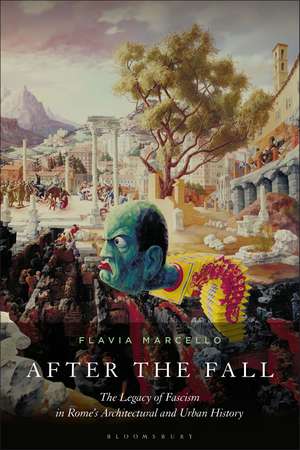
After the Fall: The Legacy of Fascism in Rome's Architectural and Urban History
Autor Flavia Marcelloen Limba Engleză Paperback – 25 ian 2024
Italy's fascist period (1922-1943) is perhaps the least-understood episode of Rome's architectural history. Yet paradoxically those two decades have, arguably more than any other, defined our contemporary view of Rome's world-famous ancient, Renaissance, and Baroque urban landscapes. The book examines the ways in which the fascist regime sought to remake Rome according to its own vision of the past, and surveys the afterlife of Mussolini's architectural and urban projects, from the Roman Masterplan to the Foro Italico. Internationally, there is currently much debate on the controversial status of public monuments - their abandonment, defacement, re-integration or removal - and, as After the Fall demonstrates, Rome provides a rich setting in which to examine these topical, pressing questions.
Adding a new chapter to the architectural history of Rome, this fascinating history brings architecture, politics, and art together as living, contested experiences in a host of different locations around contemporary Rome.
Preț: 184.32 lei
Preț vechi: 242.24 lei
-24%
Puncte Express: 276
Carte disponibilă
Livrare economică 28 octombrie-11 noiembrie
Livrare express 13-17 octombrie pentru 96.35 lei
Livrare prin curier în România Termenul estimat este afișat lângă disponibilitate.
Transport gratuit de la 400.00 lei Plată online sau ramburs, în funcție de opțiunile comenzii.
Retur gratuit în 14 zile Comandă securizată și suport în română.
Specificații
ISBN-13: 9781350120587
ISBN-10: 1350120588
Pagini: 256
Ilustrații: 72 bw illus
Dimensiuni: 156 x 232 x 18 mm
Greutate: 0.58 kg
Editura: Bloomsbury Publishing
Colecția Bloomsbury Visual Arts
Locul publicării:London, United Kingdom
ISBN-10: 1350120588
Pagini: 256
Ilustrații: 72 bw illus
Dimensiuni: 156 x 232 x 18 mm
Greutate: 0.58 kg
Editura: Bloomsbury Publishing
Colecția Bloomsbury Visual Arts
Locul publicării:London, United Kingdom
V-ar putea interesa
-
 Italy RebornMark GilbertPreț: 106.98 lei
 -
 The Eternal City: A History of Rome in MapsJessica MaierPreț: 391.30 lei
 -
 Fascism: The History of a WordFederico MarconPreț: 243.15 lei
 -
 Aureli, P: POSSIBILITY OF AN ABSOLUTE ARCPier Vittorio AureliPreț: 197.87 lei
 -
 The Image of the CityKevin LynchPreț: 275.76 lei
 -
 Iconic Fascism: The Excess of Destruction and Creation in Interwar Radical Right-Wing PoliticsProfessor Aristotle Kallis-32%Preț: 551.93 lei816.78 lei
 -
 Fashion under Fascism: Beyond the Black ShirtProfessor Eugenia Paulicelli-15%Preț: 214.84 lei253.76 lei
 -
 -35%Preț: 70.77 lei108.51 lei
 -
 Furnishing Fascism: Modernist Design and Politics in ItalyIgnacio G. GalánPreț: 249.55 lei
 -
 Brutalist ItalyRoberto Conte-24%Preț: 159.11 lei208.01 lei
 -
 Fascist Italy at WarThomas X. Ferenczi-15%Preț: 193.35 lei226.98 lei
 -
 Up in the AirHolly SmithPreț: 151.38 lei
 -
 Preț: 223.51 lei
 -
 RomeGiovanni Fanelli-8%Preț: 462.36 lei502.56 lei
 -
 Vincenzo Paglicua - BunkerSteve BissonPreț: 304.58 lei
 -
 Brutalia: Build Your Own Brutalist ItalyZupagrafika-24%Preț: 167.53 lei220.09 lei
 -
 A Difficult HeritageCarmen BelmontePreț: 338.59 lei
 -
 RomeIlia CelientoPreț: 128.11 lei
 -
 The Frescoed Façade in Renaissance Roman Visual CultureAlexis Culotta-9%Preț: 677.54 lei744.55 lei
Cuprins
List of Figures
Acknowledgements
Note on Terms and Acronyms
Chapter 1: Introduction
Chapter 2: Mussolini's Mark: Tracing the Legacy of Fascism in Rome's Post-war Urban Planning
Chapter 3: The Architecture of Fascist Rome between Politics and Practicality
Chapter 4: The Fascist Phoenix: Virgilio Testa and the Resurrection of EUR
Chapter 5: Mothers, Martyrs and Military Men: The Changing Meanings of Rome's Fascist Monuments
Chapter 6: Aspirations and Illusions of Control: Re-contextualising Rome's Fascist Epigraphy
A Conclusion for a Centenary
Bibliography
Index
Acknowledgements
Note on Terms and Acronyms
Chapter 1: Introduction
Chapter 2: Mussolini's Mark: Tracing the Legacy of Fascism in Rome's Post-war Urban Planning
Chapter 3: The Architecture of Fascist Rome between Politics and Practicality
Chapter 4: The Fascist Phoenix: Virgilio Testa and the Resurrection of EUR
Chapter 5: Mothers, Martyrs and Military Men: The Changing Meanings of Rome's Fascist Monuments
Chapter 6: Aspirations and Illusions of Control: Re-contextualising Rome's Fascist Epigraphy
A Conclusion for a Centenary
Bibliography
Index
Recenzii
This book is not only a rich compendium of case studies of difficult heritage but also a significant contribution to an understanding of postwar architectural culture. Peeling back and reconstructing layers of meaning associated with key works of the Fascist Regime in Rome, the book will make the city more comprehensible and richer in historical associations. Flavia Marcello has illuminated this study with a humanist understanding that would not have been possible a few years ago.
After the Fall provides a detailed account of how key sites of fascist Rome have evolved and endured in the last century. Comprised of concise encyclopedic entries on monuments, buildings and sites, it will be a useful guide for all those interested in what has become of fascist Rome.
Flavia Marcello's absorbing and richly detailed book explores the ongoing impact of Fascism and Italy's evolving relationship to its history on Rome's urban development and built environment. It will be invaluable reading for anyone with an interest in Rome's historical and contemporary urban topography or in Italy's complex and contested relationship with its Fascist past.
After the Fall illuminates a fascinating history . [F]or architects, academics, students, and other travellers to Rome, this book is a useful reference that provides a deeper understanding of Fascist era sites that are commonly experienced but rarely fully appreciated.
After the Fall provides a detailed account of how key sites of fascist Rome have evolved and endured in the last century. Comprised of concise encyclopedic entries on monuments, buildings and sites, it will be a useful guide for all those interested in what has become of fascist Rome.
Flavia Marcello's absorbing and richly detailed book explores the ongoing impact of Fascism and Italy's evolving relationship to its history on Rome's urban development and built environment. It will be invaluable reading for anyone with an interest in Rome's historical and contemporary urban topography or in Italy's complex and contested relationship with its Fascist past.
After the Fall illuminates a fascinating history . [F]or architects, academics, students, and other travellers to Rome, this book is a useful reference that provides a deeper understanding of Fascist era sites that are commonly experienced but rarely fully appreciated.