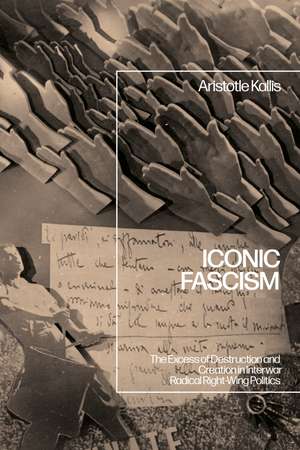
Iconic Fascism: The Excess of Destruction and Creation in Interwar Radical Right-Wing Politics
Autor Professor Aristotle Kallisen Limba Engleză Hardback – 19 mar 2026
Preț: 551.93 lei
Preț vechi: 816.78 lei
-32%
Puncte Express: 828
Carte disponibilă
Livrare economică 28 octombrie-11 noiembrie
Livrare prin curier în România Termenul estimat este afișat lângă disponibilitate.
Transport gratuit pentru acest produs Plată online sau ramburs, în funcție de opțiunile comenzii.
Retur gratuit în 14 zile Comandă securizată și suport în română.
Specificații
ISBN-13: 9781350169074
ISBN-10: 1350169072
Pagini: 272
Ilustrații: 27 bw illus
Dimensiuni: 160 x 236 x 20 mm
Greutate: 0.54 kg
Editura: Bloomsbury Publishing
Colecția Bloomsbury Academic
Locul publicării:London, United Kingdom
ISBN-10: 1350169072
Pagini: 272
Ilustrații: 27 bw illus
Dimensiuni: 160 x 236 x 20 mm
Greutate: 0.54 kg
Editura: Bloomsbury Publishing
Colecția Bloomsbury Academic
Locul publicării:London, United Kingdom
Cuprins
List of Illustrations
Introduction
1. Fascism, Destructive Creation, Violence
2. The Construction of the False Gods
3. The Production of the Icon
4. Fascist Violence between Performance and Efficiency
5. Iconoclasm from below and from above
6. From Icon-Destruction to Icon-Production
Conclusions
Bibliography
Index
Introduction
1. Fascism, Destructive Creation, Violence
2. The Construction of the False Gods
3. The Production of the Icon
4. Fascist Violence between Performance and Efficiency
5. Iconoclasm from below and from above
6. From Icon-Destruction to Icon-Production
Conclusions
Bibliography
Index
Recenzii
This book makes a very positive contribution to the literature on fascism and tackles this much-written about topic from a fresh and interesting angle. Cogent and convincing in its argument, original in its interpretations, and carefully crafted and sophisticated in its style, Aristotle Kallis has produced an excellent monograph.
In a world where "fascism" is constantly trivialized by application to any form of unpalatable form of authoritarianism, reading Iconic Fascism is a salutary and sobering experience. This scholarly but highly accessible book confronts the human catastrophes unleashed two generations ago by an ideology that makes the systematic destruction of demonized human lives and their habitats the precondition for making a nation "great again". In doing so it should help dispel the widespread tendency to confuse even radical right-wing populism's more appalling perversions of democracy with the "real thing".
In a world where "fascism" is constantly trivialized by application to any form of unpalatable form of authoritarianism, reading Iconic Fascism is a salutary and sobering experience. This scholarly but highly accessible book confronts the human catastrophes unleashed two generations ago by an ideology that makes the systematic destruction of demonized human lives and their habitats the precondition for making a nation "great again". In doing so it should help dispel the widespread tendency to confuse even radical right-wing populism's more appalling perversions of democracy with the "real thing".