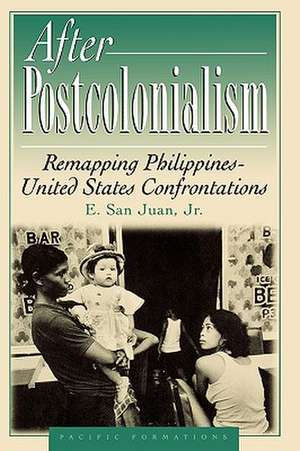
After Postcolonialism: Remapping PhilippinesDUnited States Confrontations: Pacific Formations: Global Relations in Asian and Pacific Perspectives
Autor E. San Juan Jr.en Limba Engleză Paperback – 24 mai 2000


Preț: 322.87 lei
Preț vechi: 398.63 lei
-19%
Puncte Express: 484
Carte tipărită la comandă
Livrare economică 23 noiembrie-07 decembrie
Livrare prin curier în România Termenul estimat este afișat lângă disponibilitate.
Transport gratuit de la 400.00 lei Plată online sau ramburs, în funcție de opțiunile comenzii.
Retur gratuit în 14 zile Comandă securizată și suport în română.
Specificații
ISBN-13: 9780847698615
ISBN-10: 0847698610
Pagini: 272
Dimensiuni: 149 x 227 x 15 mm
Greutate: 0.4 kg
Editura: Bloomsbury Publishing
Colecția Rowman & Littlefield
Seria Pacific Formations: Global Relations in Asian and Pacific Perspectives
Locul publicării:New York, United States
ISBN-10: 0847698610
Pagini: 272
Dimensiuni: 149 x 227 x 15 mm
Greutate: 0.4 kg
Editura: Bloomsbury Publishing
Colecția Rowman & Littlefield
Seria Pacific Formations: Global Relations in Asian and Pacific Perspectives
Locul publicării:New York, United States
V-ar putea interesa
-
 -13%Preț: 249.93 lei287.27 lei
 -
 Affirmative Action in Plural SocietiesFrances StewartPreț: 394.88 lei
 -
 -31%Preț: 570.45 lei824.15 lei
 -
 -26%Preț: 642.21 lei872.64 lei
 -
 -27%Preț: 1000.19 lei1362.87 lei
 -
 Being ArabSamir KassirPreț: 94.11 lei
 -
 -19%Preț: 143.32 lei176.36 lei
Cuprins
Chapter 1 Introduction
Chapter 2 Symbolic Trajectories of the Asian Diaspora
Chapter 3 Historicizing the Space of Asian America
Chapter 4 Specters of United States Imperialism
Chapter 5 From Neocolonial Representations to National-Democratic Allegory
Chapter 6 Displacing Borders of Misrecognition: On Jessica Hagedorn's Fictions
Chapter 7 Kidlat Tahimik's Cinema of the Naïve Subaltern
Chapter 8 Prospects and Problems of Revolutionary Transformation
Chapter 9 Afterword
Chapter 10 Appendix: Writing and the Asian Diaspora
Chapter 2 Symbolic Trajectories of the Asian Diaspora
Chapter 3 Historicizing the Space of Asian America
Chapter 4 Specters of United States Imperialism
Chapter 5 From Neocolonial Representations to National-Democratic Allegory
Chapter 6 Displacing Borders of Misrecognition: On Jessica Hagedorn's Fictions
Chapter 7 Kidlat Tahimik's Cinema of the Naïve Subaltern
Chapter 8 Prospects and Problems of Revolutionary Transformation
Chapter 9 Afterword
Chapter 10 Appendix: Writing and the Asian Diaspora
Recenzii
With his usual hardhitting candor and penetrating insight, E. San Juan, Jr., invites readers to join him in a post-postcolonial interrogation of the Philippine 'problematique' within the context of both American imperialism studies and Asian American studies. To be sure, The Filipino in the United States is a concrete historical phenomenon, but becoming Filipino in the Diaspora continues to be a process of dialectical struggle.
This is a great book, full of life and passion, conviction and commitment-all built upon a bedrock of solid literary, cultural, historical, and political analysis. This will be regarded, I believe, as possibly his very best work.
This collection is an indispensable part of Philippine studies.
In one of the most thoroug, hard-hitting, perspicacious analyses on the subject, San Juan dismantels the myths surrounding US-Philippine relations and lays bare the harsh realities US imperialism has wrought on its former "showcase of democracy".
In this trenchant survey of both the historyand contemporary status of relations between the Philippines and the United States, E. San Juan.display[s] his talent for provocative analysis.
It is critical to lay bare the reality of the Diaspora experience through the prism of those who have the skills to articulate it. San Juan gives this expression throughout with a powerful critique of Eurocentric universalism and the myths of multiculturalism. He has provided a provocative analysis of how the fashionable liberal vocabulary of transnationalism has obfuscated what in reality are modes of domination. San Juan's optic is unique, placing him alone at the cutting edge of a progressive counter attack against the orthodoxy of the academy.
One of the most thorough, hard-hitting, perspicaious analyses on the subject.
This book is a must read for Philippine specialists as well as specialists of Asian-American affairs.
This is a great book, full of life and passion, conviction and commitment-all built upon a bedrock of solid literary, cultural, historical, and political analysis. This will be regarded, I believe, as possibly his very best work.
This collection is an indispensable part of Philippine studies.
In one of the most thoroug, hard-hitting, perspicacious analyses on the subject, San Juan dismantels the myths surrounding US-Philippine relations and lays bare the harsh realities US imperialism has wrought on its former "showcase of democracy".
In this trenchant survey of both the historyand contemporary status of relations between the Philippines and the United States, E. San Juan.display[s] his talent for provocative analysis.
It is critical to lay bare the reality of the Diaspora experience through the prism of those who have the skills to articulate it. San Juan gives this expression throughout with a powerful critique of Eurocentric universalism and the myths of multiculturalism. He has provided a provocative analysis of how the fashionable liberal vocabulary of transnationalism has obfuscated what in reality are modes of domination. San Juan's optic is unique, placing him alone at the cutting edge of a progressive counter attack against the orthodoxy of the academy.
One of the most thorough, hard-hitting, perspicaious analyses on the subject.
This book is a must read for Philippine specialists as well as specialists of Asian-American affairs.