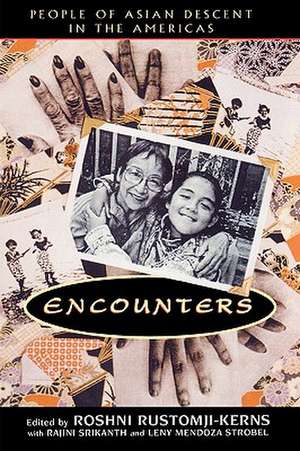
Encounters: People of Asian Descent in the Americas: Pacific Formations: Global Relations in Asian and Pacific Perspectives
Editat de Roshni Rustomji-Kerns, Rajini Srikanth, Leny Mendoza Strobelen Limba Engleză Paperback – iul 1999
Contributions by: Kozy K. Amemiya, Himani Bannerji, Monica Cinco Basurto, Raissa Nina Burns, Jeff Chang, Jay Chaudhari, Kathryn Jeun Cho, Rienzi Crusz, Astrid Hadad, Laura Hall, Muriel H. Hasbun, Tomoyo Hiroishi, Velina Hasu Houston, Evelyn Hu-DeHart, Naheed Islam, Feroza Jussawalla, Nguyet Lam, Armando Siu Lau, Stephanie Li, R. Zamora Linmark, Sunaina Maira, Diane Monroe, Ofelia Murrieta, Luis Nishizawa, Dwight Okita, Gary Pak, Monica J. Rainwater, Aly Remtulla, Roshni Rustomji-Kerns, Ann Suni Shin, Jan Lo Shinebourne, Janet Shirley, Lok C. D. Siu, Rajini Srikanth, Leny Mendoza Strobel, Eileen Tabios, Ayumi Takenaka, Gabriela Kinuyo Torres, Kay Reiko Torres, Takeyuki Tsuda, Usha Welaratna, Bill Woo, Karen Tei Yamashita, and Thomas Sze Leong Yu.


Preț: 372.66 lei
Preț vechi: 552.19 lei
-33%
Puncte Express: 559
Carte tipărită la comandă
Livrare economică 23 noiembrie-07 decembrie
Livrare prin curier în România Termenul estimat este afișat lângă disponibilitate.
Transport gratuit de la 400.00 lei Plată online sau ramburs, în funcție de opțiunile comenzii.
Retur gratuit în 14 zile Comandă securizată și suport în română.
Specificații
ISBN-13: 9780847691456
ISBN-10: 0847691454
Pagini: 320
Dimensiuni: 146 x 226 x 22 mm
Greutate: 0.41 kg
Ediția:0320
Editura: Bloomsbury Publishing
Colecția Rowman & Littlefield
Seria Pacific Formations: Global Relations in Asian and Pacific Perspectives
Locul publicării:New York, United States
ISBN-10: 0847691454
Pagini: 320
Dimensiuni: 146 x 226 x 22 mm
Greutate: 0.41 kg
Ediția:0320
Editura: Bloomsbury Publishing
Colecția Rowman & Littlefield
Seria Pacific Formations: Global Relations in Asian and Pacific Perspectives
Locul publicării:New York, United States
V-ar putea interesa
-
 Human Rights, Human Wrongs: Oxford Amnesty Lectures 2001Nicholas Owen-16%Preț: 200.77 lei240.14 lei
 -
 Globalizing Rights: The Oxford Amnesty Lectures 1999Matthew J. Gibney-17%Preț: 199.07 lei239.19 lei
 -
 Mill on LibertyC. L. Ten-27%Preț: 345.72 lei474.67 lei
 -
 Citizenship in Diverse SocietiesWill Kymlicka-28%Preț: 351.54 lei485.59 lei
 -
 Citizenship and Immigration in Postwar BritainRandall Hansen-33%Preț: 708.47 lei1052.77 lei
 -
 The Handbook of ReparationsPablo De Greiff-32%Preț: 731.30 lei1067.66 lei
 -
 Gender and Justice in Multicultural Liberal StatesMonique Deveaux-20%Preț: 296.44 lei371.91 lei
 -
 -11%Preț: 384.37 lei432.51 lei
 -
 -11%Preț: 352.82 lei397.71 lei
 -
 -31%Preț: 662.60 lei961.14 lei
 -
 -12%Preț: 292.29 lei333.53 lei
 -
 Genealogies of CitizenshipMargaret R. SomersPreț: 216.27 lei
 -
 Active CitizenshipBernard Crick-17%Preț: 172.48 lei208.61 lei
 -
 -45%Preț: 81.86 lei148.80 lei
 -
 Race and RemembranceArthur L JohnsonPreț: 187.28 lei
 -
 In the Land of CottonMartha A. TaylorPreț: 127.48 lei
 -
 Down with PowerL. Neil SmithPreț: 189.93 lei
Cuprins
Introduction
Part I: In Search of My Ombligo: Locating the Family
Chapter 1: China in Mexico: Yesterday's Encounter and Today's Discovery
Chapter 2: Con Tacto
Chapter 3: Sophie's Conflicts
Chapter 4: The Boy under the Bridge
Chapter 5: In Search of My Ombligo
Chapter 6: We Sail across Memories
Chapter 7: Lessons from the Field: Being Chinese American in Panama
Chapter 8: La Búsquedad de la Identidad-In Search of an Identity
Chapter 9: American Dreams: An Original Play
Chapter 10: A Portrait of the Poet: Small-Kid Time
Chapter 11: Where Are You Now?
Chapter 12: The President's Palace
Chapter 13: Dreaming All the Way Home
Part II: The Politics of the Cool: Locating Community
Chapter 14: Race Construction and Race Relations: Chinese and Blacks in Nineteenth Century Cuba
Chapter 15: Japanese Peruvians and Their Ethnic Encounters
Chapter 16: The Great Day for Arlen
Chapter 17: Land, Culture, and the Power of Money: Assimilation and Resistance of Okinawan Immigrants in Bolivia
Chapter 18: Spanish
Chapter 19: Chattanooga Days
Chapter 20: On Ice Cube's "Black Korea"
Chapter 21: Trial and Error: Representations of a Recent Past
Chapter 22: The Politics of the Cool: Indian American Youth Culture in New York City
Chapter 23: The Story of the Double R
Chapter 24: Luis Nishizawa: Portrait of a Nisei Artist
Chapter 25: Ethnic Preferences: The Positive Minority
Chapter 26: Phuri Sherpa: Nepal and Mexico in California
Part III: Volcán de Izalco, Amén: Locating the Body and the Land
Chapter 27: Notes for a Poem on Being Asian American
Chapter 28: Santos y Sombras
Chapter 29: Never Look Down in Chinatown
Chapter 30: Race Markers Transgressors: Mapping a Racial Kaleidoscope within an (Im)migrant Landscape
Chapter 31: Upon Hearing Beverly Glen Copeland
Chapter 32: Paki Go Home
Chapter 33: Soho, Southhall, Brixton; Chinatown in New York
Chapter 34: Archipelago
Chapter 35: De Oro
Chapter 36: Queen Mariachi
Chapter 37: My Homes
Chapter 38: Despeinados
Chapter 39: The Valley of Dead Air
Chapter 40: Self-Portrait Dressed as a Mexican
Chapter 41: La Nina del Robozo
Chapter 42: Her Body: A Stage, an Altar
Chapter 43: Hotel Room (Mayaro, Trinidad)
Chapter 44: Mayaro Sea-Sculpture
Chapter 45: The Interview
Chapter 46: Ganesh
Chapter 47: When Nana Died
Part I: In Search of My Ombligo: Locating the Family
Chapter 1: China in Mexico: Yesterday's Encounter and Today's Discovery
Chapter 2: Con Tacto
Chapter 3: Sophie's Conflicts
Chapter 4: The Boy under the Bridge
Chapter 5: In Search of My Ombligo
Chapter 6: We Sail across Memories
Chapter 7: Lessons from the Field: Being Chinese American in Panama
Chapter 8: La Búsquedad de la Identidad-In Search of an Identity
Chapter 9: American Dreams: An Original Play
Chapter 10: A Portrait of the Poet: Small-Kid Time
Chapter 11: Where Are You Now?
Chapter 12: The President's Palace
Chapter 13: Dreaming All the Way Home
Part II: The Politics of the Cool: Locating Community
Chapter 14: Race Construction and Race Relations: Chinese and Blacks in Nineteenth Century Cuba
Chapter 15: Japanese Peruvians and Their Ethnic Encounters
Chapter 16: The Great Day for Arlen
Chapter 17: Land, Culture, and the Power of Money: Assimilation and Resistance of Okinawan Immigrants in Bolivia
Chapter 18: Spanish
Chapter 19: Chattanooga Days
Chapter 20: On Ice Cube's "Black Korea"
Chapter 21: Trial and Error: Representations of a Recent Past
Chapter 22: The Politics of the Cool: Indian American Youth Culture in New York City
Chapter 23: The Story of the Double R
Chapter 24: Luis Nishizawa: Portrait of a Nisei Artist
Chapter 25: Ethnic Preferences: The Positive Minority
Chapter 26: Phuri Sherpa: Nepal and Mexico in California
Part III: Volcán de Izalco, Amén: Locating the Body and the Land
Chapter 27: Notes for a Poem on Being Asian American
Chapter 28: Santos y Sombras
Chapter 29: Never Look Down in Chinatown
Chapter 30: Race Markers Transgressors: Mapping a Racial Kaleidoscope within an (Im)migrant Landscape
Chapter 31: Upon Hearing Beverly Glen Copeland
Chapter 32: Paki Go Home
Chapter 33: Soho, Southhall, Brixton; Chinatown in New York
Chapter 34: Archipelago
Chapter 35: De Oro
Chapter 36: Queen Mariachi
Chapter 37: My Homes
Chapter 38: Despeinados
Chapter 39: The Valley of Dead Air
Chapter 40: Self-Portrait Dressed as a Mexican
Chapter 41: La Nina del Robozo
Chapter 42: Her Body: A Stage, an Altar
Chapter 43: Hotel Room (Mayaro, Trinidad)
Chapter 44: Mayaro Sea-Sculpture
Chapter 45: The Interview
Chapter 46: Ganesh
Chapter 47: When Nana Died
Recenzii
A compilation of scholarly essays, personal testimonials, family histories, and literary and artistic works, Encounters invites us to share the everyday experiences of persons of Asian descent in Latin America and the United States. Provocative and powerful, materials in this volume offer multiple challenges to social stereotype, ideological preconception, and a good deal of academic theory. A significant contribution to our understanding of cross-cultural interaction in a globalizing age.
For the Asian in the Americas, notions of home and narratives of history change with one's vantage point and knowledge. Encounters: People of Asian Descent in the Americas provides a vibrant complexity and humanity to the diverse experiences of Asians in the Americas. Roshni Rustomji-Kerns' thoughtful essay recognizes that 'different configurations of ethnicities, races, languages, and art as lived by individuals from Asia in different areas of the Americas' question current premises around Asian American, diasporic, global, Pacific Rim, and postcolonial studies. This is a collection that welcomes the future with a new vision.
Challenges readers to move beyond the neat categories established by previous and current studies of ethnic experiences in the United States. . . . Fertile ground for new explorations on how people of Asian descent interact with other non-dominant groups in the Americas; how they define themselves; and how they mediate the challenges of different cultural forces.
Encounters provides a multifaceted comparative and theoretical framework that is not only highly innovative, but which is a valuable contribution to diaspora studies.
Encounters is a fitting tribute to all peoples, especially peoples of Asian descent, who have made the courageous decision to leave familiar places for a better life.
This anthology specifically strives to fill the subjective spaces ignored by or unknown to mainstream theories about the Asian American experience. It is concerned with the hemispheric diversity of Asian voices, with minority-minority relations, with differing minority encounters with the dominant majority culture. It thus fills a void that exists between received theories and lived experiences and uncovers new angles of vision and experience.
For the Asian in the Americas, notions of home and narratives of history change with one's vantage point and knowledge. Encounters: People of Asian Descent in the Americas provides a vibrant complexity and humanity to the diverse experiences of Asians in the Americas. Roshni Rustomji-Kerns' thoughtful essay recognizes that 'different configurations of ethnicities, races, languages, and art as lived by individuals from Asia in different areas of the Americas' question current premises around Asian American, diasporic, global, Pacific Rim, and postcolonial studies. This is a collection that welcomes the future with a new vision.
Challenges readers to move beyond the neat categories established by previous and current studies of ethnic experiences in the United States. . . . Fertile ground for new explorations on how people of Asian descent interact with other non-dominant groups in the Americas; how they define themselves; and how they mediate the challenges of different cultural forces.
Encounters provides a multifaceted comparative and theoretical framework that is not only highly innovative, but which is a valuable contribution to diaspora studies.
Encounters is a fitting tribute to all peoples, especially peoples of Asian descent, who have made the courageous decision to leave familiar places for a better life.
This anthology specifically strives to fill the subjective spaces ignored by or unknown to mainstream theories about the Asian American experience. It is concerned with the hemispheric diversity of Asian voices, with minority-minority relations, with differing minority encounters with the dominant majority culture. It thus fills a void that exists between received theories and lived experiences and uncovers new angles of vision and experience.