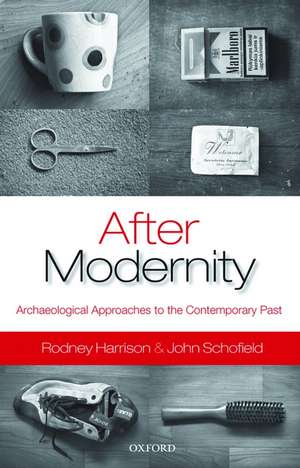
After Modernity: Archaeological Approaches to the Contemporary Past
Autor Rodney Harrison, John Schofielden Limba Engleză Hardback – 22 iul 2010
Preț: 994.13 lei
Preț vechi: 1316.76 lei
-25%
Puncte Express: 1491
Carte tipărită la comandă
Livrare economică 27 noiembrie-02 decembrie
Livrare prin curier în România Termenul estimat este afișat lângă disponibilitate.
Transport gratuit pentru acest produs Plată online sau ramburs, în funcție de opțiunile comenzii.
Retur gratuit în 14 zile Comandă securizată și suport în română.
Specificații
ISBN-13: 9780199548071
ISBN-10: 0199548072
Pagini: 344
Ilustrații: 42 in-text illustrations
Dimensiuni: 142 x 225 x 26 mm
Greutate: 0.54 kg
Ediția:New.
Editura: OUP OXFORD
Colecția OUP Oxford
Locul publicării:Oxford, United Kingdom
ISBN-10: 0199548072
Pagini: 344
Ilustrații: 42 in-text illustrations
Dimensiuni: 142 x 225 x 26 mm
Greutate: 0.54 kg
Ediția:New.
Editura: OUP OXFORD
Colecția OUP Oxford
Locul publicării:Oxford, United Kingdom
V-ar putea interesa
-
 FreeKatharine HibbertPreț: 109.83 lei
 -
 Preț: 92.36 lei
 -
 The Oxford Handbook of the Archaeology of the Contemporary WorldPaul Graves-Brown-32%Preț: 1227.85 lei1804.94 lei
 -
 Savoring Disgust: The Foul and the Fair in AestheticsCarolyn Korsmeyer-16%Preț: 361.33 lei430.07 lei
 -
 Sound and Safe: A History of Listening Behind the WheelKarin Bijsterveld-22%Preț: 361.35 lei464.82 lei
 -
 A History of the World in 100 ObjectsNeil MacGregor-26%Preț: 102.34 lei137.91 lei
 -
 AftermathJohn SchofieldPreț: 388.91 lei
 -
 The Heritage ReaderGraham Fairclough-15%Preț: 482.48 lei567.63 lei
 -
 Heritage: Critical ApproachesRodney HarrisonPreț: 382.03 lei
 -
 EthnobiologyDeborah Pearsall-23%Preț: 616.19 lei800.25 lei
 -
 Breakfast at Sotheby'sPhilip Hook-18%Preț: 65.48 lei79.80 lei
 -
 Consumer CultureCelia LuryPreț: 156.98 lei
 -
 The Rise & Fall of Thomas CromwellJohn SchofieldPreț: 115.78 lei
 -
 Love Objects: Emotion, Design and Material CultureDr Anna Moran-34%Preț: 850.58 lei1296.71 lei
 -
 Interior Design: A Critical IntroductionClive Edwards-15%Preț: 284.24 lei332.90 lei
Recenzii
By bringing archaeology right up to date Harrison and Schofield provide an eloquent argument that the transformation of things and landscapes haunts the contemporary imagination. Their book is a must-read for the many disciplines interested in understanding the turbulent century we have recently shed. The presumption that history died in 1989 is here matched by the birth of a new understanding of the past; one that is altogether more interesting because it is tangible and entrancing.
Archaeology has always been a versatile discipline, and After Modernity shows versatility to the full, using archaeological theory and technique to reflect on the materiality of our contemporary world. This is the first major study to assemble along the vectors of common themes those archaeologies that explore the world of our own lifetimes. In doing this, After Modernity prompts reflection on the power of the material world today.
This is the first textbook that encompasses all the recent work on the archaeology of ourselves. In doing so it transforms archaeology into a discipline that can both contribute to a wide range of contemporary social issues and provide new insights for anthropology, sociology, heritage and cultural geography.
This is one of those rare books poised from the outset to become a classic. In many ways it is what archaeology is at its best: a creative and scholarly exploration of everyday life. Yet After Modernity also offers fascinating explorations of the possibilities of the past in the present, and the contributions archaeologies can make to a range of contemporary social issues. ... In sum, Harrison and Schofield's book is a provocative contribution to our understanding of the archaeological discipline and the heritage world around us. After Modernity earns its place in any humanities or social science library.
Archaeology has always been a versatile discipline, and After Modernity shows versatility to the full, using archaeological theory and technique to reflect on the materiality of our contemporary world. This is the first major study to assemble along the vectors of common themes those archaeologies that explore the world of our own lifetimes. In doing this, After Modernity prompts reflection on the power of the material world today.
This is the first textbook that encompasses all the recent work on the archaeology of ourselves. In doing so it transforms archaeology into a discipline that can both contribute to a wide range of contemporary social issues and provide new insights for anthropology, sociology, heritage and cultural geography.
This is one of those rare books poised from the outset to become a classic. In many ways it is what archaeology is at its best: a creative and scholarly exploration of everyday life. Yet After Modernity also offers fascinating explorations of the possibilities of the past in the present, and the contributions archaeologies can make to a range of contemporary social issues. ... In sum, Harrison and Schofield's book is a provocative contribution to our understanding of the archaeological discipline and the heritage world around us. After Modernity earns its place in any humanities or social science library.
Notă biografică
Rodney Harrison is Lecturer in Heritage Studies at The Open University. John Schofield is a Member of English Heritage's Characterization Team.
Cuprins
- 1: Introduction
- 1. Surveying the field: the development of an archaeology of the recent and contemporary past
- 2: A disciplinary (pre)history
- 3: Field methods
- 4: Working across disciplines
- 5: Theory and politics
- 2. Archaeological approaches to late modern societies
- 6: Artefacts
- 7: Sites
- 8: Landscapes
- 9: Non-places and virtual worlds
- 10: Conclusions