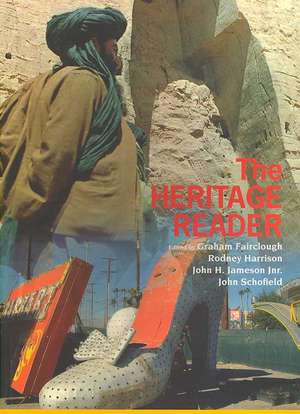
The Heritage Reader
Editat de Graham Fairclough, Rodney Harrison, John Schofield, John H. Jameson, Jnr.en Limba Engleză Paperback – 17 dec 2007
Leading experts in the field from Europe, North America and Australia, bring together recent and innovative works in the field. With geographically and thematically diverse case studies, they examine the theoretical framework for heritage resource management.
Setting significant new thinking within the framework of more established views and ideas on heritage management, this reader re-publishes texts of the past decade with an overview of earlier literature and essays that fill the gaps in between, providing students of all stages with a clear picture of new and older literature.
A helpful introduction sets out key issues and debates, and individual chapter introductions and reading lists give a background collection of key works that offer ideas for the development of thought and study.
With good coverage of major issues and solutions in Britain, the USA and Australia, The Heritage Reader will appeal to students internationally across the English-speaking world, and will stand proud as a key guide to the study and practice of this major archaeological sector.
Preț: 482.48 lei
Preț vechi: 567.63 lei
-15%
Puncte Express: 724
Carte tipărită la comandă
Livrare economică 30 noiembrie-14 decembrie
Livrare prin curier în România Termenul estimat este afișat lângă disponibilitate.
Transport gratuit pentru acest produs Plată online sau ramburs, în funcție de opțiunile comenzii.
Retur gratuit în 14 zile Comandă securizată și suport în română.
Specificații
ISBN-13: 9780415372862
ISBN-10: 0415372860
Pagini: 594
Ilustrații: black & white tables, figures
Dimensiuni: 174 x 246 x 33 mm
Greutate: 1.06 kg
Ediția:1
Editura: Taylor & Francis
Colecția Routledge
Locul publicării:Oxford, United Kingdom
ISBN-10: 0415372860
Pagini: 594
Ilustrații: black & white tables, figures
Dimensiuni: 174 x 246 x 33 mm
Greutate: 1.06 kg
Ediția:1
Editura: Taylor & Francis
Colecția Routledge
Locul publicării:Oxford, United Kingdom
V-ar putea interesa
-
 -21%Preț: 399.11 lei507.26 lei
 -
 The Oxford Handbook of the Archaeology of the Contemporary WorldPaul Graves-Brown-32%Preț: 1227.85 lei1804.94 lei
 -
 Hunter-Gatherer Mortuary Practices during the Central Texas ArchaicLeland C. BementPreț: 166.93 lei
 -
 AftermathJohn SchofieldPreț: 388.91 lei
 -
 The PersiansMaria BrosiusPreț: 357.18 lei
 -
 Heritage and GlobalisationSophia Labadi-15%Preț: 441.60 lei519.54 lei
 -
 Museum Objects: Experiencing the Properties of ThingsSandra H. Dudley-8%Preț: 517.25 lei562.23 lei
 -
 Heritage: Critical ApproachesRodney HarrisonPreț: 382.03 lei
 -
 The Heritage of WarMartin Gegner-15%Preț: 440.74 lei518.51 lei
 -
 Preț: 472.95 lei
 -
 The Cave and the CathedralAmir D AczelPreț: 170.40 lei
 -
 Understanding the Archaeological RecordGavin LucasPreț: 247.50 lei
 -
 Handbook of Landscape ArchaeologyBruno David-15%Preț: 482.87 lei568.09 lei
Public țintă
Postgraduate and UndergraduateRecenzii
‘The Heritage Reader has some fine stuff which students (and heritage professionals) really do need to read and the editors have done us a service by creating a very useful resource.’ – Australian Historical Archaeology
'The Heritage Reader opens with a powerful theoretical analysis that locates cultural heritage management in its historical trajectory and social and cultural contexts in the 21st century: diasporic and transnational communities, mass mobility, and cybercohesion. ... appropriately illustrated, referenced, and indexed.' – CHOICE
'All in all, this is an excellent collection, containing statements by many of the leading Anglophone figures in the field ... It is thoughtfully arranged, the positions of the authors in relation to their topic are clearly spelled out with no hint of a spurious ‘objectivity’, and there is enough diversity of approach to fuel many a seminar discussion among students and their tutors alike. I recommend it wholeheartedly.' – Dr John Carman, University of Birmingham, UK
'The Heritage Reader opens with a powerful theoretical analysis that locates cultural heritage management in its historical trajectory and social and cultural contexts in the 21st century: diasporic and transnational communities, mass mobility, and cybercohesion. ... appropriately illustrated, referenced, and indexed.' – CHOICE
'All in all, this is an excellent collection, containing statements by many of the leading Anglophone figures in the field ... It is thoughtfully arranged, the positions of the authors in relation to their topic are clearly spelled out with no hint of a spurious ‘objectivity’, and there is enough diversity of approach to fuel many a seminar discussion among students and their tutors alike. I recommend it wholeheartedly.' – Dr John Carman, University of Birmingham, UK
Cuprins
Chapter 1 - Heritage management, theory and practice Chapter 2 - Heritage: from patrimony to pastiche Chapter 3 - What is archaeological heritage management? History and development in the United States Chapter 4 - Towards a theoretical framework for archaeological heritage management Chapter 5 - Excavation as Theatre Chapter 6 - Sustainability and heritage Chapter 7 - Assessing values in conservation planning: methodological issues and choices Chapter 8 - Is the past a non-renewable resource? Chapter 9 - Sites of memory and sites of discord: historic monuments as a medium for discussing conflict in Europe Chapter 10 - Archaeology and authority in the twenty-first century Chapter 11 - Heritage as social action Section 2: Whose heritage? Local and global perspectives Chapter 12 – The politics of the past: conflict in the use of heritage in the modern world Chapter 13 – Professional attitudes to indigenous interests in the Native Title era: settler societies compared Chapter 14 – The globalisation of archaeology as heritage: a discussion with Arjun Appadurai Chapter 15 – Whose heritage? Un-settling ‘The heritage’, re-imagining the Post-nation Chapter 16 – Western hegemony in archaeological heritage management Chapter 17 – Familiarising the Australian landscape Chapter 18 – Whose heritage to preserve: cross-cultural reflections on political dominance and urban heritage conservation Chapter 19 – ‘Time out of Mind’ – ‘Mind out of time’: custom versus tradition in environmental heritage research and interpretation Chapter 20 – Conflict in the Archaeology of Living Traditions Chapter 21 – Politics Section 3: Methods and approaches to cultural heritage management Chapter 22 – New Heritage, an introduction – people, landscape and change Chapter 23 - Sustaining the Historic Environment. (extract) Chapter 24 - The Conservation Plan Chapter 25 - Commemorative integrity and cultural landscapes: two National Historic Sites in British Columbia. Chapter 26 - Explaining LARA: the Lincoln Archaeological Research Assessment in its policy context. Chapter 27 - Assessing public perception of landscape: the LANDMAP experience. Cultural heritage and resources (extract) Chapter 28 – Cultural Heritage and Resources Chapter 29 - Cultural Connections to the Land: a Canadian Example Chapter 30 – ‘An emu in the hole’: exploring the link between biodiversity and Aboriginal cultural heritage in New South Wales, Australia Chapter 31 - Social sustainability: people, history and values Chapter 32 - Florence Convention – the European landscape Convention (extract) Chapter 33 - ‘The Long Chain’: Archaeology, Historic Landscape Characterisation and Time-Depth in the Landscape Section 4: Interpretation and Communication Chapter 34 – Presenting archaeology to the public, then and now Appendix to Chapter 34 The ICOMOS Charter for the Interpretation and Presentation of Cultural Heritage Sites (Fifth Draft) Chapter 35 – Archaeological messages and messengers Chapter 36 – A ‘public’ versus a ‘people’s’ form of historical archaeology outreach Chapter 37 – Heritage that hurts: interpretation in a postmodern world Chapter 38 – Archaeologies that hurt; descendents that matter: a pragmatic approach to collaboration in the public interpretation of African-American heritage Chapter 39 - More Than Just “Telling the Story”: Interpretive narrative archaeology Chapter 40 – Interpretive Narrative Archaeology Chapter 41 – The archaeologist as playwright. Afterword: Chapter 42 – Change and Creation: Historic Landscape Character 1950-2000.
Descriere
Experts in the field from European, US and Australian heritage associations, examine case studies, and discuss significant new ideas and theories alongside established principles for this study of new thinking in cultural heritage management.