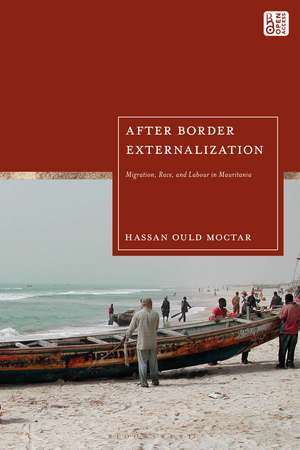
After Border Externalization: Migration, Race, and Labour in Mauritania
Autor Hassan Ould Moctaren Limba Engleză Hardback – 3 oct 2024
The ebook editions of this book are available open access under a CC BY-NC-ND 4.0 licence on bloomsburycollections.com. Open access was funded by the Bloomsbury Open Collections Library Collective.
Preț: 551.25 lei
Preț vechi: 864.49 lei
-36%
Puncte Express: 827
Carte tipărită la comandă
Livrare economică 08-22 decembrie
Livrare prin curier în România Termenul estimat este afișat lângă disponibilitate.
Transport gratuit pentru acest produs Plată online sau ramburs, în funcție de opțiunile comenzii.
Retur gratuit în 14 zile Comandă securizată și suport în română.
Specificații
ISBN-13: 9781350376786
ISBN-10: 1350376787
Pagini: 240
Dimensiuni: 160 x 238 x 18 mm
Greutate: 0.5 kg
Editura: Bloomsbury Publishing
Colecția Bloomsbury Academic
Locul publicării:London, United Kingdom
ISBN-10: 1350376787
Pagini: 240
Dimensiuni: 160 x 238 x 18 mm
Greutate: 0.5 kg
Editura: Bloomsbury Publishing
Colecția Bloomsbury Academic
Locul publicării:London, United Kingdom
V-ar putea interesa
-
 -31%Preț: 661.79 lei954.02 lei
 -
 Europe without BordersIsaac Stanley-BeckerPreț: 226.32 lei
 -
 Border Nation: A Story of MigrationLeah CowanPreț: 99.12 lei
 -
 Border Abolition NowSara RivaPreț: 146.18 lei
 -
 Preț: 298.95 lei
 -
 Can We Solve the Migration Crisis?Jacqueline BhabhaPreț: 87.14 lei
 -
 Migration Studies and ColonialismJoe TurnerPreț: 159.74 lei
 -
 The Futures of Racial CapitalismGargi BhattacharyyaPreț: 159.13 lei
 -
 We, the DecolonizedH. BéjiPreț: 138.11 lei
 -
 At the Margins of the Modern StateSeyla BenhabibPreț: 159.20 lei
 -
 The Precarious Migrant Worker: The Socialization o f PrecarityPanos TheodoropoulosPreț: 156.68 lei
 -
 ExileDidier FassinPreț: 202.80 lei
 -
 Bourgeois ColdnessHenrike Kohpeiß-17%Preț: 84.84 lei101.96 lei
 -
 Ciao OusmaneHsiao-Hung Pai-14%Preț: 146.85 lei170.55 lei
 -
 The Migration QuestionLeila Simona TalaniPreț: 262.29 lei
 -
 Foreign FruitKatie GohPreț: 120.47 lei
 -
 Crude CapitalismAdam HaniehPreț: 170.87 lei
 -
 Undoing Border ImperialismHarsha WaliaPreț: 91.87 lei
Cuprins
Chapter 1: Introduction
Part 1
Chapter 2: The Sum of its Parts?
Part 2
Chapter 3: The Proximity of the Past in Mauritania
Chapter 4: EU Border Externalization in Mauritania
Part 3
Chapter 5: A Tale of Two Cities
Chapter 6: 'You can't be a Migrant at Home'
Chapter 7: Bordering Postcolonial Capitalism
Chapter 8: Conclusion
Bibliography
Index
Part 1
Chapter 2: The Sum of its Parts?
Part 2
Chapter 3: The Proximity of the Past in Mauritania
Chapter 4: EU Border Externalization in Mauritania
Part 3
Chapter 5: A Tale of Two Cities
Chapter 6: 'You can't be a Migrant at Home'
Chapter 7: Bordering Postcolonial Capitalism
Chapter 8: Conclusion
Bibliography
Index
Recenzii
After Externalization is an incisive study of migration in Mauritania's borderlands. The book is much more than a study of the effects of European border policies in Africa. Hassan Ould Moctar has a more ambitious goal, to painstakingly investigate the links between migrant illegality, colonial legacies, global capitalism, and security technologies. Along the way, he shows us the twilight of a Eurocentric world order. This book is a rich contribution to our understanding of border politics in the Sahel and beyond.
Drawing upon extended ethnographic fieldwork, this is a deeply perceptive and rich account of the impact of EU border externalisation on Mauritania's society, politics, and economy. A powerful corrective to the Eurocentric ways in which borders and migration are so often spoken about today.
In this important new addition to the literature on border externalisation, Hassan Ould Moctar offers us a tour de force of how these intricate and intimate multi-scalar practices play out in the context of Mauritania, firmly contextualising externalisation efforts within wider processes of colonialism, racial capitalism, and importantly, opportunities for resistance.
Coloniality, racialised exploitation, illegality have become crucial concepts in our understanding of the so-called migration crisis. After Border Externalization takes us onto a journey where these concepts are brought to life, incarnated and situated. Its rich ethnography provides nuance and celebrates ambiguity, elevating Hassan Ould Moctar's sophisticated analytical critique. After Border Externalization charts new and exciting investigative trajectories in the field of Critical Borders and Migration Studies.
This pertinent work provides a broad yet solid foundation on border externalization and offers readers the opportunity to reconsider the role of African states in border politics, and all the components of the text fluidly link to craft a clear narrative. It is especially useful for those interested in domains such as postcolonial studies, political science, and African border and migration studies.
Drawing upon extended ethnographic fieldwork, this is a deeply perceptive and rich account of the impact of EU border externalisation on Mauritania's society, politics, and economy. A powerful corrective to the Eurocentric ways in which borders and migration are so often spoken about today.
In this important new addition to the literature on border externalisation, Hassan Ould Moctar offers us a tour de force of how these intricate and intimate multi-scalar practices play out in the context of Mauritania, firmly contextualising externalisation efforts within wider processes of colonialism, racial capitalism, and importantly, opportunities for resistance.
Coloniality, racialised exploitation, illegality have become crucial concepts in our understanding of the so-called migration crisis. After Border Externalization takes us onto a journey where these concepts are brought to life, incarnated and situated. Its rich ethnography provides nuance and celebrates ambiguity, elevating Hassan Ould Moctar's sophisticated analytical critique. After Border Externalization charts new and exciting investigative trajectories in the field of Critical Borders and Migration Studies.
This pertinent work provides a broad yet solid foundation on border externalization and offers readers the opportunity to reconsider the role of African states in border politics, and all the components of the text fluidly link to craft a clear narrative. It is especially useful for those interested in domains such as postcolonial studies, political science, and African border and migration studies.