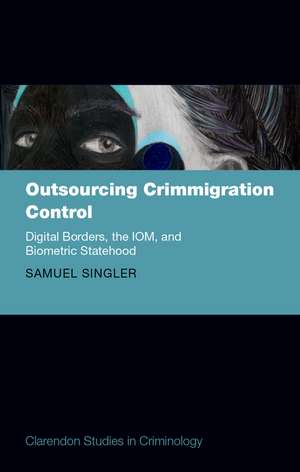
Outsourcing Crimmigration Control: Digital Borders, the IOM, and Biometric Statehood: Clarendon Studies in Criminology
Autor Samuel Singleren Limba Engleză Hardback – 26 aug 2025
Din seria Clarendon Studies in Criminology
- 32%
 Preț: 693.81 lei
 - 32%
 Preț: 692.46 lei
 - 33%
 Preț: 615.24 lei
 - 33%
 Preț: 646.04 lei
 - 33%
 Preț: 614.73 lei
 - 32%
 Preț: 660.36 lei
 - 32%
 Preț: 694.36 lei
 - 32%
 Preț: 692.22 lei
 - 33%
 Preț: 775.25 lei
 - 25%
 Preț: 660.03 lei
 - 32%
 Preț: 560.92 lei
 - 32%
 Preț: 606.34 lei
 - 33%
 Preț: 646.20 lei
 - 32%
 Preț: 659.91 lei
 - 32%
 Preț: 556.62 lei
 - 32%
 Preț: 630.39 lei
 - 33%
 Preț: 547.32 lei
 - 30%
 Preț: 484.35 lei
 - 33%
 Preț: 645.98 lei
 - 30%
 Preț: 529.77 lei
 - 32%
 Preț: 636.34 lei
 - 33%
 Preț: 569.04 lei
 - 31%
 Preț: 595.50 lei
 - 30%
 Preț: 473.13 lei
 - 31%
 Preț: 575.49 lei
 - 32%
 Preț: 525.39 lei
 - 20%
 Preț: 281.34 lei
 - 32%
 Preț: 651.02 lei
 - 12%
 Preț: 241.35 lei
 - 19%
 Preț: 344.30 lei
 - 32%
 Preț: 680.24 lei
 - 27%
 Preț: 341.41 lei
 - 20%
 Preț: 288.97 lei
 - 33%
 Preț: 595.38 lei
 - 33%
 Preț: 711.62 lei
 - 16%
 Preț: 192.40 lei
 - 32%
 Preț: 532.96 lei
 - 31%
 Preț: 612.94 lei
 - 32%
 Preț: 715.47 lei
 - 16%
 Preț: 292.73 lei
 - 30%
 Preț: 460.55 lei
 - 31%
 Preț: 574.00 lei
 - 29%
 Preț: 537.43 lei
 - 32%
 Preț: 537.65 lei
 - 31%
 Preț: 577.48 lei
Preț: 661.79 lei
Preț vechi: 954.02 lei
-31%
Puncte Express: 993
Carte tipărită la comandă
Livrare economică 03-09 decembrie
Livrare prin curier în România Termenul estimat este afișat lângă disponibilitate.
Transport gratuit pentru acest produs Plată online sau ramburs, în funcție de opțiunile comenzii.
Retur gratuit în 14 zile Comandă securizată și suport în română.
Specificații
ISBN-13: 9780198927495
ISBN-10: 0198927495
Pagini: 300
Dimensiuni: 144 x 222 x 22 mm
Greutate: 0.5 kg
Editura: OUP OXFORD
Colecția OUP Oxford
Seria Clarendon Studies in Criminology
Locul publicării:Oxford, United Kingdom
ISBN-10: 0198927495
Pagini: 300
Dimensiuni: 144 x 222 x 22 mm
Greutate: 0.5 kg
Editura: OUP OXFORD
Colecția OUP Oxford
Seria Clarendon Studies in Criminology
Locul publicării:Oxford, United Kingdom
V-ar putea interesa
-
 -23%Preț: 720.31 lei935.46 lei
 -
 -31%Preț: 663.44 lei955.24 lei
 -
 -16%Preț: 80.80 lei96.30 lei
 -
 Don't Burn Anyone at the Stake TodayNaomi AldermanPreț: 121.20 lei
 -
 Preț: 213.86 lei
 -
 Preț: 416.62 lei
 -
 Crime Without Borders: An Introduction to International Criminal JusticeAaron FichtelbergPreț: 389.18 lei
 -
 -17%Preț: 159.33 lei191.41 lei
 -
 Surveillance Technologies in Performance and MigrationDr Sidonie Carey-Green-21%Preț: 388.11 lei490.60 lei
 -
 -19%Preț: 99.37 lei122.26 leiRecomandat
 -
 Criminalizing the CasbahsDanielle BeaujonPreț: 258.41 lei
 -
 At the Margins of the Modern StateSeyla BenhabibPreț: 159.20 lei
 -
 -32%Preț: 583.32 lei864.07 lei
 -
 Mediterranean Digital Societies: Law and TechnologyAlessandro Mantelero-33%Preț: 550.09 lei815.66 lei
 -
 -29%Preț: 385.77 lei543.12 lei
 -
 The ZorgSiddharth KaraPreț: 122.93 lei
 -
 -15%Preț: 566.40 lei666.36 lei
 -
 Preț: 413.97 lei
 -
 Empire of AIKaren HaoPreț: 163.45 lei
Recenzii
This is a timely examination of how migration control is increasingly shaped by digital technology, outsourced governance and criminal justice logic. ..The empirical heart of the book is a detailed case study of the International Organization for Migration's system, known as the Migration Information and Data Analysis System (MIDAS), used in Nigeria. ..The book is an important reminder that when governance is outsourced to code, the consequences remain profoundly human.
Notă biografică
Samuel Singler is a Lecturer in Criminology at the University of Essex. His research focuses on the intersection of surveillance technologies, criminal justice, and border control, illuminating how and why digital technologies shape contemporary 'crimmigration' control practices. Singler is an Associate Director of the Border Criminologies network and co-leads its Technology & Digital Futures thematic group. Outside of academia, he has worked together with civil society organizations to reshape digital border surveillance and the deployment of biometric technologies in humanitarian contexts. He holds a DPhil in Criminology and MPhil in International Relations from the University of Oxford.
Cuprins
- PART I. CRIMINAL JUSTICE, BORDER CONTROL, AND DIGITAL TECHNOLOGIES
- 1: Introduction: Digital Borders and Social Exclusion
- 2: Sovereign Power, Postcolonial Hierarchy, and Global Crimmigration Control
- 3: Theorizing Crimmigration Control Technologies: Performativity, Pragmatism, and Humanism
- 4: From Unease to Critique: Pragmatism as a Research Paradigm
- PART II. MIDAS
- 5: MIDAS and the Performative Dimensions of Global Migration Management
- 6: 'Who is in charge here': Territory, Extraversion, and Local Agency in the IOM's Capacity-building Practices in Nigeria
- 7: 'If we don't do it, it's just not going to happen': Shaping the Digital Futures of Crimmigration Control in Nigeria
- 8: A Golden Touch? MIDAS, Biometrics, and the Expansion of Crimmigration Control
- 9: Conclusion: Enacting the 'Crimmigrant Other' in the Global South