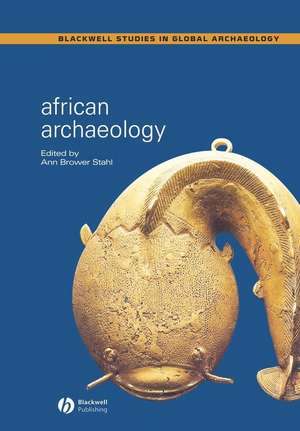
African Archaeology
Autor Stahlen Limba Engleză Hardback – 17 sep 2004
- Provides an unprecedented and exciting introduction to the archaeology of Africa
- Challenges misconceptions & claims about Africa's past and teaches students how to evaluate these claims
- Includes a thoughtful introduction that explores the contexts that have shaped archaeological knowledge of Africa's past
- Lays out research questions that have shaped the contours of African archaeology
- Comprised of chapters specifically written for this volume by prominent archaeologists with regional and topical expertise
Preț: 946.71 lei
Preț vechi: 1296.86 lei
-27%
Puncte Express: 1420
Carte tipărită la comandă
Livrare economică 13-27 noiembrie
Livrare prin curier în România Termenul estimat este afișat lângă disponibilitate.
Transport gratuit pentru acest produs Plată online sau ramburs, în funcție de opțiunile comenzii.
Retur gratuit în 14 zile Comandă securizată și suport în română.
Specificații
ISBN-13: 9781405101554
ISBN-10: 1405101555
Pagini: 508
Dimensiuni: 183 x 260 x 32 mm
Greutate: 1.14 kg
Ediția:New.
Editura: Wiley
Locul publicării:Chichester, United Kingdom
ISBN-10: 1405101555
Pagini: 508
Dimensiuni: 183 x 260 x 32 mm
Greutate: 1.14 kg
Ediția:New.
Editura: Wiley
Locul publicării:Chichester, United Kingdom
V-ar putea interesa
-
 -29%Preț: 503.15 lei704.77 lei
 -
 Prehistoric Cultural Ecology and EvolutionDonald O. Henry-18%Preț: 931.61 lei1136.11 lei
 -
 An Archaeology of Natural PlacesRichard BradleyPreț: 391.51 lei
 -
 Archaeology of Ancient AustraliaPeter Hiscock-15%Preț: 442.09 lei520.10 lei
 -
 Ancient Middle NigerRoderick J. McintoshPreț: 244.90 lei
 -
 The Ancient Egyptian StateRobert J. WenkePreț: 313.31 lei
 -
 The Rise of Bronze Age SocietyKristian Kristiansen-11%Preț: 498.51 lei560.13 lei
 -
 The First AfricansLawrence BarhamPreț: 381.25 lei
 -
 Origins and RevolutionsClive GamblePreț: 342.57 lei
 -
 Olmec Archaeology Early MesoamericaChristopher PoolPreț: 316.55 lei
 -
 The Prehistory Of The MindProf Steven Mithen-27%Preț: 78.22 lei106.49 lei
 -
 The Complete Archaeology of GreeceJohn Bintliff-8%Preț: 523.86 lei569.42 lei
 -
 A Companion to the Archaeology of the Roman RepublicJane Derose Evans-9%Preț: 1332.54 lei1464.33 lei
 -
 Classical ArchaeologyRobin OsbornePreț: 324.21 lei
Public țintă
Advanced undergraduates and graduates in archaeology, especially those focusing on African archaeology.Notă biografică
Ann Brower Stahl is Professor of Anthropology at Binghamton University, SUNY
Cuprins
Series Editors' Preface. Figures.
Tables.
Notes on Contributors.
1 Introduction. Changing Perspectives on Africa's Pasts: Ann Brower Stahl (State University of New York at Binghamton).
2 Barbarous Tribes and Unrewarding Gyrations? The Changing Role of Ethnographic Imagination in African Archaeology: Paul J. Lane (British Institute in Eastern Africa).
3 Discord after Discard. Reconstructing Aspects of Oldowan Hominin Behavior: Thomas Plummer (City University of New York).
4 The Middle and Upper Pleistocene African Record for the Biological and Behavioral Origins of Modern Humans: Curtis W. Marean and Zelalem Assefa (Arizona State University; SUNY at Stony Brook.
5 A Late Pleistocene Archive of Life at the Coast, Klasies River: H. J. Deacon and Sarah Wurz (University of Stellenbosch; University of Stellenbosch).
6 Modeling Later Stone Age Societies in Southern Africa: Peter Mitchell (University of Oxford).
7 Holocene "Aquatic" Adaptations in North Tropical Africa: Augustin F. C. Holl (University of Michigan).
8 Pastoralism and its Consequences: Diane Gifford-Gonzalez (University of California, Santa Cruz).
9 Holocene Occupations of the Forest and Savanna: Joanna Casey (University of South Carolina).
10 The Romance of Farming--Plant Cultivation and Domestication in Africa: Katharina Neumann (J. W. Goethe-Universität).
11 Metallurgy and its Consequences: S. Terry Childs and Eugenia W. Herbert (National Park Service, Mount Holyoke College).
12 The Bantu Problem and African Archaeology: Manfred Eggert (Institut für Ur- und Frühgeschichte und Archäologie des Mittelalters).
13 The Archaeology of Sub-Saharan Urbanism: Cities and their Countrysides: Adria LaViolette and Jeff Fleisher (University of Virginia; University of Virginia).
14 Interaction, Marginalization, and the Archaeology of the Kalahari: Andrew Reid (University College London).
15 Southern Africa and the East African Coast: Gilbert Pwiti (University of Zimbabwe).
16 Mosaics and Interactions: East Africa, 2000 B.P. to the Present: Chapurukha M. Kusimba and Sibel B. Kusimba (The Field Museum, Chicago; Northern Illinois University).
17 From Pottery Groups to Ethnic Groups in Central Africa: Pierre de Maret (Université Libre de Bruxelles).
18 Two Thousand Years of West African History: Scott MacEachern (Bowdoin College).
Index
Tables.
Notes on Contributors.
1 Introduction. Changing Perspectives on Africa's Pasts: Ann Brower Stahl (State University of New York at Binghamton).
2 Barbarous Tribes and Unrewarding Gyrations? The Changing Role of Ethnographic Imagination in African Archaeology: Paul J. Lane (British Institute in Eastern Africa).
3 Discord after Discard. Reconstructing Aspects of Oldowan Hominin Behavior: Thomas Plummer (City University of New York).
4 The Middle and Upper Pleistocene African Record for the Biological and Behavioral Origins of Modern Humans: Curtis W. Marean and Zelalem Assefa (Arizona State University; SUNY at Stony Brook.
5 A Late Pleistocene Archive of Life at the Coast, Klasies River: H. J. Deacon and Sarah Wurz (University of Stellenbosch; University of Stellenbosch).
6 Modeling Later Stone Age Societies in Southern Africa: Peter Mitchell (University of Oxford).
7 Holocene "Aquatic" Adaptations in North Tropical Africa: Augustin F. C. Holl (University of Michigan).
8 Pastoralism and its Consequences: Diane Gifford-Gonzalez (University of California, Santa Cruz).
9 Holocene Occupations of the Forest and Savanna: Joanna Casey (University of South Carolina).
10 The Romance of Farming--Plant Cultivation and Domestication in Africa: Katharina Neumann (J. W. Goethe-Universität).
11 Metallurgy and its Consequences: S. Terry Childs and Eugenia W. Herbert (National Park Service, Mount Holyoke College).
12 The Bantu Problem and African Archaeology: Manfred Eggert (Institut für Ur- und Frühgeschichte und Archäologie des Mittelalters).
13 The Archaeology of Sub-Saharan Urbanism: Cities and their Countrysides: Adria LaViolette and Jeff Fleisher (University of Virginia; University of Virginia).
14 Interaction, Marginalization, and the Archaeology of the Kalahari: Andrew Reid (University College London).
15 Southern Africa and the East African Coast: Gilbert Pwiti (University of Zimbabwe).
16 Mosaics and Interactions: East Africa, 2000 B.P. to the Present: Chapurukha M. Kusimba and Sibel B. Kusimba (The Field Museum, Chicago; Northern Illinois University).
17 From Pottery Groups to Ethnic Groups in Central Africa: Pierre de Maret (Université Libre de Bruxelles).
18 Two Thousand Years of West African History: Scott MacEachern (Bowdoin College).
Index
Descriere
* Provides an unprecedented and exciting introduction to the archaeology of Africa. * Challenges misconceptions & claims about Africa's past and teaches students how to evaluate these claims. * Includes a thoughtful introduction that explores the contexts that have shaped archaeological knowledge of Africa's past.