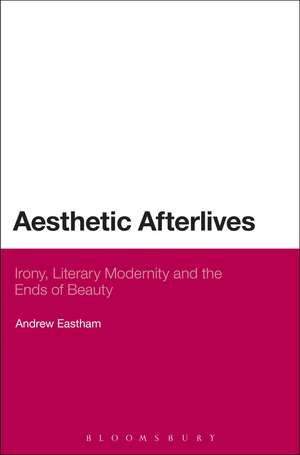
Aesthetic Afterlives: Irony, Literary Modernity and the Ends of Beauty : Continuum Literary Studies
Autor Dr Andrew Easthamen Limba Engleză Hardback – 6 oct 2011
Aesthetic Afterlives constructs a far-reaching theoretical narrative by positioning Victorian Aestheticism as the basis of Literary Modernity. Aestheticism's cultivation of irony and reflexive detachment was central to this legacy, but it was also the focus of its own self-critique. Anxieties about the concept and practice of irony persisted through Modernism, and have recently been positioned in Hollinghurst's work as a symptom of the political stasis within post-modern culture. Referring to the recent debates about the 'new aestheticism' and the politics of aesthetics, Eastham asks how a utopian Aestheticism can be reconstructed from the problematics of irony and aesthetic autonomy that haunted writers from Pater to Adorno.
Din seria Continuum Literary Studies
- 33%
 Preț: 960.54 lei
 -
 Preț: 277.68 lei
 - 25%
 Preț: 281.33 lei
 - 33%
 Preț: 835.66 lei
 - 25%
 Preț: 280.81 lei
 - 25%
 Preț: 960.54 lei
 - 24%
 Preț: 849.32 lei
 - 25%
 Preț: 960.82 lei
 - 16%
 Preț: 280.41 lei
 - 25%
 Preț: 280.81 lei
 - 25%
 Preț: 976.57 lei
 - 33%
 Preț: 976.17 lei
 - 24%
 Preț: 847.91 lei
 - 33%
 Preț: 960.43 lei
 - 14%
 Preț: 847.63 lei
 - 25%
 Preț: 960.27 lei
 - 24%
 Preț: 855.35 lei
 - 32%
 Preț: 659.93 lei
 - 15%
 Preț: 279.35 lei
 - 25%
 Preț: 976.96 lei
 - 25%
 Preț: 281.41 lei
 - 14%
 Preț: 717.29 lei
 - 33%
 Preț: 960.89 lei
 - 25%
 Preț: 276.29 lei
 - 14%
 Preț: 847.81 lei
 - 25%
 Preț: 960.08 lei
 - 33%
 Preț: 833.98 lei
 - 25%
 Preț: 960.71 lei
 - 27%
 Preț: 276.58 lei
 - 33%
 Preț: 977.41 lei
 - 25%
 Preț: 277.68 lei
 - 25%
 Preț: 957.28 lei
 - 33%
 Preț: 834.70 lei
 - 33%
 Preț: 960.36 lei
 - 33%
 Preț: 850.13 lei
 - 33%
 Preț: 961.50 lei
 - 25%
 Preț: 279.90 lei
 - 35%
 Preț: 403.83 lei
 - 34%
 Preț: 796.82 lei
 - 33%
 Preț: 959.75 lei
 - 25%
 Preț: 976.70 lei
 - 33%
 Preț: 959.75 lei
 - 25%
 Preț: 960.08 lei
 - 25%
 Preț: 975.81 lei
 - 25%
 Preț: 283.29 lei
Preț: 963.00 lei
Preț vechi: 1432.77 lei
-33%
Puncte Express: 1445
Carte tipărită la comandă
Livrare economică 09-23 decembrie
Livrare prin curier în România Termenul estimat este afișat lângă disponibilitate.
Transport gratuit pentru acest produs Plată online sau ramburs, în funcție de opțiunile comenzii.
Retur gratuit în 14 zile Comandă securizată și suport în română.
Specificații
ISBN-13: 9780826443984
ISBN-10: 0826443982
Pagini: 272
Dimensiuni: 156 x 234 x 28 mm
Greutate: 0.57 kg
Ediția:New.
Editura: Bloomsbury Publishing
Colecția Continuum
Seria Continuum Literary Studies
Locul publicării:London, United Kingdom
ISBN-10: 0826443982
Pagini: 272
Dimensiuni: 156 x 234 x 28 mm
Greutate: 0.57 kg
Ediția:New.
Editura: Bloomsbury Publishing
Colecția Continuum
Seria Continuum Literary Studies
Locul publicării:London, United Kingdom
V-ar putea interesa
-
 Conrad's Narrative MethodJakob Lothe-22%Preț: 211.94 lei273.34 lei
 -
 A Ringing Glass: The Life of Rainer Maria RilkeDonald Prater-28%Preț: 530.17 lei736.90 lei
 -
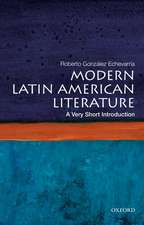 Modern Latin American Literature: A Very Short IntroductionRoberto Gonzalez Echevarria-20%Preț: 56.70 lei70.82 lei
 -
 -18%Preț: 1254.47 lei1529.84 lei
 -
 Locating Gender in Modernism: The Outsider FemaleGeetha Ramanathan-18%Preț: 1252.71 lei1527.70 lei
 -
 The Letters of Samuel Beckett: Volume 2, 1941-1956Samuel BeckettPreț: 426.73 lei
 -
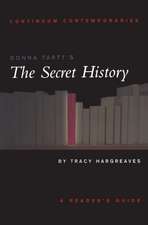 Donna Tartt's The Secret History: A Reader's GuideTracy HargreavesPreț: 126.24 lei
 -
 Sebastian Faulks's BirdsongPat Wheeler-21%Preț: 153.87 lei195.89 lei
 -
 Hanif Kureishi's The Buddha of SuburbiaNahem Yousaf-17%Preț: 126.34 lei152.85 lei
 -
 Poems in the PorchKevin J. Gardner-43%Preț: 71.87 lei125.80 lei
 -
 Anatomy of a Short Story: Nabokov's Puzzles, Codes, "Signs and Symbols"Professor Yuri Leving-15%Preț: 280.66 lei330.96 lei
 -
 Sarah Waters: Contemporary Critical PerspectivesDr Kaye Mitchell-20%Preț: 192.15 lei240.12 lei
 -
 Preț: 63.33 lei
 -
 Going Down to MoroccoJose Luis Alons De SantosPreț: 410.18 lei
Cuprins
List of Abbreviations \ Introduction \ 1. Walter Pater's
Acoustic Space: 'The School of Giorgione', Dionysian Anders-streben, and
the Politics of Soundscape \ 2. Aesthetic Vampirism: The Concept of Irony in
the Work of Walter Pater, Oscar Wilde and Vernon Lee \ 3. 'Master of Irony':
Henry James, Transatlantic Bildung and the Critique of
Aestheticism \ 4. Irony's Turn: The Redress of Aestheticism in Katherine
Mansfield's Notebooks and Stories \ 5. Sacrificing Aestheticism: The Dialectic
of Modernity and the Ends of Beauty in D.H. Lawrence's The Rainbow and Women
in Love \ 6. Aristocracies of Mourning: The Reconsecration of Aestheticism
in Evelyn Waugh's Brideshead Revisited \ 7. Sublime Ironies: The
Remainders of Romanticism in Samuel Beckett's Trilogy and Krapp's Last Tape
\ 8. Inoperative Ironies: Jamesian Aestheticism and Post-modern Culture in Alan
Hollinghurst's The Line of Beauty \ 9. The Aesthetic Afterlives of Mr
W.P. : Reanimating Pater in Twenty-first-Century Fiction \ Notes \ Works Cited
\ Index
Acoustic Space: 'The School of Giorgione', Dionysian Anders-streben, and
the Politics of Soundscape \ 2. Aesthetic Vampirism: The Concept of Irony in
the Work of Walter Pater, Oscar Wilde and Vernon Lee \ 3. 'Master of Irony':
Henry James, Transatlantic Bildung and the Critique of
Aestheticism \ 4. Irony's Turn: The Redress of Aestheticism in Katherine
Mansfield's Notebooks and Stories \ 5. Sacrificing Aestheticism: The Dialectic
of Modernity and the Ends of Beauty in D.H. Lawrence's The Rainbow and Women
in Love \ 6. Aristocracies of Mourning: The Reconsecration of Aestheticism
in Evelyn Waugh's Brideshead Revisited \ 7. Sublime Ironies: The
Remainders of Romanticism in Samuel Beckett's Trilogy and Krapp's Last Tape
\ 8. Inoperative Ironies: Jamesian Aestheticism and Post-modern Culture in Alan
Hollinghurst's The Line of Beauty \ 9. The Aesthetic Afterlives of Mr
W.P. : Reanimating Pater in Twenty-first-Century Fiction \ Notes \ Works Cited
\ Index
Recenzii
Aesthetic Afterlives traces the lineage of Paterian aesthetics from its incandescent impact within English fin de siècle culture to its spectral "afterimage" in modernist and postmodernist writing [.] Ambitious in scope, broadly researched and elaborately (if densely) argued, Eastham's book will prove of immense use to scholars anxious to reanimate an alternative line of influence in the history of literary modernity.
Aesthetic Afterlives makes an invaluable contribution to our understanding of Aestheticism's cultural legacy, with its powerful and eloquent account of Aestheticism's afterlives not only in literary modernism, but also in postmodernism and contemporary culture.
What is so striking about Aesthetic Afterlives is the way in which, having established some of the theoretical coordinates that formed the matrix of Aestheticism, it does justice to the rich complexity of affective and aesthetic interactions, including mourning, scorn, irony, yearning, faith and delusion, that mutate through the broad range of texts Eastham considers.
Aesthetic Afterlives makes an invaluable contribution to our understanding of Aestheticism's cultural legacy, with its powerful and eloquent account of Aestheticism's afterlives not only in literary modernism, but also in postmodernism and contemporary culture.
What is so striking about Aesthetic Afterlives is the way in which, having established some of the theoretical coordinates that formed the matrix of Aestheticism, it does justice to the rich complexity of affective and aesthetic interactions, including mourning, scorn, irony, yearning, faith and delusion, that mutate through the broad range of texts Eastham considers.