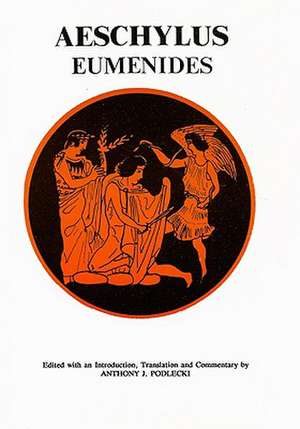
Aeschylus: Eumenides: Aris & Phillips Classical Texts (Hardcover)
Autor Aeschylus Editat de A. J. Podleckien Limba Engleză Hardback – 30 noi 1989
Preț: 455.38 lei
Preț vechi: 535.74 lei
-15%
Puncte Express: 683
Carte indisponibilă temporar
Doresc să fiu notificat când acest titlu va fi disponibil:
Se trimite...
Specificații
ISBN-13: 9780856683817
ISBN-10: 0856683817
Pagini: 227
Dimensiuni: 157 x 210 x 21 mm
Greutate: 0.49 kg
Editura: ARIS & PHILLIPS
Seria Aris & Phillips Classical Texts (Hardcover)
ISBN-10: 0856683817
Pagini: 227
Dimensiuni: 157 x 210 x 21 mm
Greutate: 0.49 kg
Editura: ARIS & PHILLIPS
Seria Aris & Phillips Classical Texts (Hardcover)
V-ar putea interesa
-
 The Mighty DeadAdam NicolsonPreț: 80.66 lei
 -
 Aristophanes' FrogsMark Griffith-13%Preț: 301.22 lei346.15 lei
 -
 The IliadHomer-22%Preț: 164.15 lei210.67 lei
 -
 The Oxford Companion to Classical LiteratureM.C. HowatsonPreț: 137.84 lei
 -
 Latin Course for Schools Part 3L.A. WildingPreț: 164.61 lei
 -
 Sophocles: ElectraMichael LloydPreț: 180.69 lei
 -
 Classics and the Bible: Hospitality and RecognitionDr John Taylor-11%Preț: 256.34 lei287.29 lei
 -
 Euripides: Suppliant WomenIan C. Storey-17%Preț: 180.75 lei217.03 lei
 -
 Aeschylean TragedyAlan H. SommersteinPreț: 335.66 lei
 -
 Writing Ancient PersiaDr Thomas Harrison-15%Preț: 167.17 lei195.74 lei
 -
 Homer: Iliad IHomer-22%Preț: 162.07 lei207.77 lei
 -
 The FabliauxNathaniel E. DubinPreț: 201.44 lei
 -
 Linear B: An IntroductionJ.T. Hooker-27%Preț: 213.20 lei292.82 lei
 -
 AgamemnonAeschylusPreț: 111.87 lei
 -
 -15%Preț: 124.54 lei147.34 lei
 -
 SenecaChristopher Star-21%Preț: 157.11 lei200.06 lei
 -
 OvidCarole E. Newlands-16%Preț: 141.69 lei169.51 lei
 -
 Preț: 143.86 lei
 -
 Molière: Le TartuffeMolière-17%Preț: 162.02 lei195.64 lei
 -
 Zoshchenko: Stories of the 1920sA. Murphy-5%Preț: 161.01 lei169.83 lei
 -
 The House of AtreusAeschylusPreț: 155.41 lei
 -
 Preț: 125.61 lei
Cuprins
- The Oresteia: summary of the stage-action
- Abbreviations: play-titles and works frequently cited
- Introduction
- Advice on the Text, Translation, and Explanatory Notes
- Bibliography and Further Reading
- A Chronology of Aeschylus
- Map of Greece and the Aegean Sea
- The Plays of the Oresteia:
- Libation Bearers
- Eumenides
- Explanatory Notes
- Textual Appendix
Descriere
Descriere de la o altă ediție sau format:
Produced in 458 BC, Aeschylus' Choephori is the second play in the Oresteian trilogy. The bloodshed begun in the first play with the murder of Agamemnon by his wife Clytemnestra is here continued when Agamemnon's son Orestes avenges his father's death by killing Clytemnestra. It is not until the third and final play, Eumenides, that peace is restored to the family of the Atreidae. This edition takes into account the large amount of recent research on the play and tackles the problems presented by an unusually corrupt text. The introduction discusses the pre-Aeschylean 'Orestes' tradition in literature and art, as well as the place of Choephori within the Oresteia, its imagery and dramatic structure, the questions of staging the play, and the manuscript tradition. The Greek text and critical apparatus are those of D.L. Page (OCT). The commentary looks at problems of style, dramatic technique, and interpretation of the play, and before each scene is discussed an analysis of its contribution to the drama as a whole is supplied.
Produced in 458 BC, Aeschylus' Choephori is the second play in the Oresteian trilogy. The bloodshed begun in the first play with the murder of Agamemnon by his wife Clytemnestra is here continued when Agamemnon's son Orestes avenges his father's death by killing Clytemnestra. It is not until the third and final play, Eumenides, that peace is restored to the family of the Atreidae. This edition takes into account the large amount of recent research on the play and tackles the problems presented by an unusually corrupt text. The introduction discusses the pre-Aeschylean 'Orestes' tradition in literature and art, as well as the place of Choephori within the Oresteia, its imagery and dramatic structure, the questions of staging the play, and the manuscript tradition. The Greek text and critical apparatus are those of D.L. Page (OCT). The commentary looks at problems of style, dramatic technique, and interpretation of the play, and before each scene is discussed an analysis of its contribution to the drama as a whole is supplied.
Notă biografică
Aeschylus (525-456 BC) The father of Greek tragic drama, usually considered the first great writer in the Western theatrical tradition. Only seven plays, of over 70 known titles, are extant. These are The Persians (472 BC), Seven Against Thebes (469 BC), Prometheus Bound (c. 460 BC), The Suppliant Women (c. 460 BC), and the Oresteia trilogy (458 BC), comprising Agamemnon, Choephoroi, and Eumenides. He also wrote numerous satyr plays, which have only survived in fragmentary form. Aeschylus's work is powerful and operatic, using majestic but often innovative language. His attitude to Greek society and religion was generally conservative, although he boldly depicted the sufferings of men and woman when moral systems, and the gods themselves, are in conflict. Legend says he was killed by a tortoise dropped by an eagle (to break the shell) on his bald head (mistaken for a stone). His tombstone makes no mention of his literary works, referring only to his service at the Battle of Marathon (490 BC).