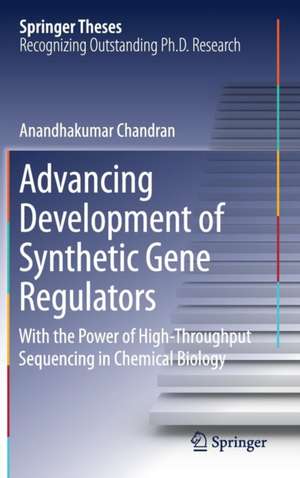
Advancing Development of Synthetic Gene Regulators: With the Power of High-Throughput Sequencing in Chemical Biology: Springer Theses
Autor Anandhakumar Chandranen Limba Engleză Hardback – 28 sep 2017
This book focuses on an “outside the box” notion by utilizing the powerful applications of next-generation sequencing (NGS) technologies in the interface of chemistry and biology. In personalized medicine, developing small molecules targeting a specific genomic sequence is an attractive goal. N-methylpyrrole (P)–N-methylimidazole (I) polyamides (PIPs) are a class of small molecule that can bind to the DNA minor groove. First, a cost-effective NGS (ion torrent platform)-based Bind-n-Seq was developed to identify the binding specificity of PIP conjugates in a randomized DNA library. Their biological influences rely primarily on selective DNA binding affinity, so it is important to analyze their genome-wide binding preferences. However, it is demanding to enrich specifically the small-molecule-bound DNA without chemical cross-linking or covalent binding in chromatinized genomes. Herein is described a method that was developed using high-throughput sequencing to map the differential binding sites and relative enriched regions of non-cross-linked SAHA-PIPs throughout the complex human genome. SAHA-PIPs binding motifs were identified and the genome-level mapping of SAHA-PIPs-enriched regions provided evidence for the differential activation of the gene network. A method using high-throughput sequencing to map the binding sites and relative enriched regions of alkylating PIP throughout the human genome was also developed. The genome-level mapping of alkylating the PIP-enriched region and the binding sites on the human genome identifies significant genomic targets of breast cancer. It is anticipated that this pioneering low-cost, high through-put investigation at the sequence-specific level will be helpful in understanding the binding specificity of various DNA-binding small molecules, which in turn will be beneficial for the development of small-molecule-based drugs targeting a genome-level sequence.
| Toate formatele și edițiile | Preț | Express |
|---|---|---|
| Paperback (1) | 607.96 lei 6-8 săpt. | |
| Springer Nature Singapore – 26 ian 2019 | 607.96 lei 6-8 săpt. | |
| Hardback (1) | 613.80 lei 6-8 săpt. | |
| Springer Nature Singapore – 28 sep 2017 | 613.80 lei 6-8 săpt. |
Din seria Springer Theses
- 18%
 Preț: 959.13 lei
 -
 Preț: 372.50 lei
 - 15%
 Preț: 611.89 lei
 - 18%
 Preț: 906.80 lei
 -
 Preț: 384.13 lei
 - 18%
 Preț: 908.31 lei
 - 15%
 Preț: 612.23 lei
 - 15%
 Preț: 616.15 lei
 - 15%
 Preț: 618.34 lei
 - 18%
 Preț: 1060.72 lei
 - 15%
 Preț: 611.27 lei
 - 18%
 Preț: 1069.04 lei
 - 18%
 Preț: 907.54 lei
 - 18%
 Preț: 1066.78 lei
 - 18%
 Preț: 1169.91 lei
 - 15%
 Preț: 615.35 lei
 - 15%
 Preț: 611.43 lei
 - 15%
 Preț: 615.35 lei
 -
 Preț: 370.62 lei
 -
 Preț: 378.41 lei
 - 15%
 Preț: 617.89 lei
 -
 Preț: 372.31 lei
 - 15%
 Preț: 613.31 lei
 - 15%
 Preț: 617.08 lei
 - 18%
 Preț: 1335.19 lei
 - 20%
 Preț: 596.68 lei
 - 18%
 Preț: 1181.26 lei
 - 15%
 Preț: 614.60 lei
 - 18%
 Preț: 960.64 lei
 - 15%
 Preț: 615.35 lei
 - 18%
 Preț: 1172.94 lei
 - 18%
 Preț: 1072.85 lei
 - 18%
 Preț: 1171.41 lei
 - 18%
 Preț: 962.00 lei
 - 18%
 Preț: 856.59 lei
 - 15%
 Preț: 615.35 lei
 - 5%
 Preț: 1109.23 lei
 - 15%
 Preț: 616.15 lei
 - 18%
 Preț: 904.53 lei
 - 15%
 Preț: 621.97 lei
 - 18%
 Preț: 960.64 lei
 -
 Preț: 370.62 lei
 -
 Preț: 374.91 lei
 - 18%
 Preț: 962.14 lei
 - 18%
 Preț: 1069.04 lei
 -
 Preț: 375.07 lei
 - 15%
 Preț: 612.55 lei
 - 20%
 Preț: 599.77 lei
 - 20%
 Preț: 601.24 lei
Preț: 613.80 lei
Preț vechi: 722.11 lei
-15% Nou
Puncte Express: 921
Preț estimativ în valută:
108.60€ • 126.71$ • 94.95£
108.60€ • 126.71$ • 94.95£
Carte tipărită la comandă
Livrare economică 16-30 ianuarie 26
Preluare comenzi: 021 569.72.76
Specificații
ISBN-13: 9789811065460
ISBN-10: 9811065462
Pagini: 114
Ilustrații: XV, 114 p. 49 illus., 44 illus. in color.
Dimensiuni: 155 x 235 mm
Greutate: 0.36 kg
Ediția:1st ed. 2018
Editura: Springer Nature Singapore
Colecția Springer
Seria Springer Theses
Locul publicării:Singapore, Singapore
ISBN-10: 9811065462
Pagini: 114
Ilustrații: XV, 114 p. 49 illus., 44 illus. in color.
Dimensiuni: 155 x 235 mm
Greutate: 0.36 kg
Ediția:1st ed. 2018
Editura: Springer Nature Singapore
Colecția Springer
Seria Springer Theses
Locul publicării:Singapore, Singapore
V-ar putea interesa
-
 Nanosensors: Physical, Chemical, and BiologicalVinod Kumar Khanna-32%Preț: 1466.39 lei2144.31 lei
 -
 Preț: 433.95 lei
 -
 Biotechnology: Recent Trends and Emerging DimensionsAtul BhargavaPreț: 425.11 lei
 -
 Biomechanical Aspects of Soft TissuesBenjamin Loret-13%Preț: 388.64 lei445.85 lei
 -
 Preparative Layer ChromatographyTeresa KowalskaPreț: 441.37 lei
 -
 Patent Pools, Competition Law and BiotechnologyDevdatta Malshe-26%Preț: 139.99 lei189.04 lei
 -
 Radiomics and RadiogenomicsRuijiang Li-19%Preț: 342.86 lei422.67 lei
 -
 Preț: 416.81 lei
 -
 Regenesis: How Synthetic Biology Will Reinvent Nature and OurselvesGeorge M. Church-16%Preț: 127.34 lei151.42 lei
 -
 Bionanotechnology: Concepts and ApplicationsLjiljana FrukPreț: 432.46 lei
 -
 Antenna and Sensor Technologies in Modern Medical ApplicationsYahya Rahmat-Samii-9%Preț: 881.51 lei968.69 lei
 -
 -15%Preț: 625.64 lei736.04 lei
 -
 Enhancing Extraction Processes in the Food IndustryNikolai Lebovka-15%Preț: 492.97 lei579.96 lei
 -
 Valorization of Food Processing By-ProductsM. Chandrasekaran-18%Preț: 723.19 lei881.94 lei
 -
 Tomosynthesis ImagingIngrid Reiser-29%Preț: 491.49 lei689.79 lei
 -
 -28%Preț: 387.32 lei536.34 lei
 -
 Managing Biogas Plants: A Practical GuideMario Alejandro Rosato-18%Preț: 1070.63 lei1305.65 lei
 -
 Preț: 446.82 lei
 -
 Cell Culture EngineeringWei-Shu Hu-18%Preț: 1745.53 lei2128.69 lei
 -
 -15%Preț: 617.89 lei726.93 lei
 -
 NanoimagingBeth A Goins-18%Preț: 866.80 lei1057.08 lei
Cuprins
Overview of Next-Generation Sequencing Technologies and its application in Chemical Biology.- Next Generation Sequencing Studies Guide the Design of Pyrrole-Imidazole Polyamides with Improved Binding Specificity by the Addition of β-alanine.- Genome-Wide Assessment of the Binding Effects of Artificial Transcriptional Activators by Utilizing the Power of High-Throughput Sequencing.- Deciphering the genomic targets of alkylating polyamide conjugates using high-throughput sequencing.
Textul de pe ultima copertă
This book focuses on an “outside the box” notion by utilizing the powerful applications of next-generation sequencing (NGS) technologies in the interface of chemistry and biology. In personalized medicine, developing small molecules targeting a specific genomic sequence is an attractive goal. N-methylpyrrole (P)–N-methylimidazole (I) polyamides (PIPs) are a class of small molecule that can bind to the DNA minor groove. First, a cost-effective NGS (ion torrent platform)-based Bind-n-Seq was developed to identify the binding specificity of PIP conjugates in a randomized DNA library. Their biological influences rely primarily on selective DNA binding affinity, so it is important to analyze their genome-wide binding preferences. However, it is demanding to enrich specifically the small-molecule-bound DNA without chemical cross-linking or covalent binding in chromatinized genomes. Herein is described a method that was developed using high-throughput sequencing to map the differential binding sites and relative enriched regions of non-cross-linked SAHA-PIPs throughout the complex human genome. SAHA-PIPs binding motifs were identified and the genome-level mapping of SAHA-PIPs-enriched regions provided evidence for the differential activation of the gene network. A method using high-throughput sequencing to map the binding sites and relative enriched regions of alkylating PIP throughout the human genome was also developed. The genome-level mapping of alkylating the PIP-enriched region and the binding sites on the human genome identifies significant genomic targets of breast cancer. It is anticipated that this pioneering low-cost, high through-put investigation at the sequence-specific level will be helpful in understanding the binding specificity of various DNA-binding small molecules, which in turn will be beneficial for the development of small-molecule-based drugs targeting a genome-level sequence.
Caracteristici
Nominated by Kyoto University as an outstanding Ph.D. thesis Reviews multitasking applications of next-generation sequencing (NGS) technologies for chemical biologists Describes low-cost Bind-n-Seq and small molecules based genomic pull-down development, identification of high-affinity binding sites for PIP conjugates using high-throughput sequencing, and the binding motif-guided redesign of PIPs Includes supplementary material: sn.pub/extras