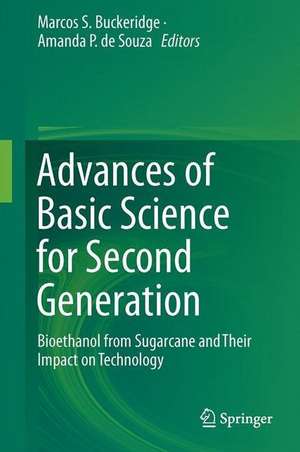
Advances of Basic Science for Second Generation Bioethanol from Sugarcane
Editat de Marcos S. Buckeridge, Amanda P. De Souzaen Limba Engleză Hardback – 4 mai 2017
Aplicabilitatea practică a volumului Advances of Basic Science for Second Generation Bioethanol from Sugarcane rezidă în furnizarea unei baze teoretice și experimentale riguroase pentru optimizarea producției de bioetanol de generația a doua (2G). Observăm o concentrare strategică pe depășirea barierelor tehnologice actuale prin înțelegerea aprofundată a compoziției peretelui celular al plantei, esențială pentru creșterea eficienței pretratamentelor și a proceselor de hidroliză în biorefinerii. Subliniem modul în care această ediție, publicată de Springer, sistematizează progresele realizate în Brazilia — lider mondial în domeniu — și oferă o perspectivă multidisciplinară care lipsește adesea din manualele clasice de botanică. Structura cărții urmărește o progresie logică: de la genomica poliploidă și biofizica biomasei, până la utilizarea metagenomicii pentru descoperirea de noi enzime microbiene. Această abordare completează perspectiva oferită de Biofuels in Brazil, adăugând o analiză moleculară și genetică detaliată acolo unde lucrarea menționată anterior se concentrează mai mult pe politici guvernamentale și aspecte socio-economice. În contextul operei editorului Marcos S. Buckeridge, acest titlu reprezintă o evoluție firească a temelor explorate în Plants and BioEnergy, trecând de la viziunea generală asupra securității energetice la soluții tehnice specifice pentru utilizarea biomasei lignocelulozice. Merită menționat că volumul nu se limitează la laborator, ci dedică secțiuni ample sustenabilității sistemelor agricole și impactului schimburilor climatice globale asupra culturilor de trestie de zahăr. Tonul este unul precis, orientat către date, reflectând rigoarea cercetării de vârf care fundamentează tranziția către o economie bazată pe resurse regenerabile.
Preț: 667.41 lei
Preț vechi: 785.19 lei
-15%
Carte disponibilă
Livrare economică 16-30 noiembrie
Specificații
ISBN-10: 331949824X
Pagini: 228
Ilustrații: VII, 219 p. 30 illus., 21 illus. in color.
Dimensiuni: 160 x 241 x 18 mm
Greutate: 0.5 kg
Ediția:1st ed. 2017
Editura: Springer
Locul publicării:Cham, Switzerland
V-ar putea interesa
-
 Principles of Plant BreedingRobert W Allard-9%Preț: 1275.70 lei1401.87 lei
 -
 Forest BioEnergy ProductionSeppo Kellomäki-18%Preț: 984.00 lei1200.01 lei
 -
 Plants and BioEnergyMaureen C. McCann-18%Preț: 985.05 lei1201.28 lei
 -
 -18%Preț: 983.79 lei1199.74 lei
 -
 -15%Preț: 663.90 lei781.06 lei
 -
 Somatic Genome ManipulationXiu-Qing Li-18%Preț: 990.13 lei1207.48 lei
 -
 Molecular Breeding of Forage and TurfHikmet Budak-18%Preț: 980.19 lei1195.35 lei
 -
 Nanotechnology and Plant SciencesManzer H. Siddiqui-18%Preț: 985.92 lei1202.34 lei
 -
 Preț: 399.02 lei
 -
 -20%Preț: 646.10 lei807.62 lei
 -
 Plant Breeding in the Omics EraRodomiro Ortiz Ríos-18%Preț: 983.14 lei1198.94 lei
 -
 Reproductive Diversity of PlantsMarines Marli Gniech Karasawa-20%Preț: 628.48 lei785.60 lei
 -
 Algae-Based BiopharmaceuticalsSergio Rosales-Mendoza-15%Preț: 664.24 lei781.45 lei
 -
 Current Advances in Fern ResearchHelena Fernández-18%Preț: 1444.88 lei1762.05 lei
 -
 Breeding Grasses and Protein Crops in the Era of GenomicsGintaras BrazauskasPreț: 407.91 lei
 -
 Genetic Modification of PlantsFrank Kempken-24%Preț: 1806.66 lei2377.19 lei
 -
 -15%Preț: 668.50 lei786.47 lei
 -
 Plant Tissue Culture: An Introductory TextSant Saran Bhojwani-18%Preț: 1889.91 lei2304.76 lei
 -
 -18%Preț: 1458.58 lei1778.76 lei
 -
 -20%Preț: 658.30 lei822.88 lei
 -
 -18%Preț: 923.68 lei1126.43 lei
 -
 Bioresources and Bioprocess in BiotechnologySabu Abdulhameed-24%Preț: 923.28 lei1214.84 lei
 -
 Bioresources and Bioprocess in BiotechnologyShiburaj Sugathan-24%Preț: 922.41 lei1213.70 lei
 -
 Biotic and Abiotic Stress Tolerance in PlantsSharad Vats-18%Preț: 1160.02 lei1414.65 lei
De ce să citești această carte
Această lucrare este esențială pentru cercetătorii și inginerii din domeniul biotehnologiei și energiei regenerabile. Cititorul câștigă acces la descoperirile recente privind genetica și biologia sistemelor trestiei de zahăr, esențiale pentru dezvoltarea de noi varietăți adaptate producției de bioetanol 2G. Este un instrument de referință pentru înțelegerea mecanismelor enzimatice și a strategiilor industriale care fac din biomasă o alternativă viabilă și sustenabilă la combustibilii fosili.
Despre autor
Marcos S. Buckeridge este un reputat specialist în fiziologia plantelor și bioenergia biomasei, fiind o figură centrală în cercetarea bioetanolului din Brazilia. În calitate de editor și autor, a coordonat proiecte majore în cadrul Institutului Național de Știință și Tehnologie a Bioetanolului. Opera sa se concentrează pe degradarea pereților celulari și pe modul în care plantele răspund la schimbările climatice, corelând biologia fundamentală cu aplicațiile industriale necesare pentru o economie verde. Contribuțiile sale anterioare au pus bazele înțelegerii modului în care biomasa poate asigura securitatea energetică globală.
Descriere scurtă
It reports achievements that have been advancing the science of cell walls, enzymes, genetics, and sustainability related to sugarcane technologies and give continuity to the research reported in the “Routes to Cellulosic Ethanol”, from Springer.
The Introduction (Chapter I) explains how the National Institute of Science and Technology of Bioethanol, founded in 2008 in Brazil, became part of the main international initiatives that started to search for forms to use biomass for bioethanol production in Brazil, US and Europe.
Part I reports the advances in plant cell wall composition, structure and architecture, and physical characteristics of sugarcane biomass. These discoveries are opening the way to increased efficiency of pretreatments and hydrolysis, being therefore important information for 2nd generation processes as well as for biorefinery initiatives.
Part II focuses on the discovery and characterization of hydrolases from microorganisms that could be used in industrial processes. Recent advances in the search for hydrolases using metagenomics is reported. A great number of genes and enzymes from microorganisms have been discovered, affording improvement of enzyme cocktails better adapted to sugarcane biomass.
Part III reports two key issues in the process of 2G ethanol, pentose fermentation and sugarcane genetics. These are the discoveries of new yeast species capable of producing ethanol more efficiently from xylose and the advances made on the sugarcane genetics, a key issue to design varieties adapted to 2G ethanol production. Part IV approaches sustainability through two chapters, one discussing the sustainability of the sugarcane agricultural and environmental system and another discussing how national and mainly international policies of Brazil regarding 2G ethanol production affected the country’s strategies to establish itself as an international player in renewable energy area.
Cuprins
Notă biografică
Amanda P. De Souza is PhD in Plant Physiology and Biochemistry and currently works as a postdoctoral researcher at the University of Illinois in Champaign-Urbana. De Souza has 12 years of experience working with physiological responses of crops to Global Climate Changes in Brazil and USA. In her young career, she published about 30 papers and chapters. From 2008 to 2015, she was the Scientific Manager of the National Institute of Science and Technology of Bioethanol (INCT do Bioetanol), assisting the research coordination in more than 30 laboratories across Brazil. During this period she was also involved in projects between Brazil and Europe related to cell wall composition in bioenergy crops.