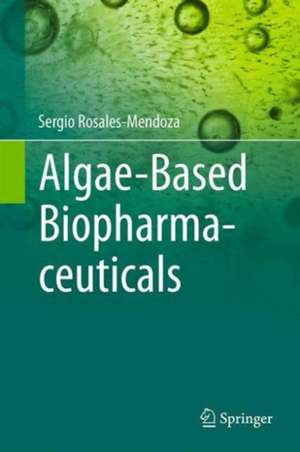
Algae-Based Biopharmaceuticals
Autor Sergio Rosales-Mendozaen Limba Engleză Hardback – 31 mai 2016
Bazându-ne pe datele tehnice furnizate de editura Springer și pe cuprinsul detaliat al lucrării, suntem de părere că Algae-Based Biopharmaceuticals reprezintă o resursă fundamentală pentru specialiștii în biotehnologie care explorează alternative sustenabile la sistemele tradiționale de producție. Volumul semnat de Sergio Rosales-Mendoza fundamentează utilizarea algelor ca platforme de expresie, evidențiind avantaje critice precum costurile scăzute, creșterea rapidă și absența patogenilor umani, elemente care le diferențiază net de sistemele bazate pe celule de mamifere. Structura cărții este riguros organizată pentru a ghida cititorul de la bazele teoretice la aplicații clinice complexe. Primele capitole analizează capacitatea biosintetică și instrumentele de inginerie genetică, evaluând comparativ abordările nucleare și cele bazate pe cloroplaste. Progresia narativă continuă cu secțiuni aplicate (capitolele 3-7) despre producția de vaccinuri umane și animale, anticorpi, imunotoxine și factori de creștere. Cititorii familiarizați cu Algae Biotechnology for Biomedical and Nutritional Applications de Ashfaq Ahmad vor aprecia în acest volum focalizarea specifică pe procesele de biomanufactură și pe provocările de reglementare necesare pentru aprobarea clinică a acestor compuși. Considerăm că integrarea capitolului despre nutraceutice și a perspectivei finale asupra bioreactoarelor oferă o viziune de ansamblu necesară oricărui cercetător. Cartea se înscrie organic în traiectoria academică a autorului, completând temele explorate în Genetically Engineered Plants as a Source of Vaccines Against Wide Spread Diseases, dar mutând accentul de pe plantele superioare pe versatilitatea sistemelor microalgale.
Preț: 664.24 lei
Preț vechi: 781.45 lei
-15%
Carte disponibilă
Livrare economică 16-30 noiembrie
Specificații
ISBN-10: 3319322303
Pagini: 176
Ilustrații: X, 166 p. 47 illus., 22 illus. in color.
Dimensiuni: 160 x 241 x 15 mm
Greutate: 0.42 kg
Ediția:1st ed. 2016
Editura: Springer
Locul publicării:Cham, Switzerland
V-ar putea interesa
-
 Plant Biotechnology: The genetic manipulation of plantsAdrian Slater-22%Preț: 407.23 lei520.58 lei
 -
 Principles of Plant Genetics and BreedingGeorge Acquaah-19%Preț: 445.21 lei549.64 lei
 -
 Plant BiologyAlison M. Smith-9%Preț: 714.55 lei785.23 lei
 -
 Preț: 145.40 lei
 -
 -18%Preț: 983.19 lei1199.01 lei
 -
 Forest Tree Breeding in EuropeLuc E. Pâques-18%Preț: 1283.48 lei1565.22 lei
De ce să citești această carte
Recomandăm această carte cercetătorilor și studenților la biotehnologie care doresc să înțeleagă potențialul algelor ca „fabrici verzi”. Veți câștiga o perspectivă clară asupra tehnicilor de inginerie genetică și a barierelor actuale în producția de vaccinuri și anticorpi. Este un instrument esențial pentru a trece de la cercetarea de laborator la implementarea industrială și conformitatea cu cadrele de reglementare internaționale.
Despre autor
Sergio Rosales-Mendoza este un cercetător recunoscut în domeniul biotehnologiei aplicate, cu un interes marcat pentru dezvoltarea sistemelor de expresie vegetale. Opera sa vastă include titluri precum Biomedical Innovations to Combat COVID-19 și Nanovaccines, demonstrând o expertiză multidisciplinară care îmbină virologia fizică cu imunologia. Prin lucrările sale, acesta a explorat constant utilizarea organismelor modificate genetic pentru combaterea bolilor infecțioase, Algae-Based Biopharmaceuticals fiind o extensie firească a cercetărilor sale privind vaccinurile vegetale și nanotehnologia aplicată în medicină.
Descriere scurtă
This book provides a detailed description of the technology as well as an updated outlook of the strides achieved thus far in the field of algae-based biopharmaceuticals. Algae constitute attractive expression hosts for the production of recombinant proteins with medical applications. Among the features that make them attractive candidates are: low cost, fast growth, wide biosynthetic capacity, and absence of human pathogens; which constitute substantial advantages with respect to bacterial and mammalian systems.
First, the features of algae as convenient hosts for the production of BFs are analyzed in terms of production costs, biosynthetic capacity, and safety (Chapter 1). Second, the genetic engineering tools for algae-species are described. Nuclear and chloroplast-based expression approaches are analyzed and compared in terms of biosynthetic advantages, gene expression complexity, and DNA transfer approaches (Chapter 2). In the following sections, chapters 3 to 7, the state of the art on producing distinct types of BFs in algae species is presented. Although this book is mainly focused on BFs, considering that the production of compounds with health-promoting properties are achieved using genetically-engineered algae strains, chapter 8 deals with nutraceuticals. In the ninth chapter, the developments reported thus far are placed in perspective and challenges for the field are discussed. Critical future prospects comprise the following: optimizing large-scale production in bioreactors, implementing glycoengineering approaches, optimizing nuclear expression, exploring new approaches for oral delivery, and implementing regulatory frameworks to accomplish technology transferand regulatory approval of algae-made BFs.