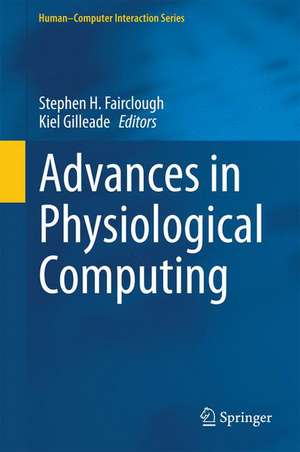
Advances in Physiological Computing: Human-Computer Interaction Series
Editat de Stephen H. Fairclough, Kiel Gilleadeen Limba Engleză Hardback – 8 apr 2014
Din seria Human-Computer Interaction Series
- 20%
 Preț: 1680.61 lei
 - 20%
 Preț: 1032.40 lei
 - 20%
 Preț: 1215.26 lei
 - 20%
 Preț: 668.49 lei
 - 20%
 Preț: 973.15 lei
 - 20%
 Preț: 666.97 lei
 - 20%
 Preț: 675.20 lei
 - 20%
 Preț: 680.66 lei
 - 20%
 Preț: 1030.45 lei
 - 20%
 Preț: 678.13 lei
 - 20%
 Preț: 852.80 lei
 - 20%
 Preț: 684.40 lei
 - 20%
 Preț: 665.73 lei
 - 15%
 Preț: 678.53 lei
 - 20%
 Preț: 676.21 lei
 - 67%
 Preț: 281.03 lei
 - 20%
 Preț: 1000.82 lei
 - 20%
 Preț: 342.45 lei
 - 20%
 Preț: 346.00 lei
 - 20%
 Preț: 997.57 lei
 - 20%
 Preț: 629.28 lei
 - 20%
 Preț: 342.90 lei
 - 20%
 Preț: 343.36 lei
 - 20%
 Preț: 644.91 lei
 - 20%
 Preț: 679.56 lei
 - 20%
 Preț: 632.78 lei
 - 20%
 Preț: 645.12 lei
 - 20%
 Preț: 961.76 lei
 - 66%
 Preț: 283.29 lei
 - 20%
 Preț: 640.58 lei
 - 38%
 Preț: 663.42 lei
 - 20%
 Preț: 999.31 lei
 - 20%
 Preț: 339.82 lei
 - 20%
 Preț: 652.64 lei
 - 20%
 Preț: 348.45 lei
 - 20%
 Preț: 1285.59 lei
 - 20%
 Preț: 330.54 lei
 - 20%
 Preț: 648.33 lei
 - 20%
 Preț: 1037.30 lei
 - 20%
 Preț: 640.65 lei
 - 20%
 Preț: 670.06 lei
 - 20%
 Preț: 871.85 lei
 - 20%
 Preț: 346.69 lei
 - 20%
 Preț: 996.74 lei
 - 35%
 Preț: 542.18 lei
 - 20%
 Preț: 357.26 lei
 - 24%
 Preț: 719.67 lei
Preț: 348.00 lei
Preț vechi: 435.00 lei
-20%
Puncte Express: 522
Carte tipărită la comandă
Livrare economică 30 noiembrie-14 decembrie
Livrare prin curier în România Termenul estimat este afișat lângă disponibilitate.
Transport gratuit de la 400.00 lei Plată online sau ramburs, în funcție de opțiunile comenzii.
Retur gratuit în 14 zile Comandă securizată și suport în română.
Specificații
ISBN-13: 9781447163916
ISBN-10: 1447163915
Pagini: 256
Ilustrații: XV, 238 p. 33 illus.
Dimensiuni: 160 x 241 x 20 mm
Greutate: 0.5 kg
Ediția:2014
Editura: Springer
Colecția Human-Computer Interaction Series
Seria Human-Computer Interaction Series
Locul publicării:London, United Kingdom
ISBN-10: 1447163915
Pagini: 256
Ilustrații: XV, 238 p. 33 illus.
Dimensiuni: 160 x 241 x 20 mm
Greutate: 0.5 kg
Ediția:2014
Editura: Springer
Colecția Human-Computer Interaction Series
Seria Human-Computer Interaction Series
Locul publicării:London, United Kingdom
V-ar putea interesa
-
 Schizophrenia: A Very Short IntroductionChris Frith-23%Preț: 59.21 lei76.67 lei
 -
 -26%Preț: 848.74 lei1152.46 lei
 -
 -26%Preț: 941.34 lei1279.20 lei
 -
 -26%Preț: 514.65 lei698.50 lei
 -
 Advances in Health Psychology: Critical ApproachesChristine HorrocksPreț: 322.44 lei
 -
 Introduction To Clinical Health PsychologyPaul Bennett-27%Preț: 213.50 lei293.65 lei
 -
 Essential Readings in Health PsychologyJane Ogden-28%Preț: 166.68 lei233.06 lei
 -
 Health Communication: Theory and PracticeDianne Berry-32%Preț: 204.56 lei299.84 lei
 -
 The Psychology of Lifestyle: Promoting Healthy BehaviourKathryn Thirlaway-5%Preț: 385.49 lei405.78 lei
 -
 SeparationE J M Bowlby-17%Preț: 103.03 lei124.70 lei
 -
 -31%Preț: 114.03 lei165.71 lei
 -
 -23%Preț: 1587.62 lei2074.22 lei
 -
 -23%Preț: 1587.83 lei2074.37 lei
 -
 -23%Preț: 1330.02 lei1736.23 lei
Public țintă
ResearchCuprins
Introduction.- Meaningful Interaction with Physiological Computing.- Engineering Issues in Physiological Computing.- Eye Tracking and Eye-Based Human-Computer Interaction.- Towards BCI-based Implicit Control in HCI.- Bio cybernetic Adaptation as Biofeedback Training.- Using fNIRS to Measure Mental Workload in the Real World.- Psychophysiological Feedback for Adaptive HRI.- The Drive to Explore.- The Vitality Bracelet.- Capturing HDM for Assisted Memory Recall.
Textul de pe ultima copertă
In the domain of physiological computing, human physiology is directly monitored and used as input to a technological system. Signals from the brain and body can be used to infer a user’s intentions and psychological state which enables a physiological computing system to respond and adapt in an appropriate fashion. A computer game could modify its level of difficulty according to the player's motivation or a word processor could disable incoming e-mail notifications when the user is concentrating.
Physiological computing is an exciting area of research which provides a speculative vision of how we may interact with technology in the future. The field is inherently interdisciplinary and encapsulates a significant breadth of knowledge from neuroscience to engineering. Advances in Physiological Computing provides a broad overview across this emerging area of research and emphasizes the common ground between the different disciplines in the field.
Physiological computing is an exciting area of research which provides a speculative vision of how we may interact with technology in the future. The field is inherently interdisciplinary and encapsulates a significant breadth of knowledge from neuroscience to engineering. Advances in Physiological Computing provides a broad overview across this emerging area of research and emphasizes the common ground between the different disciplines in the field.
Caracteristici
Broad overview of an emerging research field offering a unique and multidisciplinary insight into the area Emphasises the common ground between a range of physiological computing applications Provides a unique perspective on how we may interact with technology in the future Includes supplementary material: sn.pub/extras