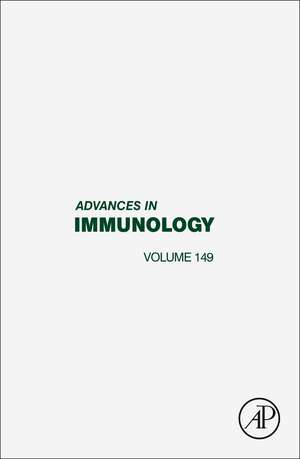
Advances in Immunology: Advances in Immunology, cartea 149
Editat de Frederick W. Alten Limba Engleză Hardback – 18 mai 2021
- Presents current developments and comprehensive reviews in immunology
- Provides the latest in a longstanding, respected serial on the subject matter
- Focuses on recent advances in the advancing area of the mechanisms involved in the evolution of HIV-1 neutralizing antibodies
Din seria Advances in Immunology
- 35%
 Preț: 806.80 lei
 - 33%
 Preț: 885.46 lei
 - 32%
 Preț: 840.40 lei
 - 32%
 Preț: 844.60 lei
 - 35%
 Preț: 841.15 lei
 - 33%
 Preț: 840.08 lei
 - 32%
 Preț: 848.23 lei
 - 25%
 Preț: 941.18 lei
 - 28%
 Preț: 904.32 lei
 - 29%
 Preț: 838.67 lei
 - 29%
 Preț: 840.90 lei
 - 29%
 Preț: 840.05 lei
 - 32%
 Preț: 846.84 lei
 - 32%
 Preț: 846.84 lei
 - 5%
 Preț: 437.97 lei
Preț: 937.57 lei
Preț vechi: 1178.53 lei
-20%
Puncte Express: 1406
Preț estimativ în valută:
165.78€ • 191.59$ • 143.23£
165.78€ • 191.59$ • 143.23£
Carte tipărită la comandă
Livrare economică 27 aprilie-11 mai
Specificații
ISBN-13: 9780128245972
ISBN-10: 0128245972
Pagini: 122
Dimensiuni: 152 x 229 mm
Greutate: 0.34 kg
Editura: ELSEVIER SCIENCE
Seria Advances in Immunology
ISBN-10: 0128245972
Pagini: 122
Dimensiuni: 152 x 229 mm
Greutate: 0.34 kg
Editura: ELSEVIER SCIENCE
Seria Advances in Immunology
V-ar putea interesa
-
 Integrative RheumatologyRandy Horwitz-20%Preț: 469.24 lei582.97 lei
 -
 Human PsychoneuroimmunologyKavita Vedhara-31%Preț: 865.48 lei1258.65 lei
 -
 MMR and Autism: What Parents Need to KnowMichael Fitzpatrick-5%Preț: 350.35 lei368.79 lei
 -
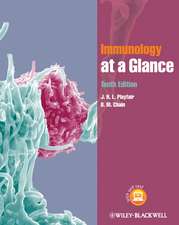 Immunology at a Glance 10eJ Playfair-5%Preț: 261.29 lei275.05 lei
 -
 -5%Preț: 268.60 lei282.74 lei
 -
 Allergy and Clinical ImmunologyHugh A. Sampson-5%Preț: 506.26 lei532.90 lei
 -
 Vaccines and AutoimmunityNicola Luigi Bragazzi-9%Preț: 986.87 lei1084.47 lei
 -
 Atlas of Lymph Node PathologyRoberto N. Miranda-5%Preț: 1889.45 lei1988.90 lei
 -
 Major Histocompatibility Complex: Biology, Functions & Roles in DiseaseNatalya V Semiletova-30%Preț: 1147.32 lei1645.01 lei
 -
 Lupus Renal Involvement: A Case-Based AtlasGyl Eanes Barros Silva-18%Preț: 782.86 lei953.89 lei
 -
 Behçets Disease: Progress in Recent Years & Unmet Needs for the FutureShunsei Hirohata MD-18%Preț: 1646.39 lei2003.84 lei
Public țintă
Immunologists and infectious disease specialists, cell biologists and hematologists.Cuprins
Contributors
Early Steps of Follicular Lymphoma Pathogenesis
1. Follicular Lymphoma
2. The Classical Model of Follicular Lymphomagenesis
3. Circulating and Resident t(14;18) Cells Detected in Healthy Individuals are not Naive B-Cells
4. The “Allelic Paradox: A Particular Immuno/Genophenotype of t(14;18)+ Activated B-Cells Which Does Not Match Any of the Physiological Memory Subsets Present in Blood
5. A Fraction of t(14;18) Cells in Healthy Carriers are Developmentally “Blocked Follicular Lymphoma-Like Cells (FLLC)
6. BCL2, BCL6, Maturation Arrest, and the Role of the IgM Receptor
7. Trafficking, Early Dissemination, and Progression
8. A Protracted Model of Multi-Hit FL Genesis
9. Perspectives
Acknowledgments
“A Rose is a Rose is a Rose, but CVID is Not CVID
1. Introduction
2. Definition and Diagnostic Criteria
3. Epidemiology
4. Pathophysiology/Immunopathology
5. Etiology/Genetics
6. CVID Classification Schemes
7. Clinical Presentation and Complications
8. Management
9. Prognosis and Survival
10. Summary
Role of Activation-Induced Cytidine Deaminase in Inflammation-Associated Cancer Development
Abbreviations
1. Introduction: Cancer as a Genetic Disease
2. Nucleotide-Editing Enzymes as Inducers of Mutations
3. Physiologic Roles of AID in Antibody Production
4. Regulation of AID Expression in B Cells
5. Excessive AID Activity and Genetic Alterations Leading to Tumorigenesis
6. Roles of AID in Inflammation-Associated Human Carcinogenesis
7. Role of AID in the Development of Hematopoietic Malignancy
8. Conclusion
Acknowledgments
Comparative Genomics and Evolution of Immunoglobulin-Encoding Loci in Tetrapods
1. Introduction
2. Structure and Function of Antibodies
3. Ig-Heavy Chain in Tetrapods
4. Ig-Light Chains in Tetrapods
5. Evolution of Immunoglobulin J-Chain
6. Noncanonical Antibodies in Camelids
7. Concordance and Divergence of the Generation of Antibody Diversity
8. Concluding Remarks
Acknowledgments
Pax5
1. Pax5 and B Cell Commitment
2. Pax5 and the Control of Igh Rearrangements
3. Pax5 and Late B Cell Development
4. Role of Pax5 in B Cell Malignancies
5. Perspective
Acknowledgments
Early Steps of Follicular Lymphoma Pathogenesis
1. Follicular Lymphoma
2. The Classical Model of Follicular Lymphomagenesis
3. Circulating and Resident t(14;18) Cells Detected in Healthy Individuals are not Naive B-Cells
4. The “Allelic Paradox: A Particular Immuno/Genophenotype of t(14;18)+ Activated B-Cells Which Does Not Match Any of the Physiological Memory Subsets Present in Blood
5. A Fraction of t(14;18) Cells in Healthy Carriers are Developmentally “Blocked Follicular Lymphoma-Like Cells (FLLC)
6. BCL2, BCL6, Maturation Arrest, and the Role of the IgM Receptor
7. Trafficking, Early Dissemination, and Progression
8. A Protracted Model of Multi-Hit FL Genesis
9. Perspectives
Acknowledgments
“A Rose is a Rose is a Rose, but CVID is Not CVID
1. Introduction
2. Definition and Diagnostic Criteria
3. Epidemiology
4. Pathophysiology/Immunopathology
5. Etiology/Genetics
6. CVID Classification Schemes
7. Clinical Presentation and Complications
8. Management
9. Prognosis and Survival
10. Summary
Role of Activation-Induced Cytidine Deaminase in Inflammation-Associated Cancer Development
Abbreviations
1. Introduction: Cancer as a Genetic Disease
2. Nucleotide-Editing Enzymes as Inducers of Mutations
3. Physiologic Roles of AID in Antibody Production
4. Regulation of AID Expression in B Cells
5. Excessive AID Activity and Genetic Alterations Leading to Tumorigenesis
6. Roles of AID in Inflammation-Associated Human Carcinogenesis
7. Role of AID in the Development of Hematopoietic Malignancy
8. Conclusion
Acknowledgments
Comparative Genomics and Evolution of Immunoglobulin-Encoding Loci in Tetrapods
1. Introduction
2. Structure and Function of Antibodies
3. Ig-Heavy Chain in Tetrapods
4. Ig-Light Chains in Tetrapods
5. Evolution of Immunoglobulin J-Chain
6. Noncanonical Antibodies in Camelids
7. Concordance and Divergence of the Generation of Antibody Diversity
8. Concluding Remarks
Acknowledgments
Pax5
1. Pax5 and B Cell Commitment
2. Pax5 and the Control of Igh Rearrangements
3. Pax5 and Late B Cell Development
4. Role of Pax5 in B Cell Malignancies
5. Perspective
Acknowledgments
Recenzii
"The series which all immunologists need." --THE PHARMACEUTICAL JOURNAL
"Advances in Immunology must find itself among the most active volumes in the libraries of our universities and institutions." --SCIENCE
"Deserves a permanent place in biomedical libraries as an aid in research and in teaching." --JOURNAL OF IMMUNOLOGICAL METHODS
"Advances in Immunology must find itself among the most active volumes in the libraries of our universities and institutions." --SCIENCE
"Deserves a permanent place in biomedical libraries as an aid in research and in teaching." --JOURNAL OF IMMUNOLOGICAL METHODS