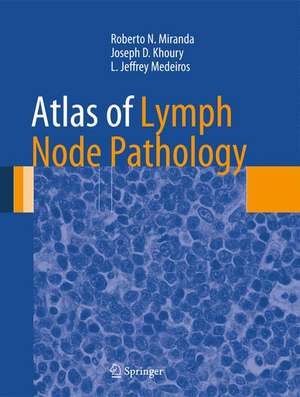
Atlas of Lymph Node Pathology: Atlas of Anatomic Pathology
Autor Roberto N. Miranda, Joseph D. Khoury, L. Jeffrey Medeirosen Limba Engleză Hardback – 6 aug 2013
Actualizarea ghidurilor în patologia ganglionară a devenit imperativă pe măsură ce tehnicile auxiliare de diagnostic, precum imunohistochimia și studiile moleculare, au redefinit criteriile de clasificare pentru leziunile reactive și neoplazice. Găsim în Atlas of Lymph Node Pathology o resursă clinică ce răspunde acestor schimbări, oferind o corelare riguroasă între morfologia clasică și datele patogenice recente. Suntem de părere că forța acestui volum rezidă în capacitatea sa de a sistematiza complexitatea arhitecturală a ganglionului limfatic, transformând-o într-un instrument de diagnostic predictibil.
Structura atlasului este una progresivă și extrem de logică: debutează cu arhitectura și funcția normală, continuând cu hiperplaziile reactive (foliculare și paracorticale) și o trecere în revistă exhaustivă a limfadenitelor, de la cele bacteriene și micobacteriene la infecții virale precum HIV sau CMV. Reținem, de asemenea, includerea unor entități rare dar critice în diagnosticul diferențial, precum boala Kikuchi-Fujimoto sau boala Castleman. Această organizare reflectă experiența vastă a autorilor, printre care se numără Roberto N. Miranda și L. Jeffrey Medeiros, acesta din urmă fiind o figură proeminentă în domeniu, cunoscut și pentru volumul Diagnostic Pathology: Lymph Nodes and Extranodal Lymphomas. Spre deosebire de acea lucrare, care pune un accent mai mare pe aspectele moleculare și limfoamele extranodale, atlasul de față se concentrează pe histopatologia nodală pură și pe algoritmi vizuali de diagnostic.
Ca alternativă la A Pattern Approach to Lymph Node Diagnosis pentru rezidenți, acest volum oferă avantajul unei acoperiri mult mai largi a patologiilor non-neoplazice și infecțioase, fiind mai mult decât un ghid de recunoaștere a tiparelor; este un compendiu de diagnostic diferențial susținut de imagini macroscopice și tabele de sinteză care clarifică entitățile cu aspecte morfologice similare.




Preț: 1890.74 lei
Preț vechi: 1990.25 lei
-5%
Carte disponibilă
Livrare economică 19 mai-02 iunie
Specificații
ISBN-10: 1461479584
Pagini: 552
Ilustrații: XIX, 530 p. 757 illus. in color.
Dimensiuni: 215 x 285 x 34 mm
Greutate: 1.58 kg
Ediția:2013
Editura: Springer
Colecția Atlas of Anatomic Pathology
Seria Atlas of Anatomic Pathology
Locul publicării:New York, NY, United States
V-ar putea interesa
-
 HistopathologyGuy Orchard-16%Preț: 402.96 lei481.10 lei
 -
 Atlas of Head and Neck PathologyBruce M. Wenig-29%Preț: 1958.32 lei2744.48 lei
 -
 -24%Preț: 1235.75 lei1624.64 lei
 -
 Diagnostic Pathology: SpleenAaron Auerbach-29%Preț: 1308.07 lei1846.80 lei
 -
 DermatopathologyKlaus J. Busam-24%Preț: 1243.08 lei1629.31 lei
 -
 HematopathologyElaine Sarkin Jaffe-28%Preț: 1657.36 lei2315.95 lei
 -
 Diagnostic Pathology: Lymph Nodes and Extranodal LymphomasL. Jeffrey Medeiros-29%Preț: 1583.87 lei2224.75 lei
 -
 -30%Preț: 1205.26 lei1717.21 lei
 -
 DermatopathologyDirk M. Elston-5%Preț: 823.10 lei866.42 lei
 -
 Pulmonary PathologyDani S. Zander-29%Preț: 1179.87 lei1651.64 lei
 -
 Weedon's Skin PathologyJames W. Patterson-28%Preț: 2056.74 lei2871.29 lei
 -
 Diagnostic Pathology: Soft Tissue TumorsMatthew R. Lindberg-29%Preț: 1467.19 lei2056.69 lei
 -
 -29%Preț: 1243.68 lei1741.61 leiRecomandat
 -
 Diagnostic Pathology: Pediatric NeoplasmsAngelica R. Putnam-29%Preț: 1709.70 lei2408.51 lei
 -
 -29%Preț: 757.84 lei1068.69 leiRecomandat
 -
 Breast Pathology: A Volume in the Series: Foundations in Diagnostic PathologyFrances P. O'Malley-25%Preț: 799.63 lei1065.60 lei
 -
 Ioachim's Lymph Node PathologyL. Jeffrey Medeiros-22%Preț: 1718.01 lei2208.69 lei
 -
 Atlas of Lymph Node Pathology: A Pattern Based ApproachAmy S. Duffield MD-22%Preț: 1489.41 lei1907.66 lei
 -
 Biopsy Interpretation of the Lymph Node: Print + eBook with MultimediaRebecca Leigh King MD-23%Preț: 1089.71 lei1414.70 lei
 -
 Atlas of Infectious Disease PathologyBryan H. Schmitt-5%Preț: 1002.35 lei1055.11 lei
Public țintă
Professional/practitionerDe ce să citești această carte
Această lucrare este esențială pentru patologii practicieni și oncologii care au nevoie de un reper vizual precis în diagnosticul afecțiunilor ganglionare. Cititorul câștigă acces la algoritmi de diagnostic clarificați și la o vastă colecție de imagini histopatologice ce acoperă atât procesele inflamatorii, cât și pe cele tumorale, facilitând o interpretare rapidă și corectă în practica zilnică de laborator.
Despre autor
Roberto N. Miranda, Joseph D. Khoury și L. Jeffrey Medeiros sunt patologi de renume internațional, cu o vastă experiență în hematopatologie. L. Jeffrey Medeiros, în special, este recunoscut pentru contribuțiile sale majore în clasificarea limfoamelor și a leziunilor hematolinfocitare, fiind autorul mai multor tratate de referință în domeniu. Expertiza lor combinată asigură o abordare clinică riguroasă, transformând acest atlas într-un standard de aur pentru studiul patologiei anatomice a ganglionilor limfatici, integrând observația microscopică cu relevanța clinică imediată.
Descriere scurtă
Authored by highly experienced pathologists, Atlas of Lymph Node Pathology is a valuable resource that illustrates the vast majority of diseases practicing pathologists, clinicians and oncologists are likely to encounter in daily practice.
Cuprins
Recenzii
“This addition to the Atlas of Anatomic Pathology series covers the full spectrum of neoplastic and non-neoplastic conditions of the lymph node. … a good resource for pathologists in training, practicing pathologists, or any clinicians interested in the study of lymph node histopathology. … This is a good quick reference. … the abundant images and a virtually all-inclusive list of lymph node pathological entities makes this atlas worth adding to the library of anyone with an interest in learning more about lymph node histopathology.” (Jamie Boone, Doody’s Book Reviews, January, 2014)
Notă biografică
M.D. Anderson Cancer Center, The University of Texas, Department of Hematopathology, Houston, TX, USA
Joseph D. Khoury, MD
M.D. Anderson Cancer Center, The University of Texas, Department of Hematopathology, Houston, TX, USA
L. Jeffrey Medeiros, MD
M.D. Anderson Cancer Center, The University of Texas, Department of Hematopathology, Houston, TX, USA