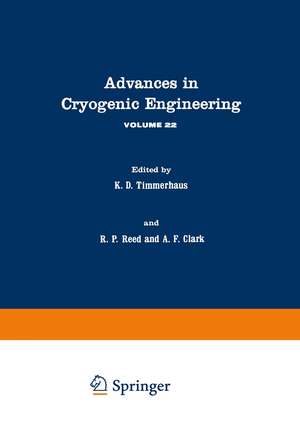
Advances in Cryogenic Engineering: Volume 22: Advances in Cryogenic Engineering, cartea 22
Editat de K. Timmerhausen Limba Engleză Paperback – 12 oct 2012
| Toate formatele și edițiile | Preț | Express |
|---|---|---|
| Paperback (4) | 394.68 lei 6-8 săpt. | |
| Springer Us – 10 oct 2013 | 394.68 lei 6-8 săpt. | |
| Springer Us – 12 oct 2012 | 396.36 lei 6-8 săpt. | |
| Springer Us – 15 noi 2011 | 405.41 lei 6-8 săpt. | |
| Springer Us – 26 noi 2012 | 634.86 lei 6-8 săpt. |
Din seria Advances in Cryogenic Engineering
- 18%
 Preț: 1776.01 lei
 - 15%
 Preț: 624.77 lei
 - 15%
 Preț: 634.86 lei
 -
 Preț: 390.81 lei
 -
 Preț: 394.85 lei
 -
 Preț: 416.69 lei
 -
 Preț: 427.21 lei
 -
 Preț: 435.36 lei
 -
 Preț: 540.59 lei
 -
 Preț: 410.00 lei
 -
 Preț: 407.06 lei
 - 18%
 Preț: 1190.65 lei
 - 24%
 Preț: 1888.23 lei
 - 18%
 Preț: 1769.35 lei
 - 18%
 Preț: 1770.41 lei
 - 18%
 Preț: 1761.77 lei
 - 24%
 Preț: 1137.29 lei
Preț: 396.36 lei
Puncte Express: 595
Preț estimativ în valută:
70.09€ • 82.26$ • 60.80£
70.09€ • 82.26$ • 60.80£
Carte tipărită la comandă
Livrare economică 10-24 martie
Specificații
ISBN-13: 9781461398523
ISBN-10: 1461398525
Pagini: 572
Ilustrații: XI, 559 p.
Dimensiuni: 178 x 254 x 30 mm
Greutate: 0.98 kg
Ediția:Softcover reprint of the original 1st ed. 1977
Editura: Springer Us
Colecția Springer
Seria Advances in Cryogenic Engineering
Locul publicării:New York, NY, United States
ISBN-10: 1461398525
Pagini: 572
Ilustrații: XI, 559 p.
Dimensiuni: 178 x 254 x 30 mm
Greutate: 0.98 kg
Ediția:Softcover reprint of the original 1st ed. 1977
Editura: Springer Us
Colecția Springer
Seria Advances in Cryogenic Engineering
Locul publicării:New York, NY, United States
V-ar putea interesa
-
 Structural Fire Loads: Theory and PrinciplesLeo Razdolsky-35%Preț: 717.93 lei1098.63 lei
 -
 CATIA V5Dieter Ziethen-34%Preț: 765.00 lei1164.71 lei
 -
 A Guide to the Collision Avoidance RulesA. N. Cockcroft-31%Preț: 393.43 lei570.45 lei
 -
 Gas Turbine Engineering HandbookMeherwan P. Boyce-22%Preț: 764.20 lei984.20 lei
 -
 DSP for Embedded and Real-Time SystemsRobert Oshana-24%Preț: 384.84 lei505.76 lei
 -
 Solar Cells: Materials, Manufacture and OperationAugustin McEvoy-23%Preț: 943.87 lei1225.80 lei
 -
 MATLAB® by Example: Programming BasicsMunther Gdeisat-31%Preț: 339.95 lei490.99 lei
 -
 -33%Preț: 227.58 lei341.11 lei
 -
 Engineering Your Future, 3eStuart G WaleshPreț: 429.04 lei
 -
 Signals and Systems for DummiesMark WickertPreț: 132.70 lei
 -
 The Effect of Sterilization on Plastics and ElastomersLaurence W. McKeen-24%Preț: 1548.14 lei2029.25 lei
 -
 Preț: 166.33 lei
 -
 Social Media for Engineers and ScientistsJon DiPietro-8%Preț: 470.33 lei511.23 lei
 -
 Recent Advances in Microbiology: Volume IShree Prakash Tiwari-30%Preț: 1750.47 lei2518.21 lei
Public țintă
ResearchCuprins
Structural Alloys—Fracture.- A—1 A Research Program on the Properties of Structural Materials at 4 K.- A—2 Fracture Mechanics and Its Application to Cryogenic Structures.- A—3 The Fracture Toughness of Cryogenic Steels.- A—4 Fatigue Crack Growth Rates of Structural Alloys at 4 K.- A—5 Cryogenic Fracture Mechanics Properties of Several Manufacturing Process/Heat Treatment Combinations of Inconel X750.- A—6 Microstructures of Inconel X750 for Cryogenic Structural Applications.- A—7 The Fracture Toughness and Fatigue Crack Growth Rate of an Fe-Ni-Cr Superalloy at 298,76, and 4 K.- A—8 Evaluation of Inconel X750 Weldments for Cryogenic Applications.- A—9 Accident Simulation Tests on a Wet-Wall LNG Design.- A—10 Plasticity and Fracture of Ductile Structural Alloys under Plane Stress at Low Temperatures.- A—11 Crack Tip Strain Field of Strain-Hardening Materials at Low Temperature.- A—12 Mechanical Property Measurement Techniques of Structural Materials at Cryogenic Temperatures.- Structural Alloys—Physical Properties.- B—1 Magnetothermal Conductivity of Selected Pure Metals and Alloys.- B—2 Thermal and Electrical Measurements on Selected Materials for Low-Temperature Applications.- B—3 Thermal Conductivity of Selected Alloys at Low Temperatures.- B—4 Low-Temperature Thermal Conductivity and Dislocation Structures in Copper—Aluminum Alloys under High-Cycle Low-Stress Fatigue.- B—5 Measurement of Thermal Conductance.- B—6 Magnetic and Thermal Properties of Stainless Steel and Inconel at Cryogenic Temperatures.- B—7 Low-Temperature Elastic Properties of Invar.- B—8 Embrittlement Mechanisms in a Hydrogen Environment.- Composites.- C—1 Application of Fiber-Reinforced Polymers to Rotating Superconducting Machinery.- C—2 StaticTensile Properties of Boron—Aluminum and Boron—Epoxy Composites at Cryogenic Temperatures.- C—3 Low Thermal Flux Glass-Fiber Tubing for Cryogenic Service.- C—4 Optimization of Mechanical Supports for Large Superconductive Magnets.- Insulators—Thermal.- D—1 Aging Characteristics of Polyurethane Foam Insulation.- D—2 Cellular Glass Insulation for Load-Bearing Application in the Storage of Cryogenic Fluids.- D—3 Thermal Conductivity of Microsphere Cryogenic Insulation.- D—4 Apparent Thermal Conductivity of Uncoated Microsphere Cryogenic Insulation.- D—5 Thermal Performance of Multilayer Insulation Applied to Small Cryogenic Tankage.- Insulators—Electrical.- E—1 Low-Temperature Properties of Resins and Their Correlations.- E—2 Evaluation of Pre-Impregnated Resin-Glass Systems for Insulating Superconducting Magnets.- E—3 Dielectric Design Considerations for a Flexible Superconducting Power Transmission Cable.- E—4 Surface Flashover Voltage of Spacers in Vacuum at Cryogenic Temperatures.- E—5 Dimensional Behavior of Thin-Film Dielectric Polymers in the Temperature Range 4.2 to 300 K.- Superconductors.- F—1 Superconducting Materials for Large Scale Applications.- F—2 Effect of Metallurgical Treatments on AC Losses of Nb3Sn Produced by Solid State Diffusion.- F—3 Critical Current and AC Loss of Coevaporated Nb3Sn Superconductors.- F—4 Nb3Sn for Superconducting RF Cavities.- F—5 Chemical Vapor Deposition of Nb3Ge.- Superconductors—Multifilamentary.- G—1 Improvements in Critical Current Densities of Nb3Sn by Solid Solution Additions of Sn in Nb.- G—2 Performance Data of a Multifilamentary Nb3Sn Conductor and Magnet.- G—3 Test Results of a 27-Cm Bore Multifilamentary Nb3Sn Solenoid.- G—4 Superconducting Wire Test at Fermilab.-G—5 Superconducting Wires for a Pulsed Magnet.- G—6 Survey Results of Multifilamentary Nb—Ti Users.- G—7 Single-Phase Helium as Coolant for Superconducting Magnets.- G—8 Critical Rate of Magnetic Field Variation for Composite Superconductor.- G—9 Stability of Composite Superconductors under AC Conditions.- Transient Losses in Superconductors.- H—1 Technique for Measuring AC Losses in Thin-Film Superconductors.- H—2 Field Orientation Dependence of Losses in Rectangular Multifilamentary Superconductors.- H—3 Hysteresis Loss in a Multifilament Superconductor.- H—4 Design of Helically-Wound Superconducting AC Power Transmission Cables.- H—5 Interaction between Two Parallel Superconducting Wires Carrying Alternating Current.- Stress Effects in Conductor Materials.- I—1 Effect of Stress on the Critical Current of NbTi Multifilamentary Composite Wire.- I—2 Mechanical Properties of Superconducting Nb-Ti Composites.- I—3 Low Temperature Tensile Behavior of Copper-Stabilized Niobium-Titanium Superconducting Wire.- I—4 Electrical and Mechanical Properties of Dilute Aluminum—Gold Alloys at 300,77, and 4.2 K.- I—5 Effect of Cyclic Strain on Electrical Resistivity of Copper at 4.2 K.- I—6 Low Temperature Resistance of Cyclically Strained Aluminum.- I—7 Stress Analysis of Nonhomogeneous Superconducting Solenoids.- I—8 Study of Cooldown Stresses in the Cryogenic Envelope of a Superconducting Cable.- Special Materials.- J—1 Aboveground Concrete Secondary Containment for LNG.- J—2 Thin Windows for Gaseous and Liquid Targets: An Optimization Procedure.- J—3 A Promising New Cryogenic Seal Candidate.- Indexes.- Author Index.- Material Index.