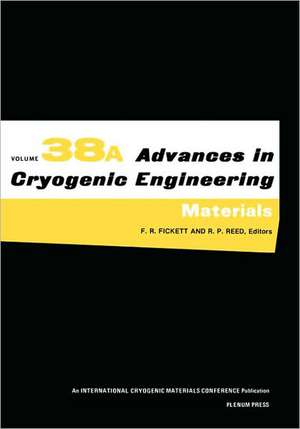
Materials: Advances in Cryogenic Engineering, cartea 38
Editat de Richard P. Reed, F. R. Ficketten Limba Engleză Hardback – 30 apr 1992
Din seria Advances in Cryogenic Engineering
- 18%
 Preț: 1800.18 lei
 - 15%
 Preț: 624.77 lei
 - 15%
 Preț: 634.86 lei
 -
 Preț: 390.81 lei
 -
 Preț: 394.85 lei
 -
 Preț: 416.69 lei
 -
 Preț: 451.78 lei
 -
 Preț: 435.36 lei
 -
 Preț: 540.59 lei
 -
 Preț: 410.00 lei
 -
 Preț: 407.06 lei
 - 18%
 Preț: 1183.12 lei
 - 24%
 Preț: 1747.10 lei
 - 18%
 Preț: 1899.62 lei
 - 24%
 Preț: 1823.63 lei
 - 18%
 Preț: 1891.01 lei
 - 24%
 Preț: 1137.29 lei
Preț: 1277.85 lei
Preț vechi: 1558.36 lei
-18%
Puncte Express: 1917
Carte tipărită la comandă
Livrare economică 04-18 decembrie
Livrare prin curier în România Termenul estimat este afișat lângă disponibilitate.
Transport gratuit pentru acest produs Plată online sau ramburs, în funcție de opțiunile comenzii.
Retur gratuit în 14 zile Comandă securizată și suport în română.
Specificații
ISBN-13: 9780306441837
ISBN-10: 0306441837
Pagini: 484
Ilustrații: XXII, 457 p.
Dimensiuni: 183 x 260 x 31 mm
Greutate: 1.04 kg
Ediția:1992
Editura: Springer Us
Colecția Advances in Cryogenic Engineering
Seria Advances in Cryogenic Engineering
Locul publicării:New York, NY, United States
ISBN-10: 0306441837
Pagini: 484
Ilustrații: XXII, 457 p.
Dimensiuni: 183 x 260 x 31 mm
Greutate: 1.04 kg
Ediția:1992
Editura: Springer Us
Colecția Advances in Cryogenic Engineering
Seria Advances in Cryogenic Engineering
Locul publicării:New York, NY, United States
V-ar putea interesa
-
 -23%Preț: 369.34 lei480.57 lei
 -
 The Current Status and Future Direction of High-Magnetic-Field Science and Technology in the United StatesNational Academies of Sciences Engineering and MedicinePreț: 196.75 lei
 -
 -23%Preț: 714.25 lei927.59 lei
 -
 -30%Preț: 97.81 lei139.80 lei
 -
 TMS 2020 149th Annual Meeting & Exhibition Supplemental ProcThe Minerals, Metals & Materials Society-20%Preț: 1250.06 lei1562.58 lei
 -
 Dynamic Behavior of Materials, Volume 1Leslie Lamberson-18%Preț: 1652.66 lei2015.44 lei
 -
 -18%Preț: 1380.91 lei1684.04 lei
 -
 Dynamic Behavior of Materials, Volume 1Steven Mates-18%Preț: 1384.20 lei1688.05 lei
 -
 -18%Preț: 1453.61 lei1772.69 lei
 -
 -18%Preț: 991.29 lei1208.89 lei
 -
 Progress in Materials Science and EngineeringCarlos Brebbia-15%Preț: 667.19 lei784.93 lei
 -
 -14%Preț: 681.78 lei792.77 lei
 -
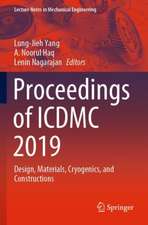 Proceedings of ICDMC 2019Lung-Jieh Yang-24%Preț: 1205.69 lei1586.43 lei
 -
 Advanced Materials and ManufacturingJitendra Kumar Katiyar-18%Preț: 1402.65 lei1710.55 lei
 -
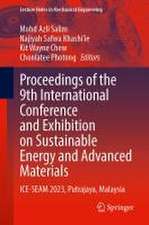 -18%Preț: 1514.82 lei1847.34 lei
 -
 -24%Preț: 1915.67 lei2520.62 lei
 -
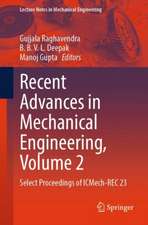 -18%Preț: 2388.83 lei2913.21 lei
 -
 Advances in Materials EngineeringPramod Bhingole-18%Preț: 1274.10 lei1553.78 lei
 -
 Dynamic Behavior of Soft and Hard Materials, Volume 3R. Velmurugan-18%Preț: 1442.46 lei1759.09 lei
Public țintă
ResearchCuprins
Mechanical Properties of Incoloy 908 — An Update.- The Effect of Indium Additions on the Cryogenic Tensile Properties of Superplastically Deformed Al-Cu-Li-Zr Alloy 2090.- Deformation and Fracture of Al-Li Alloys in Mechanical-Impact Tests.- Microstructure and Cryogenic Tensile Fracture Behavior of an Al-Li-Zn-Zr Alloy.- Microstructural Influence on the Work Hardening of Aluminumlithium Alloy 2090 at Cryogenic Temperatures.- Effects of Nb3Sn Heat Treatment on the Strength and Toughness of 316LN Alloys with Different Carbon Contents.- Metastable Austenites in Cryogenic High Magnetic Field Environments.- Property Evaluation of Ni Base Alloy for Superconducting Generators and Its Application to Seal Welded Joints.- Vamas Second Round Robin Test of Structural Materials at Liquid Helium Temperature.- Effect of Hydrogen Charging on Ambient and Cryogenic Mechanical Properties of a Precipitate-Strengthened Austenitic Steel.- Deformation Measurements of Materials at Low Temperatures Using Laser Speckle Photography Method.- Hydrogen Effect on the Mechanical Properties of Incoloy 907 from Ambient to Cryogenic Temperature.- Thick-Section Weldments in 21-6-9 and 316LN Stainless Steel for Fusion Energy Applications.- Joining of Austenitic Stainless Steels for Cryogenic Applications.- Creep of Indium at Low Temperatures.- 1100 Hour Creep Test Results for Ofhc Copper: Validation of Previously Published Results.- Fatigue and Fatigue Crack Growth Properties of 316LN and Incoloy 908 Below 10 K.- Deformation Structures in High-Cycle Fatigue of 0.1N32Mn-7Cr Steel at Cryogenic Temperatures.- Near-Threshold Fatigue Crack Growth of Austenitic Stainless Steels at Liquid Helium Temperature.- Long-Crack Fatigue Thresholds and Short Crack Simulation at Liquid Helium Temperature.- SuperconductorConduits: Fatigue Crack Growth Rate and Near-Threshold Behavior of Three Alloys.- High-Cycle Fatigue Properties of Titanium Alloys at Cryogenic Temperatures.- Cold Thermal Fatigue of Austenitic Stainless Steel.- Influence of Aging on the Fracture Toughness of Cryogenic Austenitic Materials, Evaluated by a Simple Test Method.- Effects of Boron on Increasing Toughness of High Strength High Manganese Non-Magnetic Steels.- The Charpy Impact Test as an Evaluation of 4 K Fracture Toughness.- Charpy Specimen Tests at 4 K.- Selected Residual Effects Upon Temperature Transitions.- Reactor Neutron and Gamma Irradiation of Various Composite Materials.- Radiation Damage of Glass-Fiber-Reinforced Composite Materials at Low Temperatures.- Effects of Fabric Type, Specimen Size, and Irradiation Atmosphere on the Radiation Resistance of Polymer Composites at 77 K.- A Radiation-Resistant Epdxy Resin System for Toroidal Field and Other Superconducting Coil Fabrication.- Effects of Radiation on Insulation Materials.- Radiation Effects on High Current Diodes at Cryogenic Temperatures in an Accelerator Environment.- Alumina Dispersion-Strengthened Copper Alloy Matrix Ti Added Nb3Sn Wire by the Tube Process.- Electrical Resistivity of Nanocrystalline Ni-P Alloys.- Magnetic Property of Gadolinium Hydrides.- Quench Protection Diodes for the Large Hadron Collider (LHC) at Cern.- Coefficient of Friction Measurements of Solid Film Lubricants at Cryogenic Temperatures.- Magneto-Transport Properties of Filamentary Aluminum Conductors in Magnetic Fields, 12–30 K.- Tribological Behavior of 440C Martensitic Stainless Steel from -184°C TO 750°C.- Scaling Tests on Smooth and Notched Specimens of Polyimide (Sintimid) at Cryogenic Temperatures.- Several Properties of Impregnating Epdxy Resins Used forSuperconducting Coils.- Shear Behavior of Glass-Reinforced Systems at Low Temperatures.- Shear Fracture Tests (Mode II) on Fiber Reinforced Plastics at Room and Cryogenic Temperatures.- Compression and Shear Tests of Vacuum-Impregnated Composites at Cryogenic Temperatures.- Cryogenic Fatigue Testing of Glass Reinforced Epdxy Tubes.- Glass-Film-Glass Hybrid Organic Composites for Forced-Flow Fusion Magnets.- Fracture-Mechanical Characterization of Fiber Reinforced Plastics in the Crack-Opening-Mode (Mode I).- Fracto-Emission from Crystalline and Non-Crystalline Materials at Cryogenic Temperatures.- Friction and Wear of Radiation Resistant Composites, Coatings and Ceramics in Vacuum and Low Temperature Environment.- An Innovative Process for the Impregnation of Magnet Coils and Other Structures.- Large Scale Tests of Composite Support Struts for Superconducting Magnetic Energy Storage Rings.- Friction and Wear of a Three-Dimensional Fabric-Reinforced Plastic at Room Temperature and Liquid Nitrogen Temperature.- Modification of the Astm D 3039 Tensile Specimen for Cryogenic Applications.- Thermal Insulating Support Systems for Radiation Environments.- Fatigue Behavior of UD-Carbon-Fibre Composites Cryogenic Temperatures.