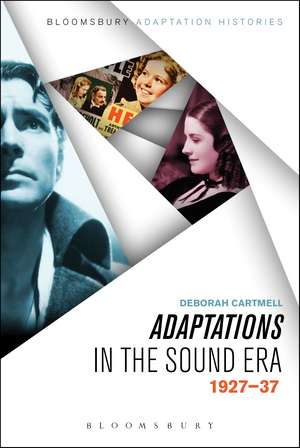
Adaptations in the Sound Era: 1927-37: Bloomsbury Adaptation Histories
Autor Dr. Deborah Cartmellen Limba Engleză Paperback – 30 iul 2015
Focusing on promotional materials, Adaptations in the Sound Era tracks early attempts to promote sound through the elevation of words in adaptations in the early sound period. The popular appeal of these films clearly stands in opposition to academic regard for them and the book reflects on the presence and marketing of 'words' in a variety of adaptations, from the introduction of sound in the late 1920s to the mid 1930s. This book contextualizes a range of adaptations in relation to debates about 'picturizations' of books in the early sound era, including reactions to the talking adaptation by writers such as, Irwin Panofsky, Aldous Huxley and Graham Greene. Film adaptations of Shakespeare, Dickens, gothic fiction and biopics are also discussed in relation to their use and promotion of sound or, more precisely, words.

Preț: 195.63 lei
Preț vechi: 265.68 lei
-26%
Puncte Express: 293
Carte tipărită la comandă
Livrare economică 08-22 iunie
Specificații
ISBN-13: 9781623568788
ISBN-10: 1623568781
Pagini: 176
Ilustrații: 14 bw illus
Dimensiuni: 152 x 229 x 13 mm
Greutate: 0.27 kg
Editura: Bloomsbury Publishing
Colecția Bloomsbury Academic
Seria Bloomsbury Adaptation Histories
Locul publicării:New York, United States
ISBN-10: 1623568781
Pagini: 176
Ilustrații: 14 bw illus
Dimensiuni: 152 x 229 x 13 mm
Greutate: 0.27 kg
Editura: Bloomsbury Publishing
Colecția Bloomsbury Academic
Seria Bloomsbury Adaptation Histories
Locul publicării:New York, United States
V-ar putea interesa
-
 The Oxford Handbook of Dance and the Popular ScreenMelissa Blanco Borelli-14%Preț: 1005.11 lei1168.73 lei
 -
 Lady in the Dark – Iris Barry and the Art of FilmRobert SittonPreț: 358.76 lei
 -
 Interpreting Shakespeare on ScreenDr. Deborah Cartmell-26%Preț: 270.21 lei366.11 lei
 -
 Talking Shakespeare: Shakespeare into the MillenniumDr. Deborah Cartmell-26%Preț: 271.20 lei367.21 lei
 -
 Adaptations: From Text to Screen, Screen to TextDeborah Cartmell-18%Preț: 1077.14 lei1313.60 lei
 -
 The Cambridge Companion to Literature on ScreenDeborah CartmellPreț: 271.27 lei
 -
 A Companion to Literature, Film, and AdaptationDeborah CartmellPreț: 356.20 lei
 -
 -19%Preț: 154.39 lei189.60 lei
 -
 Silver Screen Buddha: Buddhism in Asian and Western FilmDr. Sharon A. Suh-15%Preț: 224.82 lei265.33 lei
 -
 Cinematic Terror: A Global History of Terrorism on FilmPhD Tony Shaw-26%Preț: 858.16 lei1154.47 lei
 -
 Cinematic Terror: A Global History of Terrorism on FilmPhD Tony Shaw-25%Preț: 200.77 lei269.02 lei
 -
 Picture ThisMolly Bang-15%Preț: 112.82 lei133.13 lei
 -
 -27%Preț: 185.46 lei252.49 lei
 -
 -18%Preț: 195.74 lei239.68 lei
 -
 -17%Preț: 265.91 lei320.10 lei
 -
 Preț: 374.91 lei
Cuprins
Chapter 1: Introduction: Early Reactions to Sound Adaptations
Chapter 2: The Taming of the Shrew (1929) and the First Adaptation of Shakespeare
Chapter 3: Sound Shakespeares in the 1930s
Chapter 4: Sound Dickens in the 1930s
Chapter 5: Sound and Early 1930s Biopics: Disraeli (1929), The Private Life of Henry VIII (1933), Cleopatra (1934), The Barretts of Wimpole Street (1934)
Chapter 6: Sound and the Gothic Survival of 1931
Chapter 7: Conclusion: The Sound Adaptation Genre
References: Key Critical Works and a List of Adaptations
Chapter 2: The Taming of the Shrew (1929) and the First Adaptation of Shakespeare
Chapter 3: Sound Shakespeares in the 1930s
Chapter 4: Sound Dickens in the 1930s
Chapter 5: Sound and Early 1930s Biopics: Disraeli (1929), The Private Life of Henry VIII (1933), Cleopatra (1934), The Barretts of Wimpole Street (1934)
Chapter 6: Sound and the Gothic Survival of 1931
Chapter 7: Conclusion: The Sound Adaptation Genre
References: Key Critical Works and a List of Adaptations
Recenzii
Adaptation studies thrive amongst the complex and fertile interactions of writing, theatre and film. Disciplinary boundaries, professional territorialism and critical conventions often impede our access to the truth about those cultural relationships. Deborah Cartmell's new book provokes us to dismantle barriers, disown vested interests and think again about the written and spoken word and their screen manifestations. Using the transition from silent to sound movies as a test-case, Cartmell demonstrates, with erudition, acumen and penetrating theoretical insight, that screen adaptations need to be explained by their economic, political, social and cultural entanglements, and not as separable 'works' of literature, drama or film.
Deborah Cartmell makes an important and foundational contribution to the growing scholarship that brings a film historical approach to adaptation studies. Organised around the introduction of sound to cinema and considering a range of film adaptations-from Shakespeare to children's literature-Cartmell focuses her study on the marketing and promotional material of the films and considers them in relation to film critics' ambivalence about the new technology and literary critics' anxiety about mass-produced culture. Adaptations in the Sound Era clearly articulates the importance of this decade for establishing the expectations for and debates about fidelity that have dominated adaptation studies ever since, making it a must-have for anyone who studies film adaptation in any period.
Deborah Cartmell makes an important and foundational contribution to the growing scholarship that brings a film historical approach to adaptation studies. Organised around the introduction of sound to cinema and considering a range of film adaptations-from Shakespeare to children's literature-Cartmell focuses her study on the marketing and promotional material of the films and considers them in relation to film critics' ambivalence about the new technology and literary critics' anxiety about mass-produced culture. Adaptations in the Sound Era clearly articulates the importance of this decade for establishing the expectations for and debates about fidelity that have dominated adaptation studies ever since, making it a must-have for anyone who studies film adaptation in any period.