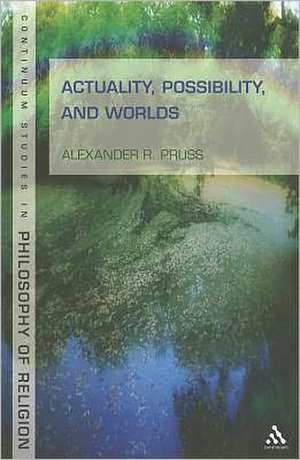
Actuality, Possibility, and Worlds: Continuum Studies in Philosophy of Religion
Autor Prof Alexander R. Prussen Limba Engleză Hardback – 21 iul 2011
The notion of possible worlds appears to be useful for many purposes, such as the analysis of counterfactuals or elucidating the nature of propositions and properties. This usefulness of possible worlds makes for a second general question: Are there any possible worlds and, if so, what are they? Are they concrete universes as David Lewis thinks, Platonic abstracta as per Robert M. Adams and Alvin Plantinga, or maybe linguistic or mathematical constructs such as Heller thinks? Or is perhaps Leibniz right in thinking that possibilia are not on par with actualities and that abstracta can only exist in a mind, so that possible worlds are ideas in the mind of God?
Preț: 1028.35 lei
Preț vechi: 1361.59 lei
-24%
Puncte Express: 1543
Carte tipărită la comandă
Livrare economică 23 noiembrie-07 decembrie
Livrare prin curier în România Termenul estimat este afișat lângă disponibilitate.
Transport gratuit pentru acest produs Plată online sau ramburs, în funcție de opțiunile comenzii.
Retur gratuit în 14 zile Comandă securizată și suport în română.
Specificații
ISBN-13: 9781441145161
ISBN-10: 1441145168
Pagini: 320
Dimensiuni: 168 x 246 x 24 mm
Greutate: 0.68 kg
Editura: Bloomsbury Publishing
Colecția Continuum
Seria Continuum Studies in Philosophy of Religion
Locul publicării:New York, United States
ISBN-10: 1441145168
Pagini: 320
Dimensiuni: 168 x 246 x 24 mm
Greutate: 0.68 kg
Editura: Bloomsbury Publishing
Colecția Continuum
Seria Continuum Studies in Philosophy of Religion
Locul publicării:New York, United States
V-ar putea interesa
-
 Probability in the Philosophy of ReligionJake Chandler-31%Preț: 663.16 lei961.46 lei
 -
 -31%Preț: 659.66 lei959.33 lei
 -
 -9%Preț: 290.90 lei319.77 lei
 -
 Reason, Morality, and Law: The Philosophy of John FinnisJohn Keown DCL-31%Preț: 913.10 lei1316.62 lei
 -
 Divine Teaching and the Way of the World: A Defense of Revealed ReligionSamuel Fleischacker-20%Preț: 354.31 lei444.30 lei
 -
 Kant's Elliptical PathKarl Ameriks-21%Preț: 356.79 lei450.34 lei
 -
 Spirituality: What It Is and Why It MattersRoger S. Gottlieb-12%Preț: 335.75 lei379.62 lei
 -
 Imagining the KingdomJames K. A. SmithPreț: 149.47 lei
 -
 The Highest Poverty: Monastic Rules and Form-of-LifeGiorgio AgambenPreț: 133.54 lei
 -
 Religion: Key Concepts in PhilosophyDr Brendan Sweetman-15%Preț: 232.80 lei272.54 lei
 -
 The Reality of God and the Problem of EvilFr Brian Davies-17%Preț: 321.67 lei388.94 lei
 -
 Theology in the Age of Global AIDS & HIVC. TrentazPreț: 383.15 lei
 -
 The Evolving God: Charles Darwin on the Naturalness of ReligionProfessor J. David PleinsPreț: 205.33 lei
 -
 God's Final Victory: A Comparative Philosophical Case for UniversalismProfessor John Kronen-25%Preț: 278.18 lei369.61 lei
 -
 CS Lewis vs the New AtheistsPeter S. WilliamsPreț: 140.63 lei
Cuprins
Preface
Part I. Introduction
Section 1 Generic definitions and basic modal realism
Section 2 Metaphysical versus logical possibility?
Section 3 S5
Section 4 Eight views of possibility
Part II. Applications and pseudo-applications
Section 1 Modality
Section 2 Counterfactuals and causality
Section 3 Propositions
Section 4 Properties
Section 5 Overall assessment
Part III. The Lewisian ontology of extreme modal realism
Section 1 The Lewisian account of possible worlds
Section 2 Identity vs. counterpart theory
Section 3 Indiscernible worlds?
Section 4 Lewis's arguments for his ontology
Section 5 Objections to Lewis's account of actuality
Section 6 The possibility of spatio-temporally unrelated co-actual entities
Section 7 Cardinality and the "set" of all possible worlds
Section 8 Ethical issues
Section 9 Induction and actuality
Section 10 The epistemological objection
Section 11 Explaining the actual in terms of the necessary
Section 12 A final assessment of extreme modal realism
Part IV. Platonic ersatz ontologies
Section 1 The general strategy
Section 2 Linguistic approaches
Section 3 Platonism
Section 4 Conclusions
Part V. Sketches towards a Spinozistic-Tractarian account of modality
Section 1 Asserting, naming and infallibility
Section 2 Spinoza
Section 3 A radical theory of modality
Section 4 Costs
Section 5 The less radical theory
Part VI. Aristotelian-Leibnizian ontology
Section 1 Leibniz's approach
Section 2 Aristotelian possibility and causality
Section 3 Combining with the Spinozistic-Tractarian view
Section 4 Ordinary alethic modal talk
Section 5 The Principle of Sufficient Reason
Section 6 Ontology and implications
Section 7 The main challenges to Lewisian and Platonic ontologies can be resolved
Section 9 Objections to the A-L view
Part VII. Final conclusions
Section 1 Cost-benefit arguments for the Aristotelian-Leibnizian ontology of possible worlds
Section 2 Choosing between accounts of possibility
Bibliography
Part I. Introduction
Section 1 Generic definitions and basic modal realism
Section 2 Metaphysical versus logical possibility?
Section 3 S5
Section 4 Eight views of possibility
Part II. Applications and pseudo-applications
Section 1 Modality
Section 2 Counterfactuals and causality
Section 3 Propositions
Section 4 Properties
Section 5 Overall assessment
Part III. The Lewisian ontology of extreme modal realism
Section 1 The Lewisian account of possible worlds
Section 2 Identity vs. counterpart theory
Section 3 Indiscernible worlds?
Section 4 Lewis's arguments for his ontology
Section 5 Objections to Lewis's account of actuality
Section 6 The possibility of spatio-temporally unrelated co-actual entities
Section 7 Cardinality and the "set" of all possible worlds
Section 8 Ethical issues
Section 9 Induction and actuality
Section 10 The epistemological objection
Section 11 Explaining the actual in terms of the necessary
Section 12 A final assessment of extreme modal realism
Part IV. Platonic ersatz ontologies
Section 1 The general strategy
Section 2 Linguistic approaches
Section 3 Platonism
Section 4 Conclusions
Part V. Sketches towards a Spinozistic-Tractarian account of modality
Section 1 Asserting, naming and infallibility
Section 2 Spinoza
Section 3 A radical theory of modality
Section 4 Costs
Section 5 The less radical theory
Part VI. Aristotelian-Leibnizian ontology
Section 1 Leibniz's approach
Section 2 Aristotelian possibility and causality
Section 3 Combining with the Spinozistic-Tractarian view
Section 4 Ordinary alethic modal talk
Section 5 The Principle of Sufficient Reason
Section 6 Ontology and implications
Section 7 The main challenges to Lewisian and Platonic ontologies can be resolved
Section 9 Objections to the A-L view
Part VII. Final conclusions
Section 1 Cost-benefit arguments for the Aristotelian-Leibnizian ontology of possible worlds
Section 2 Choosing between accounts of possibility
Bibliography
Recenzii
"In this book Alexander Pruss cogently argues the merits of an Aristotelian account that takes possibilities to inhere in the causal power of things. His instructive and insightful approach will be of interest to anyone concerned with the metaphysics of modality." -- Nicholas Rescher, Distinguished University Professor of Philosophy, University of Pittsburgh, USA.