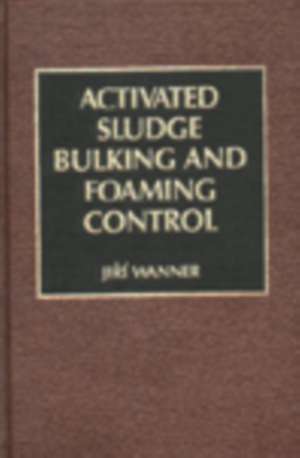
Activated Sludge: Bulking and Foaming Control
Autor Jiri Wanneren Limba Engleză Hardback – 24 noi 1994
The result of over 25 years of research, the book stresses practical control measures based on kinetic and metabolic selection theories, as well as on case histories. Topics in the book include: biochemical processes in wastewater treatment, evaluation ofseparation problems, settling and foaming principles, bulking and foaming control methods, and system design. More than 100 tables and figures illustrate complex processes, and over 500 references provide a detailed compendium of available resources.
It was the intention of the author to summarize in this book all essential pieces of information on both the microbiological and technical aspects of bulking and foaming control, so microbiologists and engineers can find new and helpful information from each other's field without studying vast numbers of primary literature sources. Naturally, the practical pieces of information required for solving practical operational problems are more stressed.
The book is arranged into six major chapters which are subdivided into uniform topical sections. The reader interested in a particular problem or searching for a particular solution does not necessarily need to read the whole book to get the answer. There are many cross-references in the text which will lead the reader to the background of the problem, and to show its connection to similar problems and their solutions.
Preț: 2079.84 lei
Preț vechi: 2536.39 lei
-18%
Puncte Express: 3120
Carte tipărită la comandă
Livrare economică 07-21 decembrie
Livrare prin curier în România Termenul estimat este afișat lângă disponibilitate.
Transport gratuit pentru acest produs Plată online sau ramburs, în funcție de opțiunile comenzii.
Retur gratuit în 14 zile Comandă securizată și suport în română.
Specificații
ISBN-13: 9781566761215
ISBN-10: 1566761212
Pagini: 338
Ilustrații: illustrations
Dimensiuni: 152 x 229 x 23 mm
Greutate: 0.79 kg
Ediția:1
Editura: CRC Press
Colecția CRC Press
ISBN-10: 1566761212
Pagini: 338
Ilustrații: illustrations
Dimensiuni: 152 x 229 x 23 mm
Greutate: 0.79 kg
Ediția:1
Editura: CRC Press
Colecția CRC Press
V-ar putea interesa
-
 Bioprocess Engineering PrinciplesRoss Carlson-31%Preț: 605.17 lei881.03 lei
 -
 Adventures in FermentationJohnny DrainPreț: 166.76 lei
 -
 Clinical ChemistryWilliam J. Marshall-5%Preț: 357.78 lei376.60 leiRecomandat
 -
 -5%Preț: 735.24 lei773.94 lei
 -
 Fungal Biology 4eJ W Deacon-19%Preț: 450.99 lei556.78 lei
 -
 The Activated Sludge Process: Methods and Recent DevelopmentsBenjamin Lefebvre-26%Preț: 535.30 lei727.65 lei
 -
 Wastewater Treatment: Processes, Uses and ImportanceAdriana Magdalena-27%Preț: 887.73 lei1209.83 lei
 -
 Enhanced Electrochemical Advanced Oxidation Processes for Wastewater Sludge Stabilization & ReuseGagik Badalians Gholikandi-27%Preț: 1273.89 lei1736.14 lei
 -
 Physical Chemical & Biological Treatment Processes for Water & WastewaterDr Tushar Kanti Sen-27%Preț: 2072.89 lei2823.92 lei
 -
 The Biochar HandbookKelpie Wilson-19%Preț: 220.82 lei274.25 lei
 -
 Biological Treatment Process in Drinking WaterShraddha Gautam-23%Preț: 1318.27 lei1712.04 lei
 -
 Plant Powered PlusWill BulsiewiczPreț: 138.34 lei
 -
 FermentTim Spector-5%Preț: 149.00 lei156.83 lei
 -
 Wastewater Sludge NexusAshootosh Mandpe-18%Preț: 1159.69 lei1414.26 lei
 -
 -11%Preț: 481.24 lei540.71 lei
Public țintă
ProfessionalCuprins
Contemporary Activated Sludge Process: History and Development of Activated Sludge Process - History and Development of Bulking and Foaming Control - Unified Description of Activated Sludge Process - Basic Biochemistry and Microbiology of the Activated Sludge Process: - Terminology of Biochemical Processes - Metabolism of Carbonaceous Compounds - Nitrogen Metabolism - Phosphorus Metabolism - Sulphur Metabolism - Microbiology of Activated Sludge Activated Sludge Separation Problems: Well Settling Activated Sludge - Problems with the Separation of Activated Sludge from Treated Wastewaters - Evaluation of Settling and Foaming Properties of Activated Sludges - Filamentous Microorganisms in Activated Sludge: Filamentous Growth Form - Identification of Filamentous Microorganisms - Most Common Filamentous Microorganisms in Activated Sludges - Control of Filamentous Bulking: Principles of Kinetic Selection of Floc-Forming Microorganisms - Metabolic Selection in Activated Sludge - Modifications of Activated Sludge Process for Filamentous Bulking Control - Design for Bulking Control Activated Sludge Systems - Nonspecific Methods of Filamentous Bulking Control - Control of Filamentous Foaming - Manipulation of Biomass Retention Time * Kinetic and Metabolic Selection - Use of Chemicals and Antifoam Agents - Physical Removal of Biological Foams.
Descriere
The result of over 25 years of research, this book is a concise guide to the microbiological and technical aspects of bulking and foaming control. It stresses practical control measures based on kinetic and metabolic selection theories and supported by case histories. Topics include: biochemical processes in wastewater treatment, evaluation of separation problems, settling and foaming principles, bulking and foaming control methods, and system design. More than 100 tables and figures illustrate complex processes, and over 500 references provide a detailed compendium of available resources. Cross-references provide background of a problem, its connection to similar problems, and their solutions.