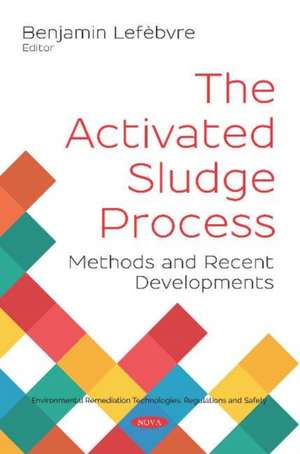
The Activated Sludge Process: Methods and Recent Developments
Editat de Benjamin Lefebvreen Limba Engleză Paperback – 21 mar 2019
Preț: 535.30 lei
Preț vechi: 727.65 lei
-26%
Puncte Express: 803
Carte disponibilă
Livrare economică 28 octombrie-11 noiembrie
Livrare prin curier în România Termenul estimat este afișat lângă disponibilitate.
Transport gratuit pentru acest produs Plată online sau ramburs, în funcție de opțiunile comenzii.
Retur gratuit în 14 zile Comandă securizată și suport în română.
Specificații
ISBN-13: 9781536152029
ISBN-10: 1536152021
Pagini: 158
Dimensiuni: 155 x 230 x 13 mm
Greutate: 0.29 kg
Editura: Nova Science Publishers Inc
Colecția Nova Science Publishers Inc
Locul publicării:United States
ISBN-10: 1536152021
Pagini: 158
Dimensiuni: 155 x 230 x 13 mm
Greutate: 0.29 kg
Editura: Nova Science Publishers Inc
Colecția Nova Science Publishers Inc
Locul publicării:United States
V-ar putea interesa
-
 Adventures in FermentationJohnny DrainPreț: 166.52 lei
 -
 Wastewater Treatment: Processes, Uses and ImportanceAdriana Magdalena-27%Preț: 887.73 lei1209.83 lei
 -
 Advances in Chemistry Research. Volume 58: Volume 58James C. Taylor-27%Preț: 1384.34 lei1887.87 lei
 -
 -9%Preț: 647.93 lei712.01 lei
 -
 Potential of Activated Sludge UtilizationXiaoyi Yang-26%Preț: 393.98 lei530.86 lei
 -
 Advances in Environmental Research: Volume 18Justin A Daniels-26%Preț: 730.58 lei992.26 lei
 -
 Enhanced Electrochemical Advanced Oxidation Processes for Wastewater Sludge Stabilization & ReuseGagik Badalians Gholikandi-27%Preț: 1273.89 lei1736.14 lei
 -
 Biological Treatment Process in Drinking WaterShraddha Gautam-23%Preț: 1296.39 lei1683.63 lei
 -
 -31%Preț: 95.45 lei137.35 lei
 -
 FermentTim Spector-5%Preț: 116.95 lei123.10 lei
 -
 Wastewater Sludge NexusAshootosh Mandpe-18%Preț: 1128.25 lei1375.91 lei
 -
 -18%Preț: 963.29 lei1174.75 lei
 -
 Basic Electrochemistry for BiotechnologyFalk Harnisch-11%Preț: 393.15 lei441.75 lei
 -
 -14%Preț: 1728.20 lei2009.54 lei
Cuprins
For more information, please visit our website at:https://novapublishers.com/shop/the-activated-sludge-process-methods-and-recent-developments/