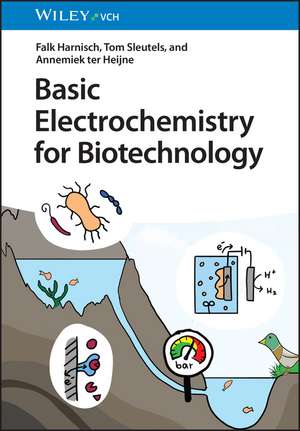
Basic Electrochemistry for Biotechnology
Autor Falk Harnisch, Tom Sleutels, Annemiek ter Heijneen Limba Engleză Paperback – 6 dec 2023
Observăm că literatura academică actuală abundă în monografii avansate despre surse de energie regenerabilă, însă resimte lipsa unui manual introductiv care să pună puntea de legătură între principiile chimice riguroase și aplicațiile practice din biotehnologie. Volumul Basic Electrochemistry for Biotechnology de F Harnisch vine să completeze exact această lacună, oferind o resursă didactică structurată pentru studenții și cercetătorii care încep explorarea sistemelor electrochimice microbiene. Textul este organizat logic, începând cu o „Ghidare a cititorului” și evoluând de la mecanismele de transfer de electroni la nivel microbian către aspecte tehnice de design al sistemelor. Remarcăm atenția deosebită acordată terminologiei și termodinamicii, capitolele despre potențialul de electrod și ecuațiile de reacție fiind esențiale pentru înțelegerea limitelor energetice în conversia bioelectrochimică. Comparabil cu Electrochemical Methods de Allen J. Bard în ceea ce privește rigoarea metodologică, acest volum este însă actualizat specific pentru sectorul biotehnologic, concentrându-se pe microorganisme electroactive mai degrabă decât pe sisteme anorganice pure. Spre deosebire de lucrări mai specializate, precum Biofilms in Bioelectrochemical Systems de Haluk Beyenal, care se axează strict pe dinamica biofilmelor, lucrarea de față propune o viziune de ansamblu. Un element distinctiv îl reprezintă includerea experimentelor practice și a soluțiilor detaliate, transformând teoria abstractă într-un instrument de lucru imediat aplicabil în laborator. Tonul este unul precis, axat pe claritate pedagogică, facilitând tranziția de la conceptele de bază ale oxidării și reducerii la aplicații complexe precum epurarea apelor uzate sau celulele de combustie microbiene.
Preț: 393.15 lei
Preț vechi: 441.75 lei
-11%
Carte disponibilă
Livrare economică 16-30 noiembrie
Livrare express 30 octombrie-05 noiembrie pentru 36.59 lei
Specificații
ISBN-10: 3527348085
Pagini: 256
Ilustrații: 5 farbige Abbildungen, 27 schwarz-weiße Tabellen
Dimensiuni: 169 x 243 x 15 mm
Greutate: 0.5 kg
Editura: Wiley-VCH GmbH
Locul publicării:Weinheim, Germany
De ce să citești această carte
Recomandăm această carte oricărui student sau cercetător la început de drum în biotehnologie care are nevoie de o bază solidă în electrochimie. Veți câștiga o înțelegere clară a modului în care bacteriile transferă electroni și, mai important, veți învăța cum să aplicați aceste principii prin experimente concrete. Este un ghid practic esențial pentru a stăpâni tehnologiile electrochimice microbiene moderne.
Cuprins
List of Figures ix
List of Boxes xxi
Preface xxiii
1 A Reader's Guide to Basic Electrochemistry for Biotechnology 1
2 A Basic Introduction to Microbial Electrochemical Technologies 3
2.1 Introduction to Microbial Energy Conversion and Microbial Electrochemical Technologies 3
2.1.1 Microbial Conversions 3
2.1.2 Microbial Fuel Cells and Microbial Electrolysis Cells 5
2.2 Electroactive Microorganisms and Mechanisms of Extracellular Electron Transfer 7
2.2.1 Extracellular Electron Transfer Mechanisms: The Role Models of Electroactive Microorganisms 7
2.2.2 A Snapshot on Electroactive Microorganisms 8
2.3 Energetics: The Redox Tower and a Water Analogy 9
2.4 Wastewater Characteristics 13
2.4.1 Physical Wastewater Characteristics 14
2.4.2 Chemical Wastewater Characteristics 14
2.4.3 Organic Constituents in Wastewater 15
2.4.4 Biological Wastewater Characteristics 16
2.5 Microbial Electrochemical Technologies: Systems and Design 17
2.5.1 Main Components and Design 17
2.5.2 Operational Modes 18
2.5.3 Electrodes and Current Collectors 19
2.5.4 Ionic Charge Transport and Membranes 21
2.5.5 Lab Measurements and Criteria for Normalization 22
2.6 Short Alert on Terminology 23
Questions 24
References 25
3 Electrochemical Potential, Electrode Potential, and the Need for Reference Electrodes 27
3.1 Introduction to Electrochemical Potentials 27
3.1.1 A Physical-Chemical Approach Toward Electrochemical Potentials 28
3.2 Electrodes and Electrode Reactions 36
3.2.1 Definition of Electrodes and Electrochemical Half-Cells 36
3.2.2 Scientific Notation of Electrochemical Cells 37
3.2.3 Types of Electrodes 38
3.3 The Relative Electrode Potential and the Need for Reference Electrodes 40
3.3.1 Point of Reference for Electrode Potentials 42
3.3.2 Reference Electrodes Explained via the Water Analogy 45
Questions 46
References 47
4 Reaction Equations and Thermodynamics of Electrochemical Reactions 49
4.1 Introduction to Oxidation and Reduction Reactions and Thermodynamic Limits 49
4.2 How to Write and Balance Reaction Equations of (Bio)electrochemical Reactions 50
4.2.1 Reaction Equations for the Hydrogen Fuel Cell 51
4.2.2 Reaction Equations for a Microbial Electrolysis Cell 53
4.3 Thermodynamics of Electrochemical Conversions 57
4.3.1 Calculations Assuming Standard Conditions 57
4.3.2 The Effect of Actual Concentrations on Gibbs Free Energy Change 62
4.3.3 The Effect of Temperature on Gibbs Free Energy Change 65
Questions 68
References 68
5 Static Electrochemical Methods 69
5.1 Introduction to Static Electrochemical Methods 69
5.2 What Is a Three-Electrode Arrangement, a Potentiostat or Power Supply, and for What Are They Needed? 70
5.3 The Electrochemical Double Layer and Capacitive Current 74
5.4 Potentiometry, Amperometry, Coulometry, and Constant Current Measurements 78
5.5 Chronoamperometry 82
Questions 87
References 88
6 Electrochemical Kinetics 89
6.1 Introduction to Electrochemical Kinetics 89
6.2 Basics of Electrochemical Kinetics 90
6.3 Electrochemical Reversibility 91
6.4 Overpotentials 94
6.5 The Overpotential Due to Mass Transfer 98
6.6 Potential-Current Plots and Electrode Kinetics 101
6.7 The Butler-Volmer Equation 103
6.8 Tafel Equation and Tafel Plots 106
6.9 Electrocatalysis 108
Questions 113
References 114
7 Dynamic Electrochemical Methods 115
7.1 Introduction to Electrochemical Methods with Changing Electrode Potential 115
7.2 Voltammetry 117
7.3 Performing Dynamic Electrochemical Methods Using Potentiostats: Discriminating Capacitive and Faradaic Current 117
7.3.1 The Principles of Linear Sweep Voltammetry 120
7.4 Cyclic Voltammetry 123
7.4.1 General Considerations and Basic Data Analysis 123
7.4.2 Studying Biofilm Electrodes Using Cyclic Voltammetry 131
7.4.3 Experimental Design and Limits of Information from Data 134
7.5 Redox-Active Components in Microorganisms 136
7.6 Acquisition of Polarization and Power Curves Using Stepwise Chronoamperometry and Chronopotentiometry 139
7.7 Acquisition of Polarization Curves Using External Resistance 145
7.8 Electrochemical Impedance Spectroscopy 147
Questions 152
References 152
8 Electrochemical Analysis of Reactors 155
8.1 Introduction to Characterization of Microbial Electrochemical Cells 155
8.2 Mass and Electron Balances and Efficiency of Conversions 157
8.2.1 Establishing Balances for Mass and Electrons 157
8.2.2 Removal Efficiency 158
8.2.3 Coulombic Efficiency 159
8.3 Polarization and Power Curves: Analysis of Measured Data 161
8.4 Internal Resistance and Potential Losses 168
8.5 Energy Efficiency and Voltage Efficiency 174
8.6 Ionic Current and Transport Numbers 176
8.6.1 Ionic Current for the Specific Removal and Recovery of Ions 176
8.6.2 Ionic Current and pH Gradients 177
Questions 178
References 179
9 Seizing the Beauty and Acknowledging the Complexity of Basic Electrochemistry for Biotechnology 181
Appendix A Abbreviations 185
Appendix B Symbols with Definition and Unit 187
Appendix C Solutions to Exercises 193
Appendix D Tabulated Values 217
Index 219
Descriere scurtă
Notă biografică
Falk Harnisch, PhD, is a group leader at the Heimholtz Centre for Environmental Research and a Professor at Leipzig University, Leipzig, Germany. He has published extensively on microbiology and electrochemistry, and his awards and honors include the Helmholtz Young Investigators Group award as well as serving as President of the International Society of Microbial Electrochemistry and Technology (ISMET) 2021-2023.
Tom Sleutels, PhD, is a researcher at the University of Groningen and Wetsus, European Centre of Excellence for Sustainable Water Technology in the Netherlands. His research focuses on microorganisms and their role in renewable energy and resource recovery processes.
Annemiek ter Heijne, PhD, is Chair and Professor of Environmental Technology at Wageningen University & Research, The Netherlands. She is an environmental engineer studying different aspects and applications of microbial electrochemical technologies, and served as President of ISMET 2019-2021.