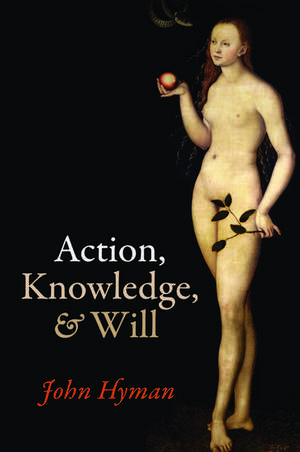
Action, Knowledge, and Will
Autor John Hymanen Limba Engleză Paperback – 16 feb 2017
Preț: 287.31 lei
Preț vechi: 349.71 lei
-18%
Puncte Express: 431
Carte tipărită la comandă
Livrare economică 13-18 noiembrie
Livrare prin curier în România Termenul estimat este afișat lângă disponibilitate.
Transport gratuit de la 400.00 lei Plată online sau ramburs, în funcție de opțiunile comenzii.
Retur gratuit în 14 zile Comandă securizată și suport în română.
Specificații
ISBN-13: 9780198769316
ISBN-10: 0198769318
Pagini: 270
Dimensiuni: 169 x 234 x 20 mm
Greutate: 0.37 kg
Editura: OUP OXFORD
Colecția OUP Oxford
Locul publicării:Oxford, United Kingdom
ISBN-10: 0198769318
Pagini: 270
Dimensiuni: 169 x 234 x 20 mm
Greutate: 0.37 kg
Editura: OUP OXFORD
Colecția OUP Oxford
Locul publicării:Oxford, United Kingdom
V-ar putea interesa
-
 Wittgenstein and Analytic Philosophy: Essays for P. M. S. HackerHans-Johann Glock-31%Preț: 744.17 lei1078.43 lei
 -
 In Praise of DesireNomy Arpaly-31%Preț: 572.21 lei827.53 lei
 -
 The Ajax Dilemma: Justice, Fairness, and RewardsPaul Woodruff-17%Preț: 142.42 lei171.61 lei
 -
 A Sentimentalist Theory of the MindMichael Slote-29%Preț: 503.44 lei704.94 lei
 -
 Contractualism and the Foundations of MoralityNicholas Southwood-12%Preț: 356.50 lei404.22 lei
 -
 Human Interests: or Ethics for PhysicalistsJoseph Mendola-31%Preț: 746.38 lei1079.76 lei
 -
 Oxford Studies in Normative Ethics, Volume 3Mark Timmons-13%Preț: 355.47 lei406.78 lei
 -
 The Human ConditionJohn Kekes-12%Preț: 336.25 lei380.24 lei
 -
 Oxford Studies in Agency and Responsibility, Volume 1David Shoemaker-11%Preț: 337.64 lei380.62 lei
 -
 From Individual to Collective Intentionality: New EssaysSara Rachel Chant-35%Preț: 626.06 lei960.03 lei
 -
 A Companion to WittgensteinHans-Johann Glock-9%Preț: 1248.29 lei1371.75 lei
Recenzii
Action, Knowledge, and Will is a splendid book--insightful, original, elegantly written and carefully edited, and a genuine pleasure to read. John Hyman weaves strands of historical, legal, empirical, and conceptual analysis into a series of arguments that are fresh and exciting at every turn.
John Hyman is one of the most creative and wide-ranging philosophers working today.
With this book, John Hyman has done more for action theory than anyone in the field since Anscombe. His arguments in support of the thesis that human agency is best conceived as the integration of four dimensions presents a new picture that, in time, will change the way everyone thinks about human action.
[T]he most important treatment of action since Anscombe and Davidson ... It takes the traditional question whether we should give a physical, ethical, psychological or intellectual account of human action and stands it on its head. For Hyman argues that the real question is how to distinguish the physical, the ethical, the psychological and the intellectual dimensions of human action, and he thereby changes the landscape in the philosophy of action.
John Hyman brilliantly tackles a problem that has rankled since Plato: what is involved when we voluntarily perform an action? "The will", he argues, has been made too much of a catch-all of the various dimensions of human agency -- physical, psychological, ethical and intellectual. Philosophy is all about fine distinctions. Here they are made acutely yet accessibly to give us a new picture of who we are.
John Hyman's new book is a masterful blend of the philosophy of action and epistemology. In it he seeks not only to realign the philosophy of action, but to turn epistemology -- at least, that part of it that is concerned with the nature of knowledge -- into a part of the philosophy of action. ... Hyman's book is an invitation to a radical new research programme in epistemology. I hope that others join him in working it out.
How could knowledge be even better for us than true beliefs that we have good reason to accept? John Hyman answers this question in Action, Knowledge, and Will. It is by no means the only question he answers in this rich, delightful book. He reaches fresh, insightful conclusions about human action and thought by attending to connections between questions usually treated separately. He explains and defends those conclusions sharply and carefully, with admirable regard for what the words involved in the question actually mean.
[A] vast improvement over the anti-psychologistic accounts of reasons-explanations that have proliferated in recent years. It both allows us to emphasize reasons why as facts that favor actions while allowing us to include an agent's psychological states in genuine reasons-explanations. ... While he challenges many widely endorsed views in contemporary philosophy of action, Hyman does not adopt an unprincipled contrarian stance. Rather, he strikes me as a friendly critic, offering ways to correct mistakes philosophers have made in the past three hundred years.
John Hyman is one of the most creative and wide-ranging philosophers working today.
With this book, John Hyman has done more for action theory than anyone in the field since Anscombe. His arguments in support of the thesis that human agency is best conceived as the integration of four dimensions presents a new picture that, in time, will change the way everyone thinks about human action.
[T]he most important treatment of action since Anscombe and Davidson ... It takes the traditional question whether we should give a physical, ethical, psychological or intellectual account of human action and stands it on its head. For Hyman argues that the real question is how to distinguish the physical, the ethical, the psychological and the intellectual dimensions of human action, and he thereby changes the landscape in the philosophy of action.
John Hyman brilliantly tackles a problem that has rankled since Plato: what is involved when we voluntarily perform an action? "The will", he argues, has been made too much of a catch-all of the various dimensions of human agency -- physical, psychological, ethical and intellectual. Philosophy is all about fine distinctions. Here they are made acutely yet accessibly to give us a new picture of who we are.
John Hyman's new book is a masterful blend of the philosophy of action and epistemology. In it he seeks not only to realign the philosophy of action, but to turn epistemology -- at least, that part of it that is concerned with the nature of knowledge -- into a part of the philosophy of action. ... Hyman's book is an invitation to a radical new research programme in epistemology. I hope that others join him in working it out.
How could knowledge be even better for us than true beliefs that we have good reason to accept? John Hyman answers this question in Action, Knowledge, and Will. It is by no means the only question he answers in this rich, delightful book. He reaches fresh, insightful conclusions about human action and thought by attending to connections between questions usually treated separately. He explains and defends those conclusions sharply and carefully, with admirable regard for what the words involved in the question actually mean.
[A] vast improvement over the anti-psychologistic accounts of reasons-explanations that have proliferated in recent years. It both allows us to emphasize reasons why as facts that favor actions while allowing us to include an agent's psychological states in genuine reasons-explanations. ... While he challenges many widely endorsed views in contemporary philosophy of action, Hyman does not adopt an unprincipled contrarian stance. Rather, he strikes me as a friendly critic, offering ways to correct mistakes philosophers have made in the past three hundred years.
Notă biografică
John Hyman has been a Fellow of The Queen's College, Oxford since 1988 and Professor of Aesthetics in the University of Oxford since 2008. He has edited the British Journal of Aesthetics since 2008. He held a Getty Scholarship at the Getty Research Institute, Los Angeles, in 2001-2002, a Fellowship at the Wissenschaftskolleg zu Berlin in 2002-2003, and a Leverhulme Major Research Fellowship in 2010-2012.