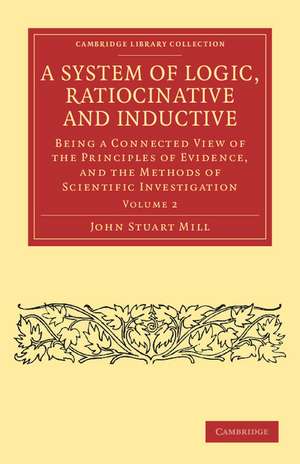
A System of Logic, Ratiocinative and Inductive: Being a Connected View of the Principles of Evidence, and the Methods of Scientific Investigation: Cambridge Library Collection - Philosophy
Autor John Stuart Millen Limba Engleză Paperback – 7 dec 2011
| Toate formatele și edițiile | Preț | Express |
|---|---|---|
| Paperback (4) | 380.82 lei 3-5 săpt. | |
| Hansebooks – 3 ian 2018 | 380.82 lei 3-5 săpt. | |
| Hansebooks – 3 ian 2018 | 381.46 lei 3-5 săpt. | |
| Cambridge University Press – 7 dec 2011 | 433.03 lei 6-8 săpt. | |
| Cambridge University Press – 7 dec 2011 | 434.69 lei 6-8 săpt. |
Din seria Cambridge Library Collection - Philosophy
-
 Preț: 210.70 lei
 -
 Preț: 428.22 lei
 -
 Preț: 427.48 lei
 - 19%
 Preț: 432.28 lei
 -
 Preț: 288.27 lei
 - 19%
 Preț: 475.14 lei
 - 19%
 Preț: 439.77 lei
 -
 Preț: 372.76 lei
 -
 Preț: 271.66 lei
 -
 Preț: 339.66 lei
 - 19%
 Preț: 426.99 lei
 -
 Preț: 377.56 lei
 -
 Preț: 253.00 lei
 -
 Preț: 288.79 lei
 - 19%
 Preț: 434.39 lei
 -
 Preț: 251.87 lei
 -
 Preț: 345.29 lei
 -
 Preț: 345.44 lei
 - 19%
 Preț: 426.53 lei
 -
 Preț: 427.84 lei
 -
 Preț: 340.22 lei
 -
 Preț: 428.22 lei
 - 19%
 Preț: 433.93 lei
 -
 Preț: 435.14 lei
 -
 Preț: 287.11 lei
 -
 Preț: 337.98 lei
 - 19%
 Preț: 643.56 lei
 -
 Preț: 240.54 lei
 -
 Preț: 374.63 lei
 -
 Preț: 253.00 lei
 -
 Preț: 338.72 lei
 -
 Preț: 377.40 lei
 -
 Preț: 339.66 lei
 -
 Preț: 425.65 lei
 -
 Preț: 240.33 lei
Preț: 434.69 lei
Preț vechi: 536.65 lei
-19% Nou
Puncte Express: 652
Preț estimativ în valută:
76.92€ • 90.32$ • 67.51£
76.92€ • 90.32$ • 67.51£
Carte tipărită la comandă
Livrare economică 27 ianuarie-10 februarie 26
Preluare comenzi: 021 569.72.76
Specificații
ISBN-13: 9781108040891
ISBN-10: 1108040896
Pagini: 642
Dimensiuni: 140 x 216 x 36 mm
Greutate: 0.8 kg
Editura: Cambridge University Press
Colecția Cambridge University Press
Seria Cambridge Library Collection - Philosophy
Locul publicării:Cambridge, United Kingdom
ISBN-10: 1108040896
Pagini: 642
Dimensiuni: 140 x 216 x 36 mm
Greutate: 0.8 kg
Editura: Cambridge University Press
Colecția Cambridge University Press
Seria Cambridge Library Collection - Philosophy
Locul publicării:Cambridge, United Kingdom
V-ar putea interesa
-
 On LibertyJohn Stuart MillPreț: 54.23 lei
 -
 On Liberty and the Subjection of WomenJohn Stuart Mill-21%Preț: 49.01 lei61.65 lei
 -
 The Scope of Autonomy: Kant and the Morality of FreedomKaterina Deligiorgi-28%Preț: 629.80 lei870.03 lei
 -
 Oxford Studies in Early Modern Philosophy Volume VIDaniel Garber-14%Preț: 753.62 lei876.30 lei
 -
 Preț: 373.03 lei
 -
![British Empirical Philosophers (Routledge Revivals): Locke, Berkeley, Hume, Reid and J. S. Mill. [An anthology]](https://i4.books-express.ro/bt/9780415537742/british-empirical-philosophers-routledge-revivals.jpg) -31%Preț: 1087.12 lei1569.13 lei
-31%Preț: 1087.12 lei1569.13 lei -
 Preț: 364.89 lei
 -
 Introductions to NietzscheRobert PippinPreț: 192.33 lei
 -
 The Cambridge Companion to Hegel and Nineteenth-Century PhilosophyFrederick C. BeiserPreț: 240.37 lei
 -
 Locke: A BiographyRoger WoolhousePreț: 244.33 lei
 -
 Utilitarianism and on LibertyJohn Stuart MillPreț: 94.62 lei
 -
 Kant: Groundwork of the Metaphysics of MoralsChristine M. KorsgaardPreț: 124.89 lei
 -
 The Death of Nietzsche's ZarathustraPaul S. LoebPreț: 334.42 lei
 -
 Descartes: A BiographyDesmond M. ClarkePreț: 242.47 lei
 -
 The Cambridge History of Philosophy 1870–1945Thomas Baldwin-19%Preț: 518.37 lei639.96 lei
Cuprins
Book III. On Induction (continued): 14. Of the limits to the explanation of laws of nature; and of hypotheses; 15. Of progressive effects; and of the continued action of causes; 16. Of empirical laws; 17. Of chance, and its elimination; 18. Of the calculation of chances; 19. Of the extension of derivative laws to adjacent cases; 20. Of analogy; 21. Of the evidence of the law of universal causation; 22. Of uniformities of co-existence not dependent upon causation; 23. Of approximate generalizations, and probable evidence; 24. Of the remaining laws of nature; 25. Of the grounds of disbelief; Book IV. Of Operations Subsidiary to Induction: 1. Of observation, and description; 2. Of abstraction, of the formation of conceptions; 3. Of naming, as subsidiary to induction; 4. Of the requisites of a philosophical language; and the principles of definition; 5. Of the natural history of the variations in the meaning of terms; 6. The principles of a philosophical language further considered; 7. Of classification, as subsidiary to induction; 8. Of classification by series; Book V. On Fallacies: 1. Of fallacies in general; 2. Classification of fallacies; 3. Fallacies of simple inspection, or à priori fallacies; 4. Fallacies of observation; 5. Fallacies of generalization; 6. Fallacies of ratiocination; 7. Fallacies of confusion; Book VI. On the Logic of the Moral Sciences: 1. Introductory remarks; 2. Of liberty and necessity; 3. That there is, or may be, a science of human nature; 4. Of the laws of mind; 5. Of ethology, or the science of the formation of character; 6. General considerations on the social science; 7. Of the chemical, or experimental method in the social science; 8. Of the geometrical, or abstract method; 9. Of the physical, or concrete deductive method; 10. Of the inverse deductive, or historical method; 11. Of the logic of practice, or art; including morality and policy.
Descriere
A foundational text in modern empiricist method, published in 1843 by Victorian England's foremost philosopher of political and social life.