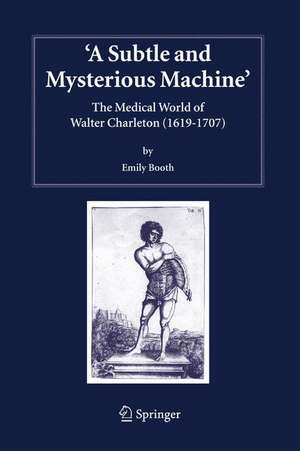
A Subtle and Mysterious Machine
Autor Emily Boothen Limba Engleză Hardback – 18 oct 2005
| Toate formatele și edițiile | Preț | Express |
|---|---|---|
| Paperback (1) | 908.45 lei 6-8 săpt. | |
| SPRINGER NETHERLANDS – 22 oct 2010 | 908.45 lei 6-8 săpt. | |
| Hardback (1) | 914.98 lei 6-8 săpt. | |
| Springer – 18 oct 2005 | 914.98 lei 6-8 săpt. |
Preț: 914.98 lei
Preț vechi: 1115.84 lei
-18%
Puncte Express: 1372
Preț estimativ în valută:
161.78€ • 186.97$ • 139.77£
161.78€ • 186.97$ • 139.77£
Carte tipărită la comandă
Livrare economică 04-18 mai
Specificații
ISBN-13: 9781402033773
ISBN-10: 140203377X
Pagini: 300
Ilustrații: VIII, 300 p.
Dimensiuni: 167 x 247 x 25 mm
Greutate: 0.63 kg
Ediția:2005 edition
Editura: Springer
Locul publicării:Dordrecht, Netherlands
ISBN-10: 140203377X
Pagini: 300
Ilustrații: VIII, 300 p.
Dimensiuni: 167 x 247 x 25 mm
Greutate: 0.63 kg
Ediția:2005 edition
Editura: Springer
Locul publicării:Dordrecht, Netherlands
V-ar putea interesa
-
 Blood and GutsRoy Porter-24%Preț: 57.02 lei75.28 lei
 -
 Hysteria: The BiographyAndrew Scull-24%Preț: 69.29 lei91.32 lei
 -
 -20%Preț: 211.04 lei262.81 lei
 -
 Medicine's 10 Greatest DiscoveriesMeyer Friedman-5%Preț: 298.87 lei314.60 lei
 -
 -31%Preț: 61.76 lei89.37 lei
 -
 Huang Di Nei Jing Su WenHermann Tessenow-5%Preț: 1327.19 lei1397.05 lei
 -
 How Shakespeare Cleaned His Teeth and Cromwell Treated His WartsKatherine KnightPreț: 89.74 lei
 -
 The Mirage of Health: Utopia, Progress, and Biological ChangeProfessor Jean Dubos-5%Preț: 263.19 lei277.04 lei
 -
 Hospital Sisters and their DutiesEva C. E. Lückes-5%Preț: 272.06 lei286.38 lei
 -
 Medical Muses: Hysteria in Nineteenth-Century ParisAsti Hustvedt-31%Preț: 70.75 lei102.75 lei
 -
 The History of MedicineMark Jackson-5%Preț: 71.44 lei75.20 lei
Public țintă
ResearchCuprins
Rewriting Walter Charleton: Physick and Natural Philosophy.- ’The Alembic of Our Pen’: Charleton’s Identity as a Physician.- ’The Animal Oeconomy’: Natural History (1659) in the Context of English Physiology.- ’The Republick of Letters’: Charleton’s Identity in the Royal Society & College of Physicians.- Enquiries Into Human Nature (1680): Charleton’s Anatomy and Physiology After the Royal Society.- Three Anatomic Lectures (1683): Ways of Knowing and the Anatomical Body.- Conclusions.
Textul de pe ultima copertă
Walter Charleton (1619-1707) has been widely depicted as a natural philosopher whose intellectual career mirrored the intellectual ferment of the ‘scientific revolution’. Instead of viewing him as a barometer of intellectual change, I examine the previously unexplored question of his identity as a physician. Examining three of his vernacular medical texts, this volume considers Charleton’s thoughts on anatomy, physiology and the methods by which he sought to understand the invisible processes of the body.
Although involved in many empirical investigations within the Royal Society, he did not give epistemic primacy to experimental findings, nor did he deliberately identify himself with the empirical methods associated with the ‘new science’. Instead Charleton presented himself as a scholarly eclectic, following a classical model of the self. Physicians needed to endorse both ancient and modern authorities, in order to attract and retain patients. I argue that Charleton’s circumstances as a practising physician resulted in the construction of an identity at variance with that widely associated with natural philosophers. The insights he can offer us into the world of seventeenth century physicians are highly significant and utterly fascinating.
Although involved in many empirical investigations within the Royal Society, he did not give epistemic primacy to experimental findings, nor did he deliberately identify himself with the empirical methods associated with the ‘new science’. Instead Charleton presented himself as a scholarly eclectic, following a classical model of the self. Physicians needed to endorse both ancient and modern authorities, in order to attract and retain patients. I argue that Charleton’s circumstances as a practising physician resulted in the construction of an identity at variance with that widely associated with natural philosophers. The insights he can offer us into the world of seventeenth century physicians are highly significant and utterly fascinating.
Caracteristici
A challenging new look at a widely recognised figure in the scientific revolution period A provocative revision of existing historiography on the history of medicine and natural philosophy Looks at how a seventeenth-century figure who was engaged in the community and activities associated with the creation of ‘modern science’ (the rise of mechanical philosophy and the triumph of experiment) might instead seek authority through an identity which relied on classical models of scholarship and eclecticism