Cantitate/Preț
Produs
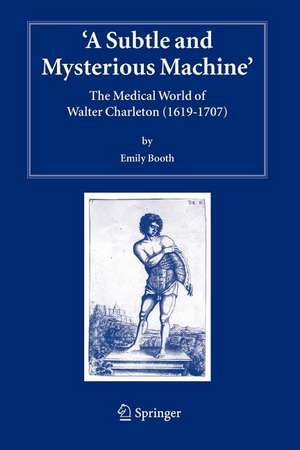
A Subtle and Mysterious Machine: The Medical World of Walter Charleton (1619-1707) de Emily Booth

A Subtle and Mysterious Machine: The Medical World of Walter Charleton (1619-1707) Studies in History and Philosophy of Science, cartea 18

90845 lei 110786 lei -18%
  • Economic11-25 ianuarie 27 90845 lei
Adaugă în listă1363 Puncte Express
  • Transport gratuit pentru acest produs
  • Plată online sau ramburs
  • Retur gratuit în 14 zile

Despre carte

Walter Charleton is an intriguing character—he flits through the diaries of Pepys and Evelyn, the correspondence of Margaret Cavendish, and his texts appear in the libraries of better-known contemporaries. We catch sight of him 1 conversing with Pepys about teeth, arguing with Inigo Jones about the origin of 2 Stonehenge, being lampooned in contemporary satire, stealing from the Royal Society, and embarrassing himself in anatomical procedures. While extremely active in a broad range of Royal Society investigations, his main discovery there seems to have been that tadpoles turned into frogs. As a practising physician of limited means, Walter Charleton was reliant for his living upon patrons and his medical practice—in addition he had the m- fortune to live in an era of dramatic political change, and consequently of unpredictable fortune. His achievements were known on the Continent. Despite his embarrassments in Royal Society anatomical investigation he was offered the prestigious chair of anatomy at the University of Padua. He turned down this extraordinary opportunity, only to die destitute in his native country a couple of decades later. The lugubrious doctor is without doubt an enigma. Charleton’s Anglicanism and staunch Royalism were unwavering throughout his career. The latter caused difficulties for him when he attempted to gain membership of the College of Physicians during the interregnum. His religious views were a source of concern when he was offered the position at Padua.

Din seria Studies in History and Philosophy of Science

  • Bernard de Mandeville's Tropology of Paradoxes
    67036 lei -15% 78866 lei
  • Mathematical Practitioners and the Transformation of Natural Knowledge in Early Modern Europe
    72525 lei -15% 85323 lei
  • Reconsidering Historical Epistemology
    63243 lei -20% 79054 lei
  • Scientific Mistakes and Mistaken Science
    78537 lei -20% 98172 lei
  • What? Where? When? Why?
    37799 lei
  • The Uses of Antiquity
    126015 lei -18% 153677 lei
  • Trees of Life
    66600 lei -15% 78353 lei
  • Natural Kinds, Laws of Nature and Scientific Methodology
    66488 lei -15% 78221 lei
  • 1543 and All That
    98677 lei -18% 120337 lei
  • Causation and Laws of Nature
    91149 lei -18% 111157 lei
  • After Popper, Kuhn and Feyerabend
    66545 lei -15% 78287 lei
  • From Discrete to Continuous
    67810 lei -15% 79777 lei
  • Recent Themes in the Philosophy of Science
    62056 lei -15% 73007 lei
  • The Science of Nature in the Seventeenth Century
    66848 lei -15% 78644 lei
  • The Wider Domain of Evolutionary Thought
    91042 lei -18% 111027 lei
  • Rationality and Reality: Conversations with Alan Musgrave
    91011 lei -18% 110989 lei
  • Experiment and Natural Philosophy in Seventeenth-Century Tuscany: The History of the Accademia del Cimento
    132487 lei -18% 161570 lei
  • Quantum Causality
    63379 lei -15% 74563 lei
  • Scientia in Early Modern Philosophy
    62920 lei -15% 74024 lei
  • The Body as Object and Instrument of Knowledge: Embodied Empiricism in Early Modern Science
    117230 lei -18% 142964 lei
  • Philosophical Biology in Aristotle's Parts of Animals
    58187 lei -33% 86839 lei
  • Descartes-Agonistes
    100367 lei -18% 122399 lei
  • Rationis Defensor
    62030 lei -15% 72977 lei
  • Contemporary Perspectives on Early Modern Philosophy
    66900 lei -15% 78706 lei
  • Science under Scrutiny
    66118 lei -15% 77787 lei
  • Motion and Knowledge in the Changing Early Modern World
    66435 lei -15% 78158 lei
  • Cartesian Empiricisms
    67201 lei -15% 79060 lei
  • The Aristotelian Tradition and the Rise of British Empiricism
    92711 lei -18% 113061 lei
  • Understanding Imagination
    96120 lei -18% 117220 lei
  • Theories of Information, Communication and Knowledge
    59614 lei -8% 64797 lei
  • The Discourse of Sensibility
    66589 lei -15% 78339 lei
  • String Figures as Mathematics?
    67597 lei -15% 79526 lei

Detalii

ISBN-13
9789048168484
ISBN-10
9048168481
Editura
SPRINGER NETHERLANDS
Colecția
Springer
Seria
Studies in History and Philosophy of Science
Ediția
Softcover reprint of hardcover 1st ed. 2005
Pagini
308
Ilustrații
VIII, 300 p.
Dimensiuni
160 x 240 x 16 mm
Greutate
0.44 kg
Locul publicării
Dordrecht, Netherlands

Cuprins

Rewriting Walter Charleton: Physick and Natural Philosophy.- ’The Alembic of Our Pen’: Charleton’s Identity as a Physician.- ’The Animal Oeconomy’: Natural History (1659) in the Context of English Physiology.- ’The Republick of Letters’: Charleton’s Identity in the Royal Society & College of Physicians.- Enquiries Into Human Nature (1680): Charleton’s Anatomy and Physiology After the Royal Society.- Three Anatomic Lectures (1683): Ways of Knowing and the Anatomical Body.- Conclusions.

Textul de pe ultima copertă

Walter Charleton (1619-1707) has been widely depicted as a natural philosopher whose intellectual career mirrored the intellectual ferment of the ‘scientific revolution’. Instead of viewing him as a barometer of intellectual change, I examine the previously unexplored question of his identity as a physician. Examining three of his vernacular medical texts, this volume considers Charleton’s thoughts on anatomy, physiology and the methods by which he sought to understand the invisible processes of the body.
Although involved in many empirical investigations within the Royal Society, he did not give epistemic primacy to experimental findings, nor did he deliberately identify himself with the empirical methods associated with the ‘new science’. Instead Charleton presented himself as a scholarly eclectic, following a classical model of the self. Physicians needed to endorse both ancient and modern authorities, in order to attract and retain patients. I argue that Charleton’s circumstances as a practising physician resulted in the construction of an identity at variance with that widely associated with natural philosophers. The insights he can offer us into the world of seventeenth century physicians are highly significant and utterly fascinating.

Caracteristici

A challenging new look at a widely recognised figure in the scientific revolution period A provocative revision of existing historiography on the history of medicine and natural philosophy Looks at how a seventeenth-century figure who was engaged in the community and activities associated with the creation of ‘modern science’ (the rise of mechanical philosophy and the triumph of experiment) might instead seek authority through an identity which relied on classical models of scholarship and eclecticism

Public țintă

Research