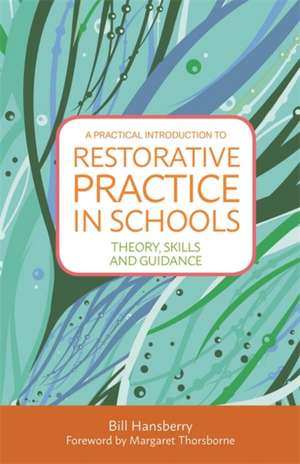
A Practical Introduction to Restorative Practice in Schools: Theory, Skills and Guidance
Autor Bill Hansberry Cuvânt înainte de Margaret Thorsborneen Limba Engleză Paperback – 21 iul 2016
Experiența autorului Bill Hansberry în cadrul propriei firme de consultanță educațională și pasiunea sa pentru predarea relațională sunt fundamentele pe care este construit acest ghid esențial. Suntem de părere că volumul A Practical Introduction to Restorative Practice in Schools reprezintă o resursă autoritară pentru liderii din educație care doresc să depășească modelul ineficient al pedepsei punitive. Autorul nu oferă doar teorie, ci o metodologie clară pentru a transforma școala într-un mediu sigur, bazat pe responsabilitate și vindecare.
Apreciem rigoarea cu care este organizat cuprinsul, facilitând o progresie logică de la schimbarea de paradigmă la implementarea tehnică. Prima secțiune provoacă cititorul să regândească rolul adultului atunci când lucrurile merg prost, folosind studii de caz precum cel al lui Tristan și Jason pentru a evidenția diferența dintre întrebările care incriminează și cele care repară. Secțiunea a doua introduce un element distinctiv: o bază psihologică solidă bazată pe lucrările lui Silvan Tomkins, explorând modul în care rușinea și afectele influențează comportamentul elevilor. Ultima parte este un manual de tactici, de la conversații afective la conferințe de grup.
Cititorul care a aplicat ideile din Just Schools de Belinda Hopkins va găsi aici instrumentele psihologice care completează viziunea etică a justiției restaurative. În timp ce alte lucrări se concentrează pe filozofia generală, Hansberry oferă pași concreți pentru „gestionarea urzicii” — confruntarea cu rușinea într-un mod sănătos. Subliniem că acest volum extinde temele explorate de autor în How to Do Restorative Peer Mediation in Your School, trecând de la medierea între egali la o abordare sistemică, aplicabilă întregii instituții. Rezultatul este un sistem care nu doar reduce incidentele, ci reconstruiește cultura școlară prin conectare și curaj.
Preț: 196.14 lei
Preț vechi: 257.14 lei
-24%
Carte disponibilă
Livrare economică 14-28 noiembrie
Specificații
ISBN-10: 1849057079
Pagini: 312
Dimensiuni: 172 x 244 x 20 mm
Greutate: 0.54 kg
Editura: JESSICA KINGSLEY PUBLISHERS
Colecția Jessica Kingsley Publishers
Locul publicării:London, United Kingdom
V-ar putea interesa
-
 The Restorative Practices PlaybookDominique SmithPreț: 319.46 lei
 -
 Safe and Peaceful SchoolsJohn WinsladePreț: 310.62 lei
 -
 The Little Book of Restorative Discipline for SchoolsLorraine Stutzman AmstutzPreț: 44.08 lei
 -
 The Little Book of Restorative Justice in EducationKatherine EvansPreț: 53.44 lei
 -
 Independent Thinking on Restorative PracticeMark FinnisPreț: 86.98 lei
 -
 -23%Preț: 251.28 lei328.29 lei
 -
 -21%Preț: 114.02 lei143.89 lei
 -
 -24%Preț: 249.71 lei328.29 lei
 -
 -25%Preț: 206.38 lei273.43 lei
 -
 -20%Preț: 144.82 lei181.55 lei
 -
 -24%Preț: 258.15 lei341.60 lei
 -
 -24%Preț: 295.35 lei387.02 lei
 -
 -20%Preț: 136.39 lei171.45 lei
 -
 -25%Preț: 205.86 lei273.55 lei
 -
 -26%Preț: 206.67 lei278.22 lei
 -
 Restorative Theory in Practice: Insights Into What Works and WhyBelinda Hopkins-24%Preț: 249.22 lei327.56 lei
 -
 -25%Preț: 204.01 lei273.12 lei
 -
 -24%Preț: 264.02 lei347.40 lei
De ce să citești această carte
Recomandăm această carte educatorilor și directorilor de școli care caută o alternativă sustenabilă la excluderea elevilor. Veți învăța cum să transformați conflictele în oportunități de învățare socială și cum să gestionați corect emoțiile dificile în clasă. Este un instrument practic care vă oferă un plan de acțiune pentru a crea un mediu de învățare mai sigur, unde disciplina înseamnă responsabilitate față de comunitate, nu doar teamă de consecințe.
Despre autor
Bill Hansberry este un consultant educațional recunoscut la nivel internațional, conducând Hansberry Educational Consultancy în Adelaide, Australia. Este un expert în managementul comportamentului, justiție restaurativă și reînnoire culturală în mediile educaționale. Hansberry este apreciat pentru stilul său angajant în facilitarea atelierelor de formare profesională și pentru promovarea „Circle Time” ca metodă de construire a comunității. Prin lucrările sale, printre care se numără și manuale de mediere între egali, el ajută școlile să dezvolte relații mai puternice între profesori și elevi.
Descriere
Suitable for education settings from preschool to college, this guide explains what restorative justice is, how it can be used in schools, what it looks like in the classroom and how it can be implemented. Featuring case studies that illuminate the underlying restorative principles and practices, this book covers a wide range of topics from the basics of restorative justice, through to school-wide processes for embedding the approach in policy and practice.
Drawing on the expertise of educators and consultants, this is a must-have resource for any school or centre that is serious about reducing bad behaviour and developing safer learning communities.
Recenzii
As a growing community of schools across the globe embrace Restorative Practices, there exists a greater need for resource materials that will give as much careful attention to restorative values and principles as they do to technical guidance around restorative tools. Bill Hansberry has found that sweet spot. Readers who embrace both aspects of this book will be as grounded in their understanding of the vital role of emotion in effective restorative practices as they will be enriched in their ability to practice a variety of restorative approaches.
As interest grows in the use of restorative practice in schools, this new book by Bill Hansberry is a welcome addition to the resources available on the subject. Drawing on the author's personal experience, it provides both valuable insight into the theory underpinning restorative practice and practical advice on how it can be implemented in a school environment. By using case studies, the author also brings to life in an accessible and engaging way what the benefits of a restorative approach can be. Restorative practice should be integral to every school and this book can help to achieve this.