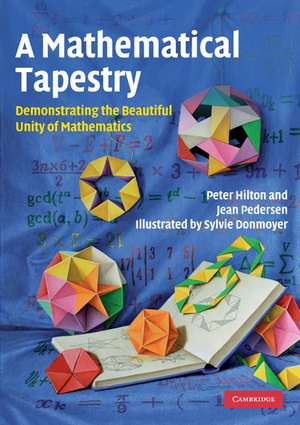
A Mathematical Tapestry
Autor Peter Hilton, Jean Pedersenen Limba Engleză Paperback – 22 iul 2010
Apreciem modul în care A Mathematical Tapestry reușește să transforme o activitate aparent simplă, precum plierea hârtiei, într-un instrument pedagogic riguros pentru explorarea conceptelor avansate. Aplicabilitatea practică a acestui volum rezidă în algoritmul sistematic propus de autori, care permite cititorului să construiască poligoane regulate și să deducă, prin manipulare directă, demonstrații complexe din teoria numerelor sau geometria combinatorică. Suntem de părere că forța acestei lucrări stă în capacitatea de a unifica ramuri matematice distincte sub o singură temă vizuală și tactilă. Structura narativă este susținută de cele 175 de ilustrații semnate de Sylvie Donmoyer, care facilitează tranziția de la planul bidimensional la spațiul tridimensional. Un exemplu remarcabil de eficiență teoretică prezentat în text este calcularea volumului unui tetraedru regulat în doar trei pași, utilizând exclusiv geometria plană elementară și aritmetica de bază. Cartea acoperă aceeași arie tematică precum Number, Shape, & Symmetry de Diane L. Herrmann, însă A Mathematical Tapestry adoptă o abordare mult mai axată pe explorarea algoritmică și pe modelarea fizică, spre deosebire de tratamentul mai teoretic al lui Herrmann. În contextul operei autorului, volumul se aliniază preocupării constante a lui Peter Hilton de a face matematica inteligibilă și fascinantă, temă centrală și în lucrările sale anterioare Mathematics sau Mathematical Reflections. Dacă în Mathematical Vistas autorul se concentra pe stimularea interesului prin probleme clasice, aici colaborează cu Jean Pedersen pentru a oferi o metodologie aplicată, transformând abstractul în ceva palpabil. Este o resursă valoroasă pentru curriculumul universitar, oferind o perspectivă interdisciplinară rar întâlnită în manualele standard.
Preț: 286.11 lei
Carte tipărită la comandă
Livrare economică 26 noiembrie-10 decembrie
Specificații
ISBN-10: 0521128218
Pagini: 308
Ilustrații: 175 b/w illus.
Dimensiuni: 170 x 244 x 17 mm
Greutate: 0.54 kg
Editura: Cambridge University Press
Locul publicării:Cambridge, United Kingdom
V-ar putea interesa
-
 Mathematical ReflectionsPeter HiltonPreț: 418.80 lei
 -
 Mathematical VistasPeter HiltonPreț: 417.53 lei
 -
 MathematicsJan Gullberg-8%Preț: 465.21 lei505.66 lei
 -
 A Course In Modern AlgebraHilton-9%Preț: 1362.85 lei1497.63 lei
 -
 Elementary Real AnalysisHarold Gordon EgglestonPreț: 331.08 lei
 -
 Advanced Algebra, Part 1Edwin A. MaxwellPreț: 387.90 lei
 -
 Algebraic Structure and Matrices Book 2Edwin A. MaxwellPreț: 357.00 lei
 -
 Preț: 332.60 lei
 -
 Introduction to Modern Prime Number TheoryT. EstermannPreț: 330.88 lei
 -
 Period Domains Over Finite and p-Adic FieldsJean-Francois Dat-14%Preț: 998.68 lei1161.26 lei
 -
 Discrete Groups and GeometryW. J. HarveyPreț: 362.18 lei
 -
 Euclid and His Modern RivalsCharles Lutwidge DodgsonPreț: 431.58 lei
 -
 Rapport historique sur les progrès des sciences mathématiques depuis 1789, et sur leur état actuelJean Baptiste Joseph DelambrePreț: 329.20 lei
 -
 Exploring Your Mind with the Psychologists: Reading - Conversation - GrammarAlbert Edward WiggamPreț: 203.06 lei
 -
 Financial MathematicsClarence H. RichardsonPreț: 205.76 lei
 -
 Preț: 226.40 lei
 -
 Differential Equations from the Algebraic StandpointJoseph Fels RittPreț: 182.62 lei
 -
 Preț: 249.91 lei
 -
 Miscellanea MathematicaPeter HiltonPreț: 390.21 lei
De ce să citești această carte
Recomandăm această carte studenților și educatorilor care doresc să descopere unitatea profundă a matematicii prin experiment. Cititorul câștigă o metodă practică de a vizualiza concepte abstracte din teoria grupurilor și a poliedrelor. Este o alegere excelentă pentru cei care caută o alternativă la rigoarea aridă a manualelor clasice, oferind o cale intuitivă de a înțelege cum geometria influențează algebra și analiza numerică.
Despre autor
Peter Hilton (1923–2010) a fost un matematician britanic de renume, recunoscut pentru contribuțiile sale fundamentale în teoria homotopiei și pentru rolul său crucial în decriptarea codurilor germane în timpul celui de-al Doilea Război Mondial la Bletchley Park. Cariera sa academică s-a concentrat pe educația matematică și pe promovarea unei viziuni integrate asupra disciplinei. Alături de Jean Pedersen, profesor la Universitatea Santa Clara, a publicat numeroase lucrări care explorează geometria și combinatorica, A Mathematical Tapestry reprezentând o sinteză a filozofiei lor comune privind predarea matematicii prin descoperire și vizualizare.
Descriere scurtă
Cuprins
Recenzii
'The book demonstrates the great unity of mathematics. This is supported by a wealth of instructive illustrations …' Zentralblatt MATH