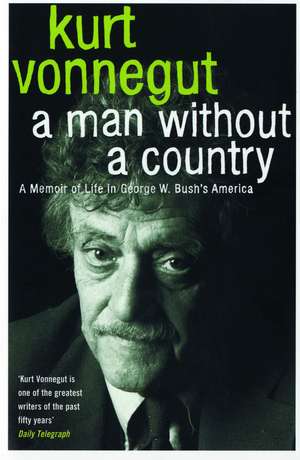
A Man Without a Country
Autor Kurt Vonneguten Limba Engleză Paperback – 5 feb 2007
În ianuarie 1943, un tânăr student la biochimie de la Universitatea Cornell lua o decizie care avea să îi rescrie destinul: abandona cursurile pentru a se înrola în armată. Această alegere l-a purtat direct în inima dezastrului de la Dresda, experiență care a devenit nucleul dur al întregii sale literaturi. În A Man Without a Country, regăsim ecoul acelei traume transformat într-o formă de rezistență prin umor. Remarcăm cum, spre amurgul vieții, cel care ne-a oferit perspectivele nuanțate din Slaughterhouse 5 sau satira acidă din Cat's Cradle alege să renunțe la masca personajelor pentru a vorbi direct, la persoana întâi, despre starea „sufletului american”. Abordarea jurnalistică și tonul confesiv evocă atmosfera din Kurt Vonnegut: The Last Interview, dar perspectiva este mult mai personală, funcționând ca un testament spiritual structurat prin viniete și eseuri scurte. Putem afirma că volumul este o discuție intimă cu un prieten vechi, în care furia politică împotriva erei Bush este echilibrată de un umanism obstinat. Vonnegut alternează momentele de introspecție profundă despre arta scrisului cu ilustrații jucăușe, oferind o privire rară în atelierul său mental. Dacă în lucrările anterioare, precum The Sirens Of Titan, autorul folosea distanțarea SF pentru a analiza condiția umană, aici el privește lumea direct în ochi, fără niciun filtru narativ, taxând ipocrizia socială cu aceeași simplitate caligrafică ce l-a consacrat.
Preț: 56.24 lei
Preț vechi: 91.85 lei
-39%
Carte disponibilă
Livrare economică 30 octombrie-13 noiembrie
Livrare express 15-21 octombrie pentru 52.15 lei
Specificații
ISBN-10: 0747586055
Pagini: 160
Dimensiuni: 126 x 196 x 16 mm
Greutate: 0.14 kg
Ediția:New ed
Editura: Bloomsbury Publishing
Colecția Bloomsbury Paperbacks
Locul publicării:London, United Kingdom
V-ar putea interesa
-
 Fear and Loathing on the Campaign Trail '72Hunter S. ThompsonPreț: 94.51 lei
 -
 The LoraxDr. SeussPreț: 49.59 lei
 -
 BluebeardKurt VonnegutPreț: 78.70 lei
 -
 Breakfast of ChampionsKurt Vonnegut-25%Preț: 59.06 lei79.20 lei
 -
 The Sagas of IcelandersVarious-15%Preț: 139.93 lei165.22 lei
 -
 ZeitounDavid Eggers-25%Preț: 59.96 lei79.73 lei
 -
 Cat's CradleKurt Vonnegut-27%Preț: 51.30 lei70.61 lei
 -
 The Selfish Gene: 40th Anniversary editionRichard DawkinsPreț: 109.90 lei
 -
 A Confederacy of DuncesJohn Kennedy Toole-26%Preț: 58.97 lei79.27 lei
 -
 Cat's CradleKurt Vonnegut-27%Preț: 51.56 lei71.03 lei
 -
 The LoraxDr. SeussPreț: 103.54 lei
 -
 Slaughterhouse-FiveKurt VonnegutPreț: 59.39 lei
 -
 A Modest Proposal and Other Satirical WorksJonathan SwiftPreț: 34.83 lei
 -
 -14%Preț: 86.87 lei101.37 lei
 -
 Heimskringla III: Magnus Olafsson to Magnus ErlingssonSnorri Sturluson-15%Preț: 85.78 lei100.77 lei
 -
 Heimskringla: Volume 1 -- The Beginnings to Óláfr TryggvasonSnorri Sturluson-15%Preț: 84.95 lei100.26 lei
 -
 Preț: 63.54 lei
 -
 Irish Fairy and Folk TalesWilliam Butler YeatsPreț: 285.34 lei
 -
 Norse MythologyNeil Gaiman-26%Preț: 53.37 lei71.67 lei
 -
 Complete Norwegian Beginner to Intermediate Course: (Book and audio support)Margaretha Danbolt-SimonsPreț: 221.00 lei
 -
 -27%Preț: 56.58 lei77.73 lei
 -
 Welcome to the Monkey HouseKurt Vonnegut-19%Preț: 57.78 lei71.05 lei
 -
 The Glass CastleJeannette Walls-26%Preț: 59.39 lei79.79 lei
 -
 Preț: 140.66 lei
 -
 North Wild KitchenBerg, Nevada-14%Preț: 169.24 lei197.54 lei
 -
 Ensayo sobre la cegueraJosé SaramagoPreț: 88.91 lei
 -
 Preț: 49.38 lei
De ce să citești această carte
Recomandăm această carte oricărui cititor care dorește să descopere omul din spatele mitului literar. Veți câștiga o perspectivă onestă asupra istoriei recente și a meseriei de scriitor, totul livrat cu umorul negru specific lui Vonnegut. Este o lectură esențială pentru a înțelege cum trauma războiului poate fi convertită într-o pledoarie pentru bunătate și rațiune într-o lume care pare să le fi pierdut pe ambele.
Despre autor
Kurt Vonnegut (1922–2007) a fost unul dintre cei mai influenți scriitori americani ai secolului XX, a cărui carieră de peste 50 de ani a cuprins 14 romane și numeroase volume de eseuri. Marcat definitiv de experiența ca prizonier de război în Dresda, unde a supraviețuit bombardamentelor aliate, Vonnegut a dezvoltat un stil literar unic ce îmbină satira socială, elementele de science-fiction și un umanism profund. De la debutul cu Player Piano până la succesul internațional obținut cu Slaughterhouse 5, opera sa a explorat constant fragilitatea umană în fața tehnologiei și a autoritarismului.
Descriere
'Part memoir, part rant and part joke ... as elusive as it is beguiling' - Sunday Times
'If Vonnegut isn't the enduring Good Humor man, who is?' - John Irving, The Times
'One of the greatest writers of the past 50 years' - Daily Telegraph
_______________
Comic riffs and diatribes on the America of G.W. Bush from the author of Slaughterhouse 5
This is vintage Vonnegut - hilariously funny and razor-sharp as he fixes his gaze on art, politics, himself and the condition of the soul of America today. Written over five years in the form of a loose memoir, A Man Without a Country is an intimate and tender communication to us all, sometimes despairing, always searching and ultimately wise and compassionate.
Recenzii
'Vonnegut's A Man without a Country is pure late Twain, darkly funny, never less than enraged at corruption and greed, and overflowing with compassion for the powerless. We've never needed him more'
'If Vonnegut isn't the enduring Good Humor man, who is?'
'This enjoyable volume of reflections and anecdotes reminds us what is unique about the author of those startlingly good American novels Slaughterhouse Five, Cat's Cradle and Breakfast of Champions ... Kurt Vonnegut is one of the greatest writers of the past 50 years'
Extras
As a kid I was the youngest member of my family, and the youngest child in any family is always a jokemaker, because a joke is the only way he can enter into an adult conversation. My sister was five years older than I was, my brother was nine years older than I was, and my parents were both talkers. So at the dinner table when I was very young, I was boring to all those other people. They did not want to hear about the dumb childish news of my days. They wanted to talk about really important stuff that happened in high school or maybe in college or at work. So the only way I could get into a conversation was to say something funny. I think I must have done it accidentally at first, just accidentally made a pun that stopped the conversation, something of that sort. And then I found out that a joke was a way to break into an adult conversation.
I grew up at a time when comedy in this country was superb—it was the Great Depression. There were large numbers of absolutely top comedians on radio. And without intending to, I really studied them. I would listen to comedy at least an hour a night all through my youth, and I got very interested in what jokes were and how they worked.
When I’m being funny, I try not to offend. I don’t think much of what I’ve done has been in really ghastly taste. I don’t think I have embarrassed many people, or distressed them. The only shocks I use are an occasional obscene word. Some things aren’t funny. I can’t imagine a humorous book or skit about Auschwitz, for instance. And it’s not possible for me to make a joke about the death of John F. Kennedy or Martin Luther King. Otherwise I can’t think of any subject that I would steer away from, that I could do nothing with. Total catastrophes are terribly amusing, as Voltaire demonstrated. You know, the Lisbon earthquake is funny.
I saw the destruction of Dresden. I saw the city before and then came out of an air-raid shelter and saw it afterward, and certainly one response was laughter. God knows, that’s the soul seeking some relief.
Any subject is subject to laughter, and I suppose there was laughter of a very ghastly kind by victims in Auschwitz.
Humor is an almost physiological response to fear. Freud said that humor is a response to frustration—one of several. A dog, he said, when he can’t get out a gate, will scratch and start digging and making meaningless gestures, perhaps growling or whatever, to deal with frustration or surprise or fear.
And a great deal of laughter is induced by fear. I was working on a funny television series years ago. We were trying to put a show together that, as a basic principle, mentioned death in every episode and that this ingredient would make any laughter deeper without the audience’s realizing how we were inducing belly laughs.
There is a superficial sort of laughter. Bob Hope, for example, was not really a humorist. He was a comedian with very thin stuff, never mentioning anything troubling. I used to laugh my head off at Laurel and Hardy. There is terrible tragedy there somehow. These men are too sweet to survive in this world and are in terrible danger all the time. They could be so easily killed.
Even the simplest jokes are based on tiny twinges of fear, such as the question, “What is the white stuff in bird poop?” The auditor, as though called upon to recite in school, is momentarily afraid of saying something stupid. When the auditor hears the answer, which is, “That’s bird poop, too,” he or she dispels the automatic fear with laughter. He or she has not been tested after all.
“Why do firemen wear red suspenders?” And “Why did they bury George Washington on the side of a hill?” And on and on.
True enough, there are such things as laughless jokes, what Freud called gallows humor. There are real-life situations so hopeless that no relief is imaginable.
While we were being bombed in Dresden, sitting in a cellar with our arms over our heads in case the ceiling fell, one soldier said as though he were a duchess in a mansion on a cold and rainy night, “I wonder what the poor people are doing tonight.” Nobody laughed, but we were still all glad he said it. At least we were still alive! He proved it.