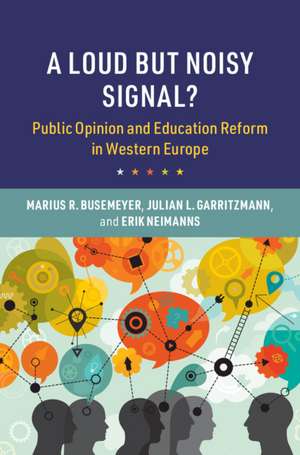
A Loud but Noisy Signal?: Public Opinion and Education Reform in Western Europe: Cambridge Studies in the Comparative Politics of Education
Autor Marius R. Busemeyer, Julian L. Garritzmann, Erik Neimannsen Limba Engleză Paperback – 2 sep 2020
| Toate formatele și edițiile | Preț | Express |
|---|---|---|
| Paperback (1) | 310.94 lei 6-8 săpt. | |
| Cambridge University Press – 2 sep 2020 | 310.94 lei 6-8 săpt. | |
| Hardback (1) | 716.26 lei 6-8 săpt. | |
| Cambridge University Press – 2 sep 2020 | 716.26 lei 6-8 săpt. |
Preț: 310.94 lei
Nou
Puncte Express: 466
Preț estimativ în valută:
55.04€ • 64.09$ • 48.07£
55.04€ • 64.09$ • 48.07£
Carte tipărită la comandă
Livrare economică 22 ianuarie-05 februarie 26
Preluare comenzi: 021 569.72.76
Specificații
ISBN-13: 9781108745871
ISBN-10: 1108745873
Pagini: 378
Ilustrații: 50 b/w illus. 5 tables
Dimensiuni: 152 x 228 x 21 mm
Greutate: 0.54 kg
Editura: Cambridge University Press
Colecția Cambridge University Press
Seria Cambridge Studies in the Comparative Politics of Education
Locul publicării:New York, United States
ISBN-10: 1108745873
Pagini: 378
Ilustrații: 50 b/w illus. 5 tables
Dimensiuni: 152 x 228 x 21 mm
Greutate: 0.54 kg
Editura: Cambridge University Press
Colecția Cambridge University Press
Seria Cambridge Studies in the Comparative Politics of Education
Locul publicării:New York, United States
Cuprins
1. Introduction: the role of public opinion in education policy-making; 2. Theoretical framework; Part I. Quantitative Evidence: Attitudes, Public Opinion, and Politics: Introduction to the INVEDUC Survey: research design, data, and methods; 3. Attitudes on education spending in Western Europe; 4. Preferences regarding education governance in Western Europe; Part II. Qualitative Evidence: The Role of Public Opinion in Education Reforms in Western Europe: Introductory remarks and research design; 5. Germany; 6. Sweden; 7. England; 8. Spain; 9. Comparative summary and conclusions.
Notă biografică
Descriere
Explores how public opinion affects policy-making in education and the conditions that make party and interest groups politics matter more.