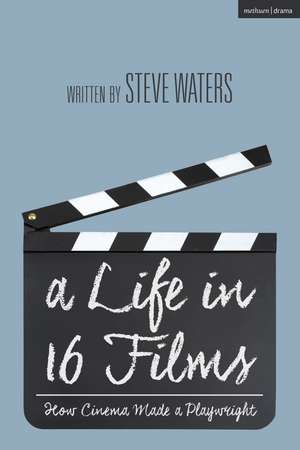
A Life in 16 Films: How Cinema Made a Playwright
Autor Steve Watersen Limba Engleză Paperback – iul 2021
The films spanning almost a century, starting with The White Hell of Pitz Palu (1929) and moving most recently to Dark Waters (2019), each chapter examines aspects of Waters's journey from his working-class Midlands upbringing to working in professional theatre to living through the Covid epidemic, through the prism of a particular film.
From The Wizard of Oz to Code Unknown, from sci-fi to documentary, from queer cinema to world cinema, this honest, comic book offers a view of film as a way of thinking about how we live. In doing so, it illuminates culture and politics in the UK over half a century and provides an intimate insight into drama and writing.
Preț: 168.17 lei
Preț vechi: 196.78 lei
-15%
Puncte Express: 252
Carte disponibilă
Livrare economică 02-16 noiembrie
Livrare express 16-22 octombrie pentru 54.51 lei
Livrare prin curier în România Termenul estimat este afișat lângă disponibilitate.
Transport gratuit de la 400.00 lei Plată online sau ramburs, în funcție de opțiunile comenzii.
Retur gratuit în 14 zile Comandă securizată și suport în română.
Specificații
ISBN-13: 9781350205239
ISBN-10: 1350205230
Pagini: 144
Dimensiuni: 156 x 232 x 6 mm
Greutate: 0.34 kg
Editura: Bloomsbury Publishing
Colecția Methuen Drama
Locul publicării:London, United Kingdom
ISBN-10: 1350205230
Pagini: 144
Dimensiuni: 156 x 232 x 6 mm
Greutate: 0.34 kg
Editura: Bloomsbury Publishing
Colecția Methuen Drama
Locul publicării:London, United Kingdom
V-ar putea interesa
-
 The Big ScreenDavid Thomson-27%Preț: 88.80 lei121.51 lei
 -
 Sculpting in Time: Reflections on the CinemaAndrey TarkovskyPreț: 245.90 lei
 -
 Something Like an AutobiographyAkira KurosawaPreț: 86.79 lei
 -
 It Used to be WitchesRyan GilbeyPreț: 144.06 lei
 -
 28 Years LaterAlex GarlandPreț: 91.48 lei
 -
 -20%Preț: 97.00 lei121.08 lei
 -
 -19%Preț: 115.40 lei143.23 lei
 -
 We Did Ok, Kid: A MemoirSir Anthony Hopkins-14%Preț: 166.21 lei192.90 leiRecomandat
 -
 Scorsese on Filmmaking and FaithMartin Scorsese-27%Preț: 78.01 lei106.96 lei
 -
 Shark-Infested WatersMichael Whitehall-26%Preț: 68.14 lei92.34 lei
 -
 50 Film Ideas You Really Need to KnowHelen O’Hara-28%Preț: 50.70 lei70.25 lei
 -
 Dear Orson Welles and Other EssaysMark CousinsPreț: 237.08 lei
 -
 Colours of Wes AndersonHannah Strong-17%Preț: 105.01 lei125.87 lei
 -
 AquaChiara BarziniPreț: 121.00 lei
 -
 The Story of British Propaganda FilmScott Anthony-25%Preț: 180.92 lei240.09 lei
 -
 KesDavid Forrest-32%Preț: 67.21 lei99.17 lei
 -
 Billy ElliotJames Leggott-32%Preț: 67.04 lei99.07 lei
 -
 The Future of TruthWerner HerzogPreț: 106.62 lei
 -
 Carrying the CanChristopher MilesPreț: 276.69 lei
 -
 -14%Preț: 582.82 lei677.69 lei
Cuprins
Introduction - Dark Waters (2019, Todd Haynes)
Watching film in an age of Covid
The Wizard of Oz (1939, Victor Fleming)
Working-class cinema-going in the Midlands; children and adult film; the Western; film as an embodiment of maleness
Logan's Run (1976, Michael Anderson)
Rural England and the appeal of horror and sci-fi; rural v city; class conflict
Nosferatu The Vampyre (1979, Werner Herzog)
Grammar school in the 80s; uncinematic nature of provincial Britain; discovery of art and European film
Solaris (1972, Andrei Tarkovsky)
Coming of age during Thatcher and punk; film and cycling; the rise of Channel 4 as a vector for film; second cold war; Solaris v Apocalypse Now
Shoah (1985, Claude Lanzmann)
Kibbutz Dalia, Israel; Film and internationalism; film and the Holocaust; travels in the Middle East; confirmation bias
Vagabond (1985, Agnès Varda)
Film and intellectualism at Oxford University; feminist and queer film; making film
Comrades (1986, Bill Douglas)
Film, work and radical politics; Communist and the city of Bristol; theatre and radical film-making; John Akomfrah and Julian Isaac
The White Hell of Pitz Palu (1929, Arnold Fanck and GW Pabst)
Becoming a teacher; film history and education; falling in love through film
Reservoir Dogs (1992, Quentin Tarantino)
Studying with playwrights Sarah Kane and David Edgar; Reservoir Dogs and Blasted; caught between film and theatre; influence of David Mamet, Quentin Tarantino and Sarah Kane
Winter Light (1963, Ingmar Bergman)
Film, marriage and faith; Bergman and Bresson; film as ritual; becoming a theatre director; becoming a playwright
Code Unknown (2001, Michael Haneke)
Film and London; residential playwright at Hampstead Theatre; writing and multi-culturalism; Haneke's pessimism versus 'Cool Britannia'
The Wind Will Carry Us (2000, Abbas Kiarostami)
After 9/11; film and the War on Terror; film and having children; writing World music; influence of Iranian film
An Inconvenient Truth (2006, Davis Guggenheim)
Film and ecology; climate change activism and writing The Contingency Plan; adapting theatre to film
Hell or High Water (2016, David Mackenzie)
Film and precarity; parents' death; illness; end of cinema; growth of populism
Afterword - Girlhood (2019, Céline Sciamma)
Watching films with my daughter
Index
Watching film in an age of Covid
The Wizard of Oz (1939, Victor Fleming)
Working-class cinema-going in the Midlands; children and adult film; the Western; film as an embodiment of maleness
Logan's Run (1976, Michael Anderson)
Rural England and the appeal of horror and sci-fi; rural v city; class conflict
Nosferatu The Vampyre (1979, Werner Herzog)
Grammar school in the 80s; uncinematic nature of provincial Britain; discovery of art and European film
Solaris (1972, Andrei Tarkovsky)
Coming of age during Thatcher and punk; film and cycling; the rise of Channel 4 as a vector for film; second cold war; Solaris v Apocalypse Now
Shoah (1985, Claude Lanzmann)
Kibbutz Dalia, Israel; Film and internationalism; film and the Holocaust; travels in the Middle East; confirmation bias
Vagabond (1985, Agnès Varda)
Film and intellectualism at Oxford University; feminist and queer film; making film
Comrades (1986, Bill Douglas)
Film, work and radical politics; Communist and the city of Bristol; theatre and radical film-making; John Akomfrah and Julian Isaac
The White Hell of Pitz Palu (1929, Arnold Fanck and GW Pabst)
Becoming a teacher; film history and education; falling in love through film
Reservoir Dogs (1992, Quentin Tarantino)
Studying with playwrights Sarah Kane and David Edgar; Reservoir Dogs and Blasted; caught between film and theatre; influence of David Mamet, Quentin Tarantino and Sarah Kane
Winter Light (1963, Ingmar Bergman)
Film, marriage and faith; Bergman and Bresson; film as ritual; becoming a theatre director; becoming a playwright
Code Unknown (2001, Michael Haneke)
Film and London; residential playwright at Hampstead Theatre; writing and multi-culturalism; Haneke's pessimism versus 'Cool Britannia'
The Wind Will Carry Us (2000, Abbas Kiarostami)
After 9/11; film and the War on Terror; film and having children; writing World music; influence of Iranian film
An Inconvenient Truth (2006, Davis Guggenheim)
Film and ecology; climate change activism and writing The Contingency Plan; adapting theatre to film
Hell or High Water (2016, David Mackenzie)
Film and precarity; parents' death; illness; end of cinema; growth of populism
Afterword - Girlhood (2019, Céline Sciamma)
Watching films with my daughter
Index
Recenzii
Playwright Steve Waters has come up with a brilliantly simple and original idea: a memoir built round the movies that have shaped his life. The result is partly autobiography, partly social history and partly a hymn of praise to the medium that made him. A jewel of a book: informative, moving, witty and compelling.