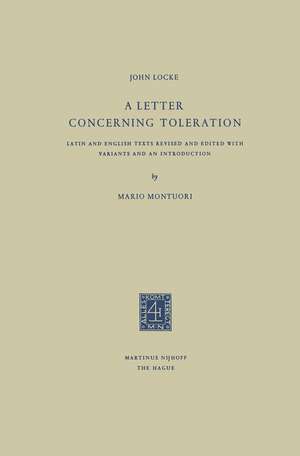
A Letter Concerning Toleration
Autor John Locke Editat de Mario Montuorien Limba Engleză Paperback – 1963
Preț: 369.08 lei
Puncte Express: 554
Carte tipărită la comandă
Livrare economică 24 august-07 septembrie
Livrare prin curier în România Termenul estimat este afișat lângă disponibilitate.
Transport gratuit de la 400.00 lei Plată online sau ramburs, în funcție de opțiunile comenzii.
Retur gratuit în 14 zile Comandă securizată și suport în română.
Specificații
ISBN-13: 9789401181600
ISBN-10: 9401181608
Pagini: 184
Ilustrații: 123 p. 5 illus.
Dimensiuni: 152 x 229 x 11 mm
Greutate: 0.28 kg
Ediția:Softcover reprint of the original 1st ed. 1963
Editura: Springer
Locul publicării:Dordrecht, Netherlands
ISBN-10: 9401181608
Pagini: 184
Ilustrații: 123 p. 5 illus.
Dimensiuni: 152 x 229 x 11 mm
Greutate: 0.28 kg
Ediția:Softcover reprint of the original 1st ed. 1963
Editura: Springer
Locul publicării:Dordrecht, Netherlands
Public țintă
ResearchCuprins
A Letter Concerning Toleration.- Epistola de Tolerantia.- Index of names.
Descriere
Descriere de la o altă ediție sau format:
Locke argued that religious belief ought to be compatible with reason, that no king, prince or magistrate rules legitimately without the consent of the people, and that government has no right to impose religious beliefs or styles of worship on the public. Locke’s defense of religious tolerance and freedom of thought was revolutionary in its time. Even today, his letter poses a challenge to religious intolerance, whether state-sponsored or originating from religious dogmatists.
Based on both Locke’s original Latin and the seventeenth-century English translation of William Popple, this edition offers a reader-friendly version that remains loyal to the original text. In addition to a forty-page introduction that situates the Letter in its historical and philosophical contexts, this edition includes excerpts from writings on religious toleration by William Penn, Baruch Spinoza, Pierre Bayle, and Samuel von Pufendorf, as well as generous selections from the famous Locke-Proast debates on religious toleration.
Locke argued that religious belief ought to be compatible with reason, that no king, prince or magistrate rules legitimately without the consent of the people, and that government has no right to impose religious beliefs or styles of worship on the public. Locke’s defense of religious tolerance and freedom of thought was revolutionary in its time. Even today, his letter poses a challenge to religious intolerance, whether state-sponsored or originating from religious dogmatists.
Based on both Locke’s original Latin and the seventeenth-century English translation of William Popple, this edition offers a reader-friendly version that remains loyal to the original text. In addition to a forty-page introduction that situates the Letter in its historical and philosophical contexts, this edition includes excerpts from writings on religious toleration by William Penn, Baruch Spinoza, Pierre Bayle, and Samuel von Pufendorf, as well as generous selections from the famous Locke-Proast debates on religious toleration.
Recenzii
Locke argued that religious belief ought to be compatible with reason, that no king, prince or magistrate rules legitimately without the consent of the people, and that government has no right to impose religious beliefs or styles of worship on the public. Locke’s defense of religious tolerance and freedom of thought was revolutionary in its time. Even today, his letter poses a challenge to religious intolerance, whether state-sponsored or originating from religious dogmatists.
Based on both Locke’s original Latin and the seventeenth-century English translation of William Popple, this edition offers a reader-friendly version that remains loyal to the original text. In addition to a forty-page introduction that situates the Letter in its historical and philosophical contexts, this edition includes excerpts from writings on religious toleration by William Penn, Baruch Spinoza, Pierre Bayle, and Samuel von Pufendorf, as well as generous selections from the famous Locke-Proast debates on religious toleration.
“My guess is that this will shortly become the most used edition of Locke’s Letter Concerning Toleration. The editor has an excellent introduction in which he describes the social context of the letter and the place it occupies in Locke’s thought. He has done a fine job of bringing up to date the standard translation of Locke’s Latin. And it is very useful to have, as an appendix, a few passages on toleration from Locke’s other writings and some of the criticisms lodged at the time against Locke’s views. All together, this is a fine publication of an important document in the history of religious toleration.” — Nicholas Wolterstorff, Yale University
“This edition stands out as a superb pedagogic resource. The edition is especially valuable because it assembles many contributions to the debate on religious toleration by Locke’s contemporaries, including selections from the exchange between Locke and his most forceful critic Jonas Proast. It is very convenient to have these materials collected for the first time in a single volume. The edition will prove indispensable for courses that investigate the intellectual origins of religious toleration in the West.” — Sam Black, Simon Fraser University
Based on both Locke’s original Latin and the seventeenth-century English translation of William Popple, this edition offers a reader-friendly version that remains loyal to the original text. In addition to a forty-page introduction that situates the Letter in its historical and philosophical contexts, this edition includes excerpts from writings on religious toleration by William Penn, Baruch Spinoza, Pierre Bayle, and Samuel von Pufendorf, as well as generous selections from the famous Locke-Proast debates on religious toleration.
“My guess is that this will shortly become the most used edition of Locke’s Letter Concerning Toleration. The editor has an excellent introduction in which he describes the social context of the letter and the place it occupies in Locke’s thought. He has done a fine job of bringing up to date the standard translation of Locke’s Latin. And it is very useful to have, as an appendix, a few passages on toleration from Locke’s other writings and some of the criticisms lodged at the time against Locke’s views. All together, this is a fine publication of an important document in the history of religious toleration.” — Nicholas Wolterstorff, Yale University
“This edition stands out as a superb pedagogic resource. The edition is especially valuable because it assembles many contributions to the debate on religious toleration by Locke’s contemporaries, including selections from the exchange between Locke and his most forceful critic Jonas Proast. It is very convenient to have these materials collected for the first time in a single volume. The edition will prove indispensable for courses that investigate the intellectual origins of religious toleration in the West.” — Sam Black, Simon Fraser University