Cantitate/Preț
Produs

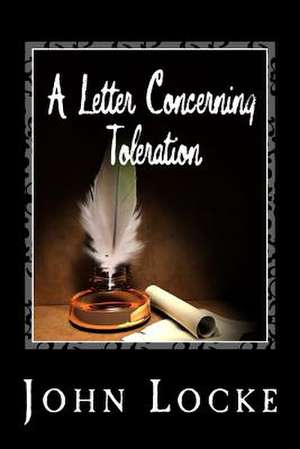
A Letter Concerning Toleration

Autor John Locke
en Limba Engleză Paperback
John Locke's Letter Concerning Toleration is one of the most under-appreciated texts in the liberal tradition of political philosophy. The subject of the Letter is specifically religious toleration, but Locke's general argument for toleration is also applicable to issues of more modern concern. This is not a state of license, in that the civil government does not actively promote a variety of (or for that matter, any) religious practices, but it is a state of negative liberty, in which the state remains neutral to the religious content of religious worship. Specific sects or acts of worship can be banned if they are "prejudicial to other men's rights" or they "break the public peace of societies," but they cannot be banned on religious grounds. Some critics have argued that Locke's Letter is no longer very relevant: he deals only with religious toleration, and religious toleration is widely accepted and practiced in the modern Western world. However, the historical context of the Letter suggests it retains its relevance. In Locke's day, religion was not the dormant issue it is today; rather it was the most controversial issue of public debate. Before Locke, toleration was just something the underdog wished for in order to survive until he gained power over everyone else. Locke, however, goes beyond this pettiness and creates a theoretical defense of toleration as an extension of his political theory. While Locke probably did not imagine the controversial issues of political debate today, the broad basis for his defense of religious toleration implicitly justifies other sorts of social toleration in the modern world. If a state is created for the purposes and by the methods Locke suggests in his Second Treatise, then the men who consent to form such a state retain a significant negative liberty of belief and action. Any of these beliefs or actions must be tolerated by the state unless they fail Locke's criteria for religious toleration, namely, unless they are "prejudicial to other men's rights" or they "break the public peace of societies." If possible, I would recommend trying to find a copy of the Routledge edition of this work (ed. Horton & Mendus), which includes critical reactions to Locke's Letter. However, Amazon currently lists it as out of print. Whatever edition you can find is worth reading: the need for toleration is as great in our own time as it was in John Locke's, and his contribution to the debate is likewise as valuable now as it was then.
Citește tot Restrânge

Toate formatele și edițiile

Toate formatele și edițiile Preț Express
Paperback (11) 3329 lei  3-5 săpt.
  BROADVIEW PR – 12 iun 2013 10253 lei  3-5 săpt.
  3329 lei  3-5 săpt.
  CREATESPACE – 3671 lei  3-5 săpt.
  CreateSpace Independent Publishing Platform – 4319 lei  3-5 săpt.
  CREATESPACE – 4965 lei  3-5 săpt.
  Merchant Books – 3 apr 2011 5017 lei  6-8 săpt.
  6004 lei  3-5 săpt.
  CreateSpace Independent Publishing Platform – 6105 lei  3-5 săpt.
  CREATESPACE – 8806 lei  3-5 săpt.
  Prometheus Books – 30 apr 1990 9246 lei  6-8 săpt.
  SPRINGER NETHERLANDS – 1963 36676 lei  6-8 săpt.

Preț: 4965 lei

Puncte Express: 74

Preț estimativ în valută:
878 1030$ 762£

Carte disponibilă

Livrare economică 17 februarie-03 martie


Specificații

ISBN-13: 9781495323171
ISBN-10: 149532317X
Pagini: 66
Dimensiuni: 152 x 229 x 4 mm
Greutate: 0.1 kg
Editura: CREATESPACE

Descriere

Descriere de la o altă ediție sau format:
Locke argued that religious belief ought to be compatible with reason, that no king, prince or magistrate rules legitimately without the consent of the people, and that government has no right to impose religious beliefs or styles of worship on the public. Locke’s defense of religious tolerance and freedom of thought was revolutionary in its time. Even today, his letter poses a challenge to religious intolerance, whether state-sponsored or originating from religious dogmatists.
Based on both Locke’s original Latin and the seventeenth-century English translation of William Popple, this edition offers a reader-friendly version that remains loyal to the original text. In addition to a forty-page introduction that situates the Letter in its historical and philosophical contexts, this edition includes excerpts from writings on religious toleration by William Penn, Baruch Spinoza, Pierre Bayle, and Samuel von Pufendorf, as well as generous selections from the famous Locke-Proast debates on religious toleration.

Recenzii

Locke argued that religious belief ought to be compatible with reason, that no king, prince or magistrate rules legitimately without the consent of the people, and that government has no right to impose religious beliefs or styles of worship on the public. Locke’s defense of religious tolerance and freedom of thought was revolutionary in its time. Even today, his letter poses a challenge to religious intolerance, whether state-sponsored or originating from religious dogmatists.
Based on both Locke’s original Latin and the seventeenth-century English translation of William Popple, this edition offers a reader-friendly version that remains loyal to the original text. In addition to a forty-page introduction that situates the Letter in its historical and philosophical contexts, this edition includes excerpts from writings on religious toleration by William Penn, Baruch Spinoza, Pierre Bayle, and Samuel von Pufendorf, as well as generous selections from the famous Locke-Proast debates on religious toleration.

“My guess is that this will shortly become the most used edition of Locke’s Letter Concerning Toleration. The editor has an excellent introduction in which he describes the social context of the letter and the place it occupies in Locke’s thought. He has done a fine job of bringing up to date the standard translation of Locke’s Latin. And it is very useful to have, as an appendix, a few passages on toleration from Locke’s other writings and some of the criticisms lodged at the time against Locke’s views. All together, this is a fine publication of an important document in the history of religious toleration.” — Nicholas Wolterstorff, Yale University
“This edition stands out as a superb pedagogic resource. The edition is especially valuable because it assembles many contributions to the debate on religious toleration by Locke’s contemporaries, including selections from the exchange between Locke and his most forceful critic Jonas Proast. It is very convenient to have these materials collected for the first time in a single volume. The edition will prove indispensable for courses that investigate the intellectual origins of religious toleration in the West.” — Sam Black, Simon Fraser University

Cuprins

Acknowledgements
Introduction
John Locke: A Brief Chronology
A Note on the Text
A Letter Concerning Toleration
Appendix A: Additional Writings on Toleration and Religion by Locke
  1. From An Essay Concerning Human Understanding (1689)
  2. From The Reasonableness of Christianity (1695)
Appendix B: Locke’s Contemporaries on Religious Toleration
  1. From William Penn, The Great Case of Liberty of Conscience Once More Briefly Debated and Defended (1670)
  2. From Baruch Spinoza, Theological-Political Treatise (1670)
  3. From Pierre Bayle, A Philosophical Commentary on These Words of the Gospel, Luke 14:23, “Compel them to come in, that my house may be full” (1686)
  4. From Samuel von Pufendorf, Of the Nature and Qualification of Religion in Reference to Civil Society (1687)
Appendix C: Locke and His Critics
  1. From Thomas Long, The Letter for Toleration Deciphered, and the Absurdity and Impiety of an Absolute Toleration Demonstrated (1689)
  2. From Jonas Proast, The Argument of the Letter Concerning Toleration, Briefly Considered and Answered (1690)
  3. From Philanthropus [John Locke], A Second Letter Concerning Toleration (1690)
Suggestions for Further Reading