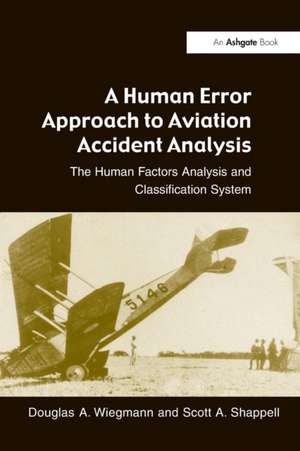
A Human Error Approach to Aviation Accident Analysis: The Human Factors Analysis and Classification System
Autor Douglas A. Wiegmann, Scott A. Shappellen Limba Engleză Paperback – 18 iul 2003
Considerăm că analiza accidentelor aviatice necesită o trecere riguroasă de la simpla constatare a erorii umane către o înțelegere profundă a cauzelor sistemice. Structura acestei lucrări este concepută progresiv, de la concept la implementare: debutează cu fundamentarea teoretică a perspectivei erorii umane și evoluează către aplicarea practică a sistemului HFACS (Human Factors Analysis and Classification System). Acest sistem, prezentat detaliat de autorii Douglas A. Wiegmann și Scott A. Shappell, integrează modelul lui James Reason pentru a identifica atât erorile active ale piloților, cât și vulnerabilitățile latente din cadrul organizațiilor.
Reținem că, spre deosebire de alte lucrări care tratează subiectul la un nivel general, acest volum oferă instrumentele specifice necesare anchetatorilor de teren. Dacă Investigating Human Error de Barry Strauch v-a oferit cadrul teoretic extins al psihologiei erorii, A Human Error Approach to Aviation Accident Analysis oferă instrumentele practice și grilele de clasificare utilizate deja de forțe armate precum US Navy sau Canadian Defense Force. Autorul Douglas A. Wiegmann a explorat anterior mecanismele cognitive în lucrarea Attention, însă în volumul de față aplică acele baze teoretice într-un context tehnic și operațional strict.
Cuprinsul reflectă o progresie logică: după stabilirea fundamentelor, cititorul este ghidat prin studii de caz reale care expun „fața” erorii umane, trecând dincolo de simplele intuiții către o analiză bazată pe date. Cartea reușește să pună în mâna profesioniștilor un limbaj comun pentru a clasifica eșecurile de supervizare și deficiențele organizaționale, elemente esențiale pentru orice program modern de prevenire a accidentelor.
Preț: 433.32 lei
Carte disponibilă
Livrare economică 18 mai-01 iunie
Livrare express 02-08 mai pentru 28.03 lei
Specificații
ISBN-10: 0754618730
Pagini: 184
Ilustrații: index
Dimensiuni: 156 x 234 x 15 mm
Greutate: 0.3 kg
Ediția:New ed.
Editura: CRC Press
Colecția Routledge
Locul publicării:United Kingdom
V-ar putea interesa
-
 Stick and Rudder: An Explanation of the Art of FlyingWolfgang Langewiesche-48%Preț: 140.93 lei270.44 lei
 -
 Human Factors in Healthcare Level 1 and Level 2 PackDebbie Rosenorn-Lanng-5%Preț: 580.17 lei610.71 lei
 -
 -21%Preț: 223.19 lei281.93 lei
 -
 Human Factors in Healthcare: Level OneDebbie Rosenorn-Lanng-27%Preț: 368.04 lei501.85 lei
 -
 Handbook of Perioperative and Procedural Patient SafetyJuan A. Sanchez-5%Preț: 704.34 lei741.41 lei
 -
 -32%Preț: 250.49 lei366.60 lei
 -
 Human Factors in Safety-Critical SystemsFelix Redmill-9%Preț: 977.87 lei1074.58 lei
 -
 -23%Preț: 996.01 lei1293.53 lei
 -
 Unique Methods for Analyzing Failures and Catastrophic EventsAnthony Sofronas-11%Preț: 623.05 lei700.05 lei
 -
 -9%Preț: 696.11 lei764.96 lei
 -
 Preț: 301.59 lei
 -
 Commercial Aviation Safety, Seventh EditionAnthony Lawrenson-32%Preț: 364.40 lei535.36 lei
 -
 -35%Preț: 45.12 lei68.98 lei
 -
 Black Box ThinkingMatthew SyedPreț: 171.71 lei
 -
 Human Factors: Enhancing Pilot PerformanceDale Wilson-23%Preț: 624.87 lei811.52 lei
 -
 Oops! Why Things Go WrongNiall DowneyPreț: 158.50 lei
 -
 The Crash DetectivesChristine Negroni-20%Preț: 71.23 lei89.30 lei
 -
 The Naked PilotDavid BeatyPreț: 126.48 lei
 -
 PPL 5 - Human Factors and Flight SafetyJeremy M PrattPreț: 138.97 lei
 -
 -20%Preț: 312.30 lei390.38 lei
De ce să citești această carte
Această carte este indispensabilă pentru investigatorii de siguranță aeronautică și ofițerii de securitate militară. Cititorul câștigă acces la sistemul HFACS, o metodologie validată pe teren care transformă datele brute ale unui accident în strategii concrete de prevenție. Este un manual tehnic ce elimină presupunerile subiective, oferind o structură clară pentru analiza eșecurilor umane, de la nivel de cabină până la nivel de management.
Despre autor
Douglas A. Wiegmann și Scott A. Shappell sunt experți recunoscuți internațional în factori umani și siguranță sistemică. Douglas A. Wiegmann, profesor la University of Illinois, are un istoric academic solid în psihologia cognitivă, fiind autorul lucrării Attention, unde a analizat interacțiunea om-tehnologie. Împreună cu Scott A. Shappell, a dezvoltat sistemul HFACS, care a devenit standardul de aur în investigarea accidentelor pentru instituții precum US Navy și Army. Experiența lor vastă se reflectă în cursurile predate la Embry-Riddle Aeronautical University și în numeroasele workshop-uri globale dedicate siguranței transporturilor.